Sanford Wiseheart: Wise, Resourceful, and Industrious (52 Ancestors #09)

“Pap used to say, ‘If you can’t find work, make work.'”  These are words I frequently heard from my grandpa about his father.

Sanford Wesley “Sandy” Wiseheart was born on October 30, 1890 in Elizabeth, Indiana to parents William Henry and Frances Lydia “Fannie” (Browning) Wiseheart.  In the 1910 Census, he was still living with his parents.  He was a peddler working on his own account and owned his own wagon.  Grandpa told me that when his dad was younger he used to buy things in town and load them up on a wagon and sell them at a slight profit to the people who couldn’t make it into town.

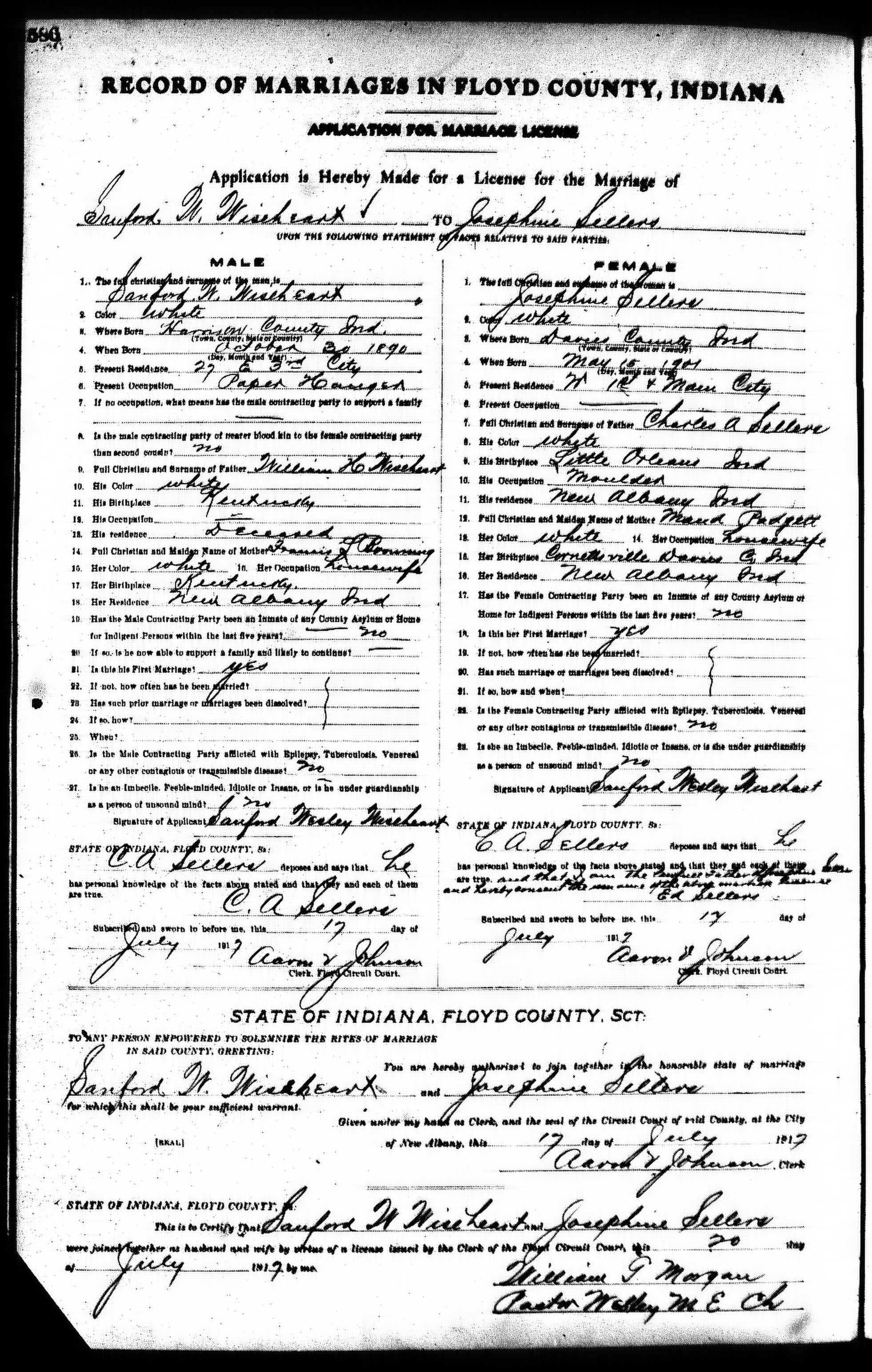
In 1917, Sandy filled out a Draft Registration Card.  His occupation was “driver for David Brubeck.”  According to the 1917 New Albany City Directory, David Brubeck was the owner of Brubeck Ice Cream Company.  About a month later, on Sandy’s marriage application with his first wife, his occupation is listed as paper hanger, that is one who hangs wallpaper.

In August of 1918, Sandy went to France and served in the occupation of Privenelle Sector, west of Moselle (Second Army Offensive).

Sanford Wesley Wiseheart (ca. 1914)

Sanford Wesley Wiseheart (ca. 1918)

While there, he was a medical transporter in Field Hospital 22.  He frequently wrote to his mother and to his friend, Mildred Springer.  One such letter contained the following:

if you could of saw what I have over here you would learn that there is no use to worry about anything we must just keep a brave heart and meet our trouble half way for we cannot change what must be.

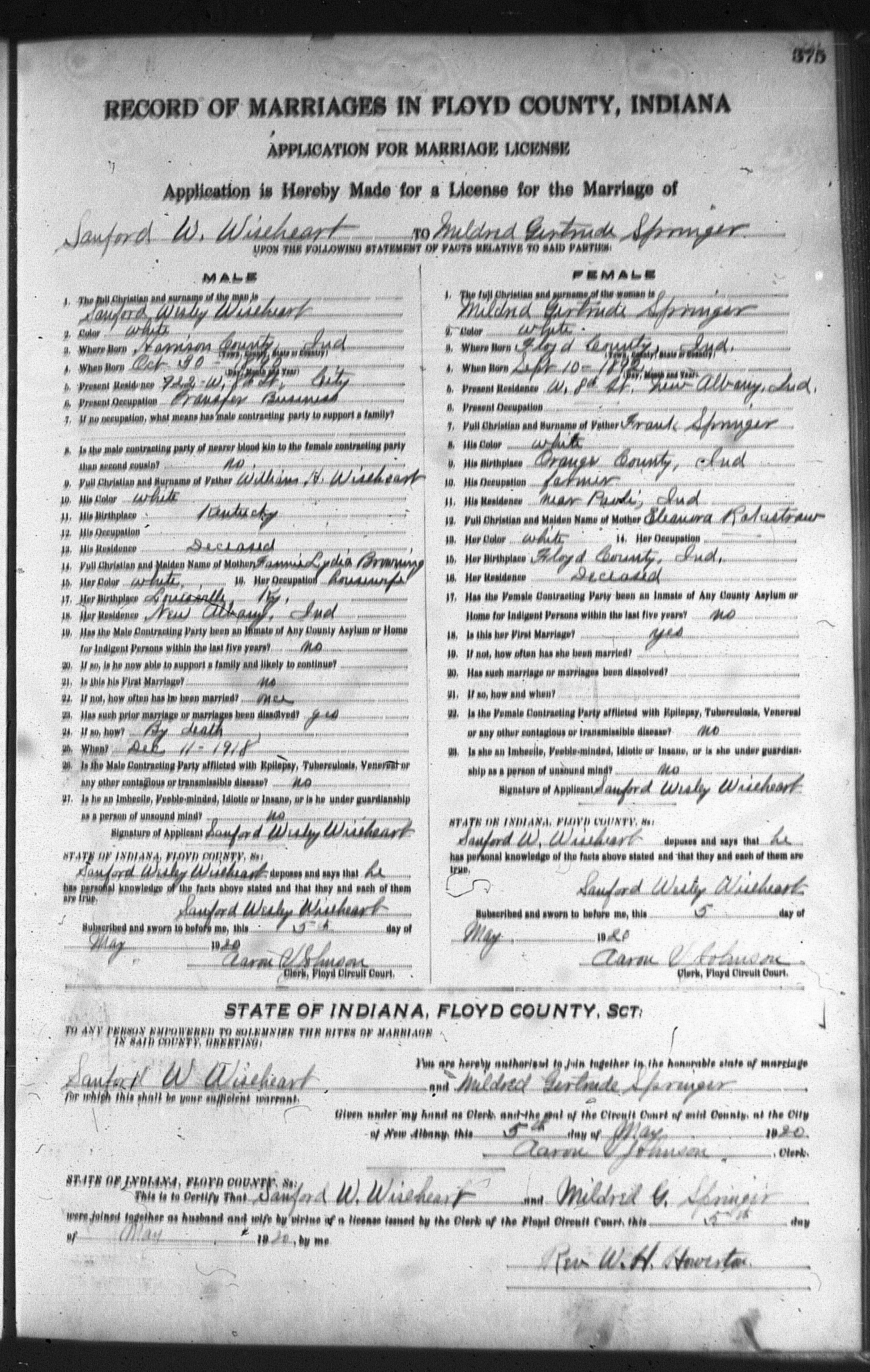
Sandy married Mildred Gertrude Springer, his second marriage, on May 5, 1920 in Floyd County, Indiana.  Here, Sandy’s occupation was “transfer business,” which is delivery service.  On the 1930 Census, he was a salesman of medicines and toiletries.

Grandpa also told me that during the 1937 flood, Sandy and one of his friends borrowed a neighbor’s rowboat and took hay around to the stranded cows.

The 1940 Census lists Sandy as being a general contractor, working on his own account, who repairs and builds homes.  In 1941, he bought a farm and the family raised crops and chickens as well.
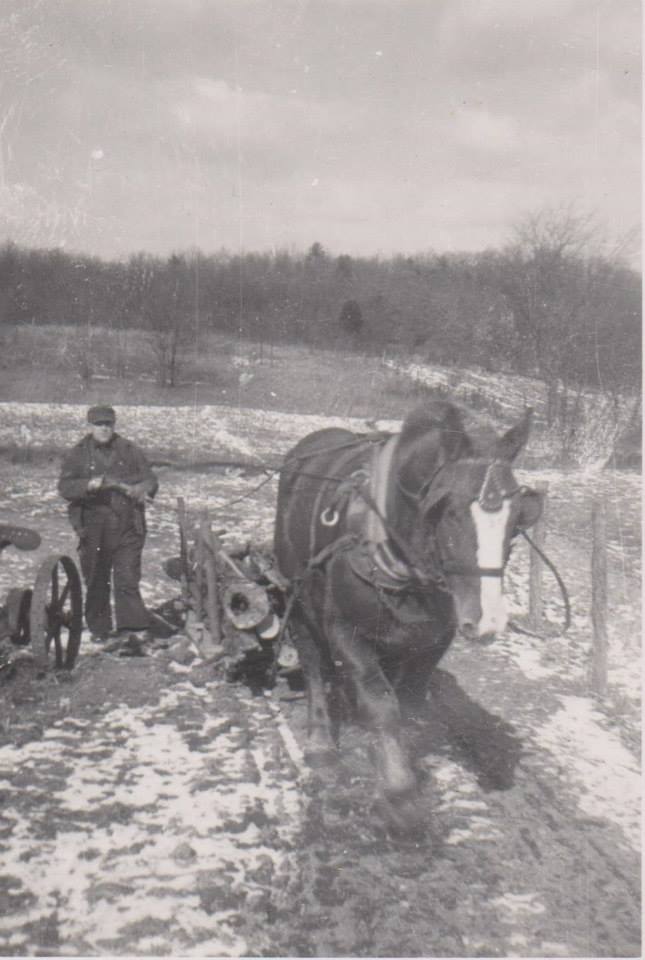
Sandy Wiseheart on the farm.

Sanford Wiseheart on the farm.

Sandy wasn’t afraid of hard work, and he did whatever job was necessary and available in order to provide for his family.

Wiseheart, Sanford - business card

James Roscoe Wiseheart: One Little Shoe

James Roscoe Wiseheart was born to parents Sanford Wesley and Mildred Gertrude (Springer) Wiseheart on November 13, 1930.  He had two older sisters and two older brothers, one of whom was my grandfather.  The family lived in Clark County, Indiana at the time.  Jimmy didn’t live long and I know very little about him.  Grandpa said that Jimmy was given his middle name, Roscoe, after his father’s good friend, Roscoe Treece.  Jimmy died at the age of two from convulsions due to a fever that was brought on by lobar pneumonia.¹  He was the first of two Wiseheart children to die young.  The other was Mary Katherine, who was born after Jimmy died.

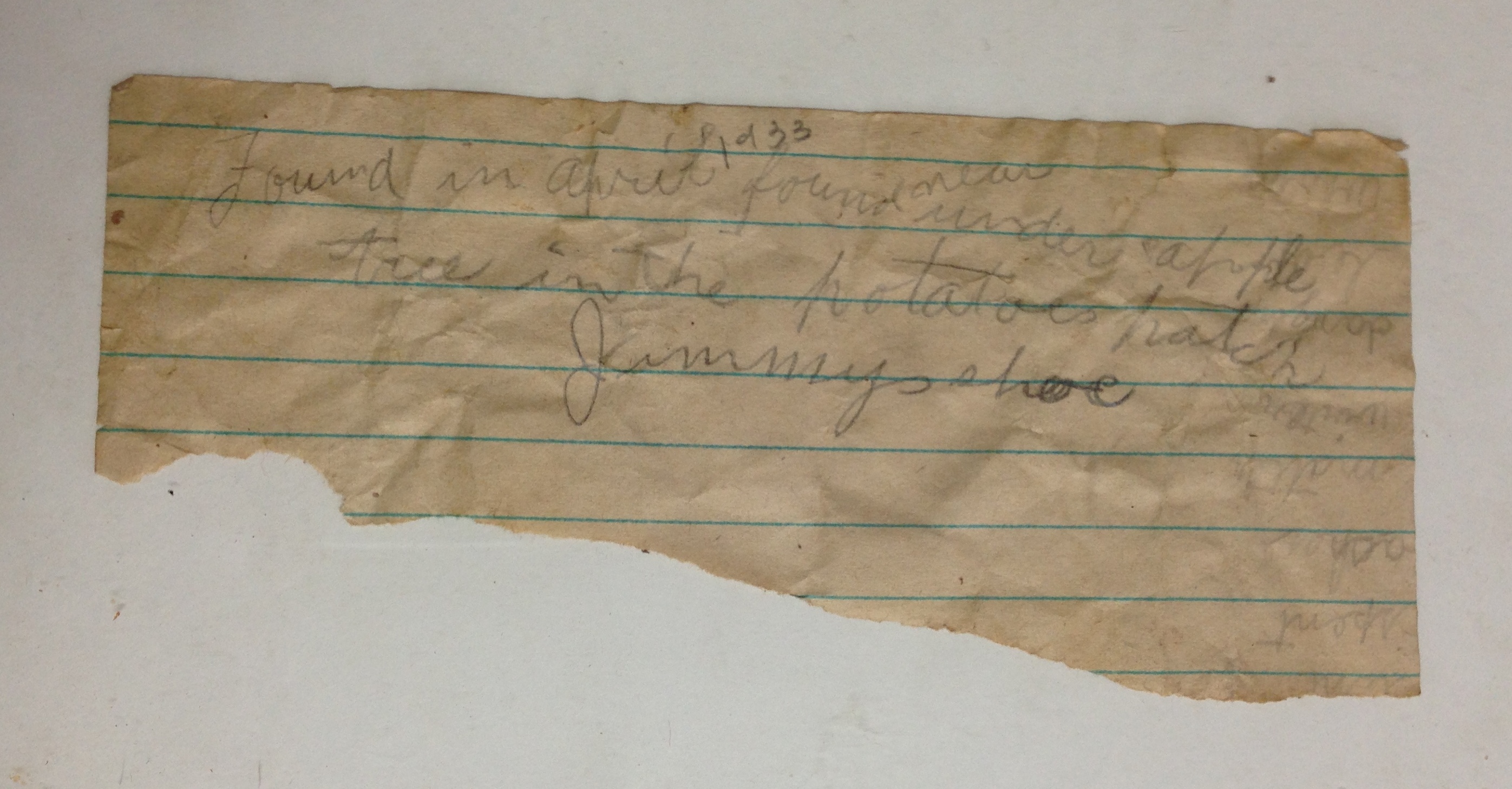
Recently, as my dad, my uncle and I were going trough the Rakestraw trunk, we came across a photograph of Jimmy in his coffin (which I will not post) and one little shoe that had been found in the potato patch just four months after his death.  How heartbreaking it must’ve been to find the shoe, and how precious.

The note that had been tucked into the shoe.

The note that had been tucked into the shoe.

Jimmy's shoe.

Jimmy’s shoe.

2015-02-22 12.46.49


1.  Clark County, Indiana Deaths, Roll 20, Book 2, p.11, Jeffersonville Township Public Library.

Jonathan Lindley: From Orange County to Orange County (52 Ancestors #08)

I haven’t done any real research on my Lindley line yet.  I suppose I always thought they’re fairly well documented and it will all still be there when I’m ready.  Jonathan Lindley was my sixth great grandfather and my eighth great uncle.  I am descended from his daughter, Hannah, and his nephew, Owen.  My grandpa told me a story about Jonathan Lindley on more than one occasion.

In the spring of 1811, Jonathan Lindley and his wife, she was Deborah Dicks (or Dix), moved their whole family and a large number of freed slaves from North Carolina up here to Indiana, up in Orange County.  They were Quakers, see, and they didn’t believe that people should be slaves.  They wanted to make sure that these freed slaves got up here safely.  They also wanted to live in a state where slavery was illegal.  I don’t know exactly how many went or what all their names were, but one of them freed slaves was called Alexander Polecat.  He was a character.  Always crackin’ jokes.

When they got to the Ohio River, they had to camp a while on the Kentucky side.  The water was too high to cross, see.  So, they camped there the first night and everything was fine, but the next mornin’, Jonathan Lindley’s dog was missin’.  Well they looked around and they called for him but he never did come, so they figured he must’ve been scared off by an animal or somethin’.  Some time later, they got a letter from an old neighbor down in North Carolina sayin’ the dog come home.  Now, isn’t that somethin’, a dog findin’ his way back home all those miles?

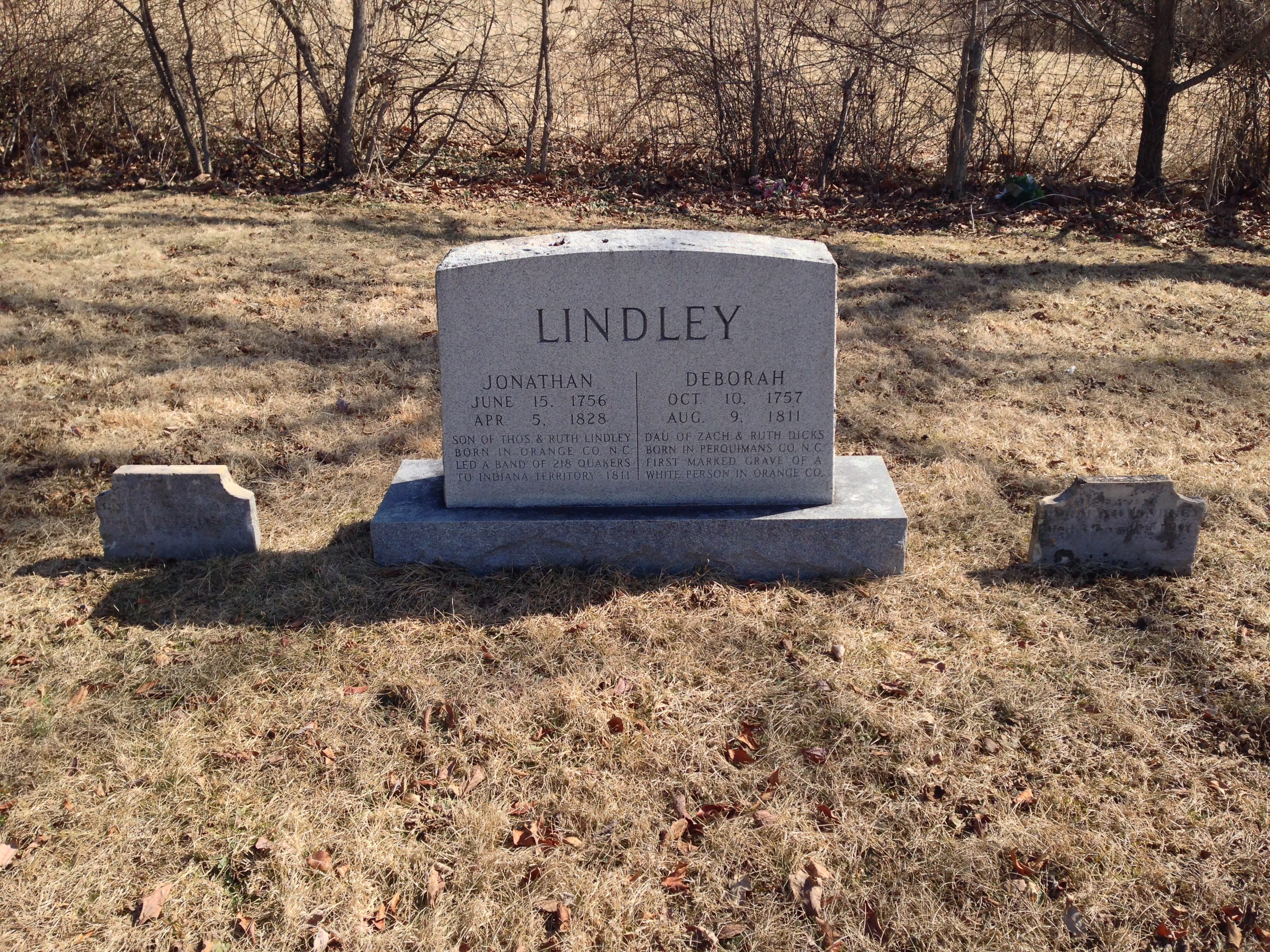
In February of 2014, I went to Orange County, Indiana with my dad.  We stopped at Lick Creek Friends Cemetery to see Jonathan and Deborah Lindley’s memorial stone.

Jonathan and Deborah Lindley memorial stone with original tombstones on either side.  Photo taken by Melissa Wiseheart, 28 Feb 2014.

Jonathan and Deborah Lindley memorial stone with original tombstones on either side. Photo taken by Melissa Wiseheart, 28 Feb 2014.

I will get around to researching the Lindleys.  My focus, for the moment, is telling the stories of those ancestors whose lives are relatively unknown.

An Example of Best Practice Genealogy from My Great Great Grandfather

Some time around one hundred years ago, Daniel Wiseheart asked his father, William Henry (my great great grandfather), if he could borrow the family Bible.  William lent it to him.  A letter from Daniel states that the family Bible was destroyed in the 1917 tornado (or cyclone) that struck New Albany, Indiana.  As I read this letter, I was dismayed.  Until that point, I held out hope that one of Uncle Dan’s descendants might still have the Bible.

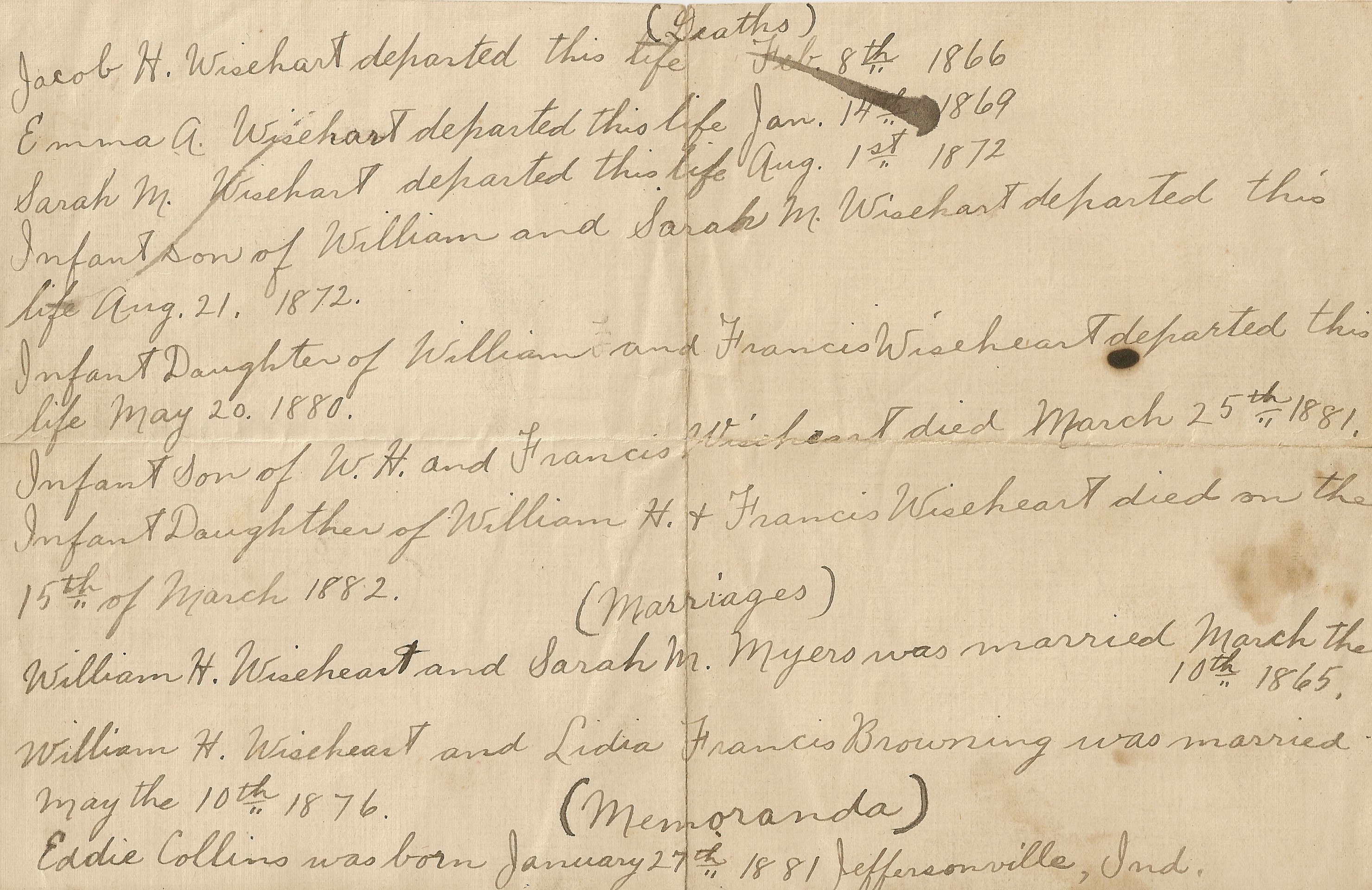
A couple of days ago, as my uncle and I went through the Rakestraw trunk looking for letters relating to Frank Springer, we found that William H. Wiseheart had copied down all of the information from the family Bible onto a piece of paper.  Words cannot express the joy I felt with that discovery!

I’m also grateful that my great great grandpa had the foresight to copy the information.  I can take a lesson from him.  Make sure to copy everything before you loan it, or make copies for the person who wants to do the borrowing.

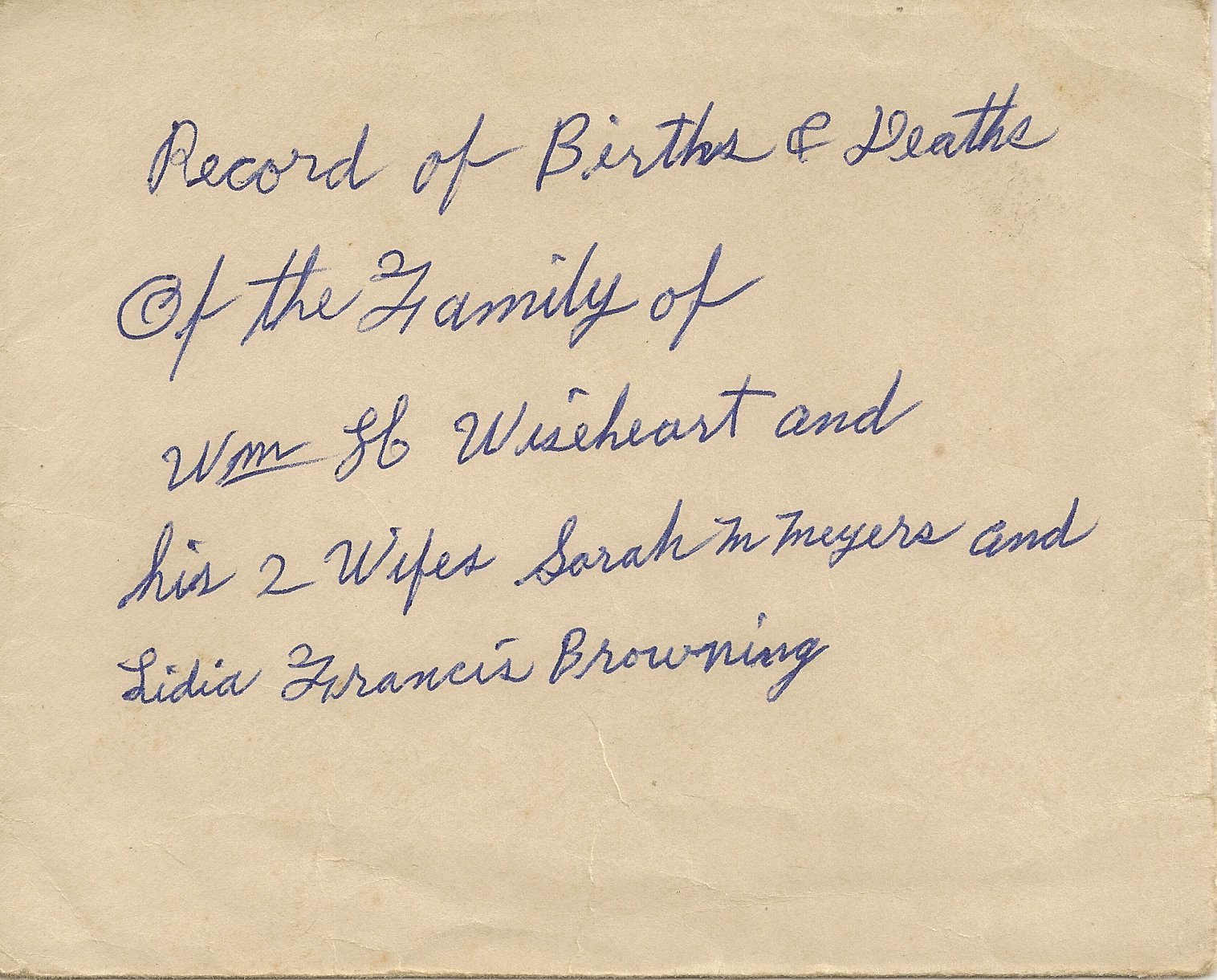
The following images are the envelope the paper was in, and the front and back of the page.  I don’t know whose writing is the blue ink, but the information is accurate based on my research thus far.

Envelope containing transcription of William H. Wiseheart Family Bible.

Envelope containing transcription of William H. Wiseheart Family Bible.

Transcription of the William H. Wiseheart Family Bible by William H. Wiseheart.  Births.

Transcription of the William H. Wiseheart Family Bible by William H. Wiseheart. Births.

Transcription of the William H. Wiseheart Family Bible by William H. Wiseheart.  Deaths, Marriages, and Memoranda.

Transcription of the William H. Wiseheart Family Bible by William H. Wiseheart. Deaths, Marriages, and Memoranda.

More Clues for Frank Springer

As my uncle was going through things at the house yesterday, he came across a ledger belonging to Mildred Springer.  It mostly contains dates and amounts received.  I’m not sure what they are exactly, but I think they could be child support payments from her father, Frank Springer.

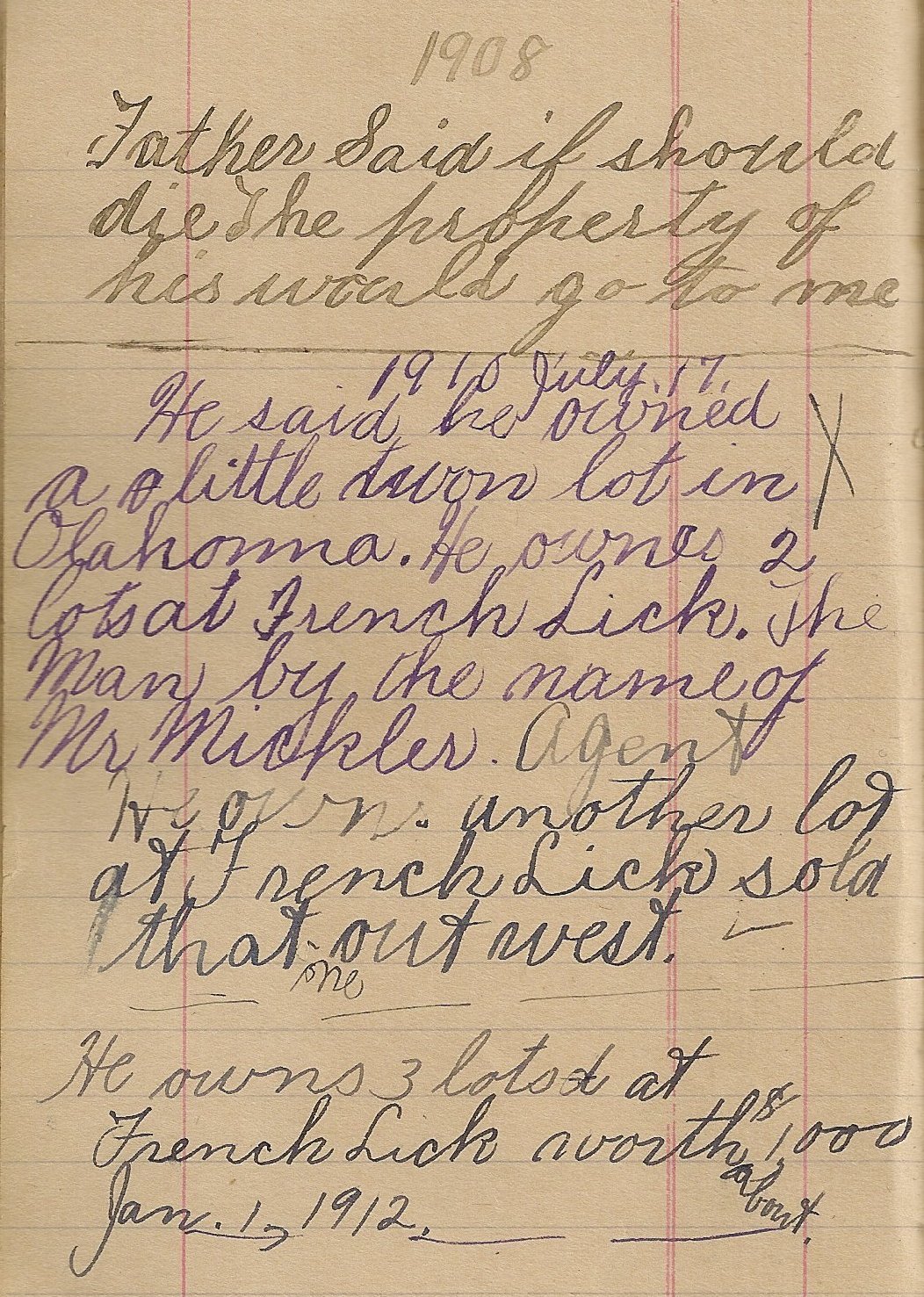
Frank left his home in Paoli, Indiana in 1893 for the World’s Fair in Chicago and I have lost track of him from then until 1920 when he appears in Paoli again.  On one page of this ledger, Mildred wrote about her father’s land holdings.

A page from Mildred Springer's ledger, 1908-1917.

A page from Mildred Springer’s ledger, 1908-1917.

In 1910, Mildred writes that Frank has a lot in Oklahoma and two lots in French Lick.  A newspaper article regarding land in Oklahoma was tucked between this page and the next.

Newspaper article from Mildred Springer's ledger, 1908-1917.

Newspaper article from Mildred Springer’s ledger, 1908-1917.

On the ledger page from the previous image, Mildred also writes that by 1912, Frank had sold his lot out west and purchased a third lot in French Lick.  There is also one page of the ledger that lists two payments coming from Madison, Illinois in 1913.

My theory is that he left Chicago after the World’s Fair and travelled West.  He settled in Oklahoma circa 1904 for a time, but was on the move again before the 1910 Census. I’ve searched for Frank Springer in the 1900 and 1910 Census for Indiana, Kentucky, Tennessee, Illinois, Iowa, Missouri, Kansas, Oklahoma, and Arkansas with no luck.  With some fairly strong evidence to suggest he was in at least two of those states, a transient lifestyle seems a logical explanation as to why I can’t find him.

Here’s my theory with a visual…

Frank Springer's journey

1.  Living in Paoli, Indiana (1892).

2.  Goes to World’s Fair, Chicago, Illinois (1893).

3.  Possible trip to Iowa.  (Part of family legend is that he spent some time in Iowa).

4.  Back to Paoli to check in with family.

5.  Purchases land in French Lick, Indiana (circa 1900).

6.  Claims land near Woodward, Oklahoma (1904).

7.  Possible trip to California.  (Part of family legend is that he spent some time in California).

8.  Sells land in Oklahoma (circa 1912).

9.  Buys another lot in French Lick (circa 1912).

10.  Goes to Madison, Illinois (1913).

11.  It is possible that the California trip fit in here instead of after Oklahoma.

12.  Back in Paoli (1920).

This is the guide I’ll be working with to try to locate Deed and City Directory records for Frank.  It’s confusing, and kind of a long shot, but it’s definitely more than what I had to go on before.  As my co-worker said just a few days ago, most genealogists don’t do it because it’s easy, they do it for the thrill of following the clues and solving the mystery.