Nicholas Springer: I Pledge Allegiance (52 Ancestors #27)

I haven’t done much research on my Revolutionary War ancestors.  Most of the ancestors I’ve been researching lived in the nineteenth century.  My grandparents had told me that Nicholas Springer fought in the Revolutionary War and that he was my sixth great-grandfather.

One day, as I was helping a patron research at the library, I happened upon Nicholas Springer in one of our DAR books.  It yielded the following information.  Nicholas Springer was born on August 5, 1743 in New Castle County, Delaware.  He married Elizabeth McIlvaine in January of 1772.  He was a recognized patriot, having signed the Oath of Allegiance on June 9, 1778.  His children were Mary (1772), Robert (1774), Samuel (1776), Hannah, George (1779), Nicholas (1782), Stephen (1785), and Elizabeth (1789).  He died on March 30, 1792 in New Castle County, Delaware.1,2,3,4,5,6

This all seemed right, according to what information I already had, but I wanted to know who his parents were and I wanted to know more about his military history.  So I began a search and turned up a few things, though for primary sources, I think a trip to Delaware is in my future.

In addition to the above information, I learned that Nicholas (or Niclas) was the son of James Springer and Mary Bishop.2,3,5  He was christened on August 8, 1743 at Holy Trinity or Old Swedes Church in Wilimington, Delaware, which is the church that his grandfather, Carl Springer, helped start.5  He was buried in White Clay Creek Church Cemetery in New Castle County, Delaware.2,6

Tombstone of Nicholas Springer, FindAGrave.com, courtesy of Richard Morrison, 16 November 2007.

Tombstone of Nicholas Springer, FindAGrave.com, courtesy of Richard Morrison, 16 November 2007.

Oath of Allegiance

I, Nicholas Springer, do solemnly declare and affirm that I do not hold myself bound to yield any allegiance or obedience to the King of Great Brittain, his heirs or successors and that I will be true and faithful to the Delaware State, and will support and maintain the freedom and independence and constitution thereof against all open and traitorous conspiracies, and will disclose and make known to the Commander-in-chief for the time being, or to some Judge or Justice of the Peace for this State all treasons or traitorous conspiracies, attempts or combinations against the same, or the government thereof, which shall come to my knowledge.

(Signed)  Nicholas Springer.

June 9, 17783


Sources

1.  Daughters of the American Revolution. “Springer, Nicholas.” A Roster of Revolutionary Ancestors of the Indiana Daughters of the American Revolution: Commemoration of the United States of America Bicentennial, July 4, 1976. Vol. 1. Evansville, IN: Unigraphic, 1976. 601.HeritageQuest Online [ProQuest]. Web. 27 Mar. 2011.

2.  Morrison, Richard. “Find A Grave – Millions of Cemetery Records.” Find A Grave – Millions of Cemetery Records. Jim Tipton, n.d. Web. 07 July 2015. (http://www.findagrave.com/). Find A Grave Memorial# 22945430.

3.  Ancestry.com. U.S., Sons of the American Revolution Membership Applications, 1889-1970 [database on-line]. Provo, UT, USA: Ancestry.com Operations, Inc., 2011.  Accessed 07 July 2015.

4.  Yates Publishing. U.S. and International Marriage Records, 1560-1900 [database on-line]. Provo, UT, USA: Ancestry.com Operations, Inc., 2004.  Accessed 07 July 2015.

5.  “Delaware Births and Christenings, 1710-1896,” database, FamilySearch (https://familysearch.org/ark:/61903/1:1:F7HD-V2Q : accessed 7 July 2015), Niclas Springer, 08 Aug 1743; citing ; FHL microfilm 908,217.

6.  “Delaware Vital Records, 1680-1971,” database with images, FamilySearch (https://familysearch.org/ark:/61903/1:1:QK9R-FTYM : accessed 7 July 2015), Nicholas Springer, 1792.
Mary Susan Henderson: Not Forgotten (52 Ancestors #26)

One of the things I find interesting about genealogy is how easy it is for me to develop tunnel vision.  I find that I focus so much on one person or one line that I forget one of the basic rules:  research your collaterals.  What is more discouraging for me is that I often forget to research my matrilineal ancestors.  A case in point is Mary Susan Henderson.

I don’t know why, but I’ve just never thought to myself, I need to research her.  She’s always just been on the periphery.  I have a tendency to think of her as Milton Rakestraw’s wife who remarried after he died, which is crazy.  She is my fourth great-grandmother by blood.  I have certainly researched more tenuous relations, why not her?

I had done a minimal amount of research on her that was required for the First Families project.  Once I had moved on to her son, the rest didn’t matter to me.  Until she came up again…

On May 25, 2015, my dad and I visited a few cemeteries for Memorial Day.  While at Fairview, Dad said he would like to find Mary Susan Rakestraw’s grave.  Knowing she had remarried to James Hand, I looked her up on the very handy (no pun intended) Find A Grave app on my phone.  Dad had a vague memory of where she was and the app confirmed the location.  Even so, we could not find her.  Perhaps the stone is no longer there, or perhaps we couldn’t find it because the rows aren’t clearly marked.  Either way, we left a little disappointed.

We next visited Mt. Tabor Cemetery.  I checked the app and saw an open photo request for a Jacob Stites Hand, so I filled it.  The requester contacted me, which sparked a conversation that caused me to finally realize that I had done almost no research on Susan after her first husband died.  At this point, I really felt as though Susan was saying to me, “Don’t forget me.”

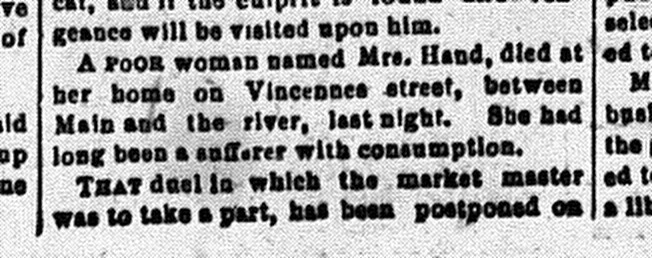
On the way home from the cemeteries, I looked at the entry on the Find A Grave app again.  A partial transcription of her obituary was on her memorial page with the source citation NALS 28 Feb 1879 (Thanks, Sue!).  That citation might not mean anything to most people, but I happen to work at the library in which the microfilmed newspapers are housed.  The next time I had a break at work, I looked up the February 28, 1879 issue of the New Albany Ledger Standard and found her obituary.  I saved a copy to my flash drive to look at later.  I also saved a copy of the marriage record for James Hand and Mary Susan Rakestraw.

Then, as I prepared to write this post, I thought about what else I could possibly turn up on Susan.  Working backwards, as I was taught to do, I considered death records.  However, Susan died in 1879 and Indiana didn’t require death records until 1882.  There were a handful of records before that date, but none were Susan Hand.  I had her marriage records already, so I moved on to births.  She was born circa 1830 in Kentucky, and the earliest recorded Kentucky birth (according to FamilySearch.org) was in 1852.

I thought about census records.  The earliest I had for her was 1850.  I am unlikely to find any earlier without knowing her father’s name, since 1850 was the first year that recorded everyone living in a household and she was married by that time.  The latest I have is 1870 and she died in 1879.  It then occurred to me that I had not checked the Fairview Cemetery indexes.  I found her, though it yielded little new information.

As I read over all of my information to see how complete a story I had for her, I really focused on her obituary.  It broke my heart a little.

Susan Hand, Obituary, New Albany Ledger Standard, Friday, 28 February 1879, p. 3, column 4, Stuart Barth Wrege Indiana History Room

Susan Hand, Obituary, New Albany Ledger Standard, Friday, 28 February 1879, p. 3, column 4, Stuart Barth Wrege Indiana History Room

“A poor woman named Mrs. Hand.”  Did nobody know her given name?

I looked at her Fairview record.

Fairview Cemetery, Volume 2, p. 41.

Fairview Cemetery, Volume 2, p. 41.

She was buried by the county in a grave owned by her former father-in-law and former brother-in-law.  This all gave me the feeling that she was poor and friendless at the end of her life.  Although, one would think that since she had so many children that somebody would have taken care of her.  I’m sure there is much more to Susan’s story than I will ever know, but I’m glad I finally took the time to research her.

Mary Susan Henderson

Born circa 1830 in Kentucky.3,5,6

Married Milton Rakestraw on March 8, 1845 in Floyd County, Indiana.1,2

Children with Milton:  Francis Marion (1847), Charles H. (c.1848), and George William (c.1849).3

Married James Hand on April 16, 1857 in Floyd County, Indiana.4

Children with James:  Elza (c.1858), Alice (1860), Annie (c.1861), Julia (c.1864), and Mary (c.1869).5,6

Died on February 27, 1879 in New Albany, Floyd, Indiana of consumption.7

Buried at Fairview Cemetery in New Albany, Floyd, Indiana on March 1, 1879.8


Sources

1.  Floyd County Clerk. Microfilm. Floyd County, Indiana Marriages Volume B (1845): p.147.  Accessed 23 Sep. 2014, Stuart Barth Wrege Indiana History Room.

2.  “Matrimonial Matters” New Albany Public Press 01 March 1882, Wednesday ed.: 8. Print. column 3.  Accessed 12 Aug. 2014, Stuart Barth Wrege Indiana History Room.

3.  1850 United States Federal Census (database-online). Ancestry.com, 2009. Web. 12 Jun. 2011. Jeffersonville, Clark, Indiana. pp.313-314.

4.  Floyd County Clerk. Microfilm. Floyd County, Indiana Marriages Volume 4 (1857): p.340.  Accessed 09 Jun. 2015, Stuart Barth Wrege Indiana History Room.

5.  1860 United States Federal Census (database-online). Ancestry.com, 2009. Web. 16 Aug. 2014. New Albany, Floyd, Indiana. p.134.

6.  1870 United States Federal Census (database-online). Ancestry.com, 2009. Web. 15 Aug. 2014. New Albany, Floyd, Indiana. p.72.

7.  “Deaths (Obituaries)” New Albany Ledger Standard 28 February 1879, Friday ed.: 3. Print. column 4.  Accessed 09 Jun. 2015, Stuart Barth Wrege Indiana History Room.

8.  Clipp, Mary Cuzzort, Richard Clipp, Jackie Murray Nance, Wanda Perkins Stepp, and Shirley Wolf, comps. Fairview Cemetery, January 7, 1866 to December 31, 1880, New Albany, Floyd County. Vol. 2. New Albany, Indiana: Southern Indiana Genealogical Society, 1991. Print. The Indiana Southern Counties Collection. p.41.

Mildred Springer: A Life of Loss (52 Ancestors #24)

My family and I are fortunate to have a number of family heirlooms.  We owe a debt for those heirlooms to my great grandmother, Mildred Gertrude (Springer) Wiseheart.  She wasn’t quite in the category of a hoarder, but she saved a lot of things.  I think this is because she suffered a lot of loss in her lifetime and holding onto mementos of her loved ones was the best way she knew to keep them with her.  I’m going to write her story as a timeline, to allow for better visualization.  I know how hard it can be to keep a bunch of dates straight in your head.

1892

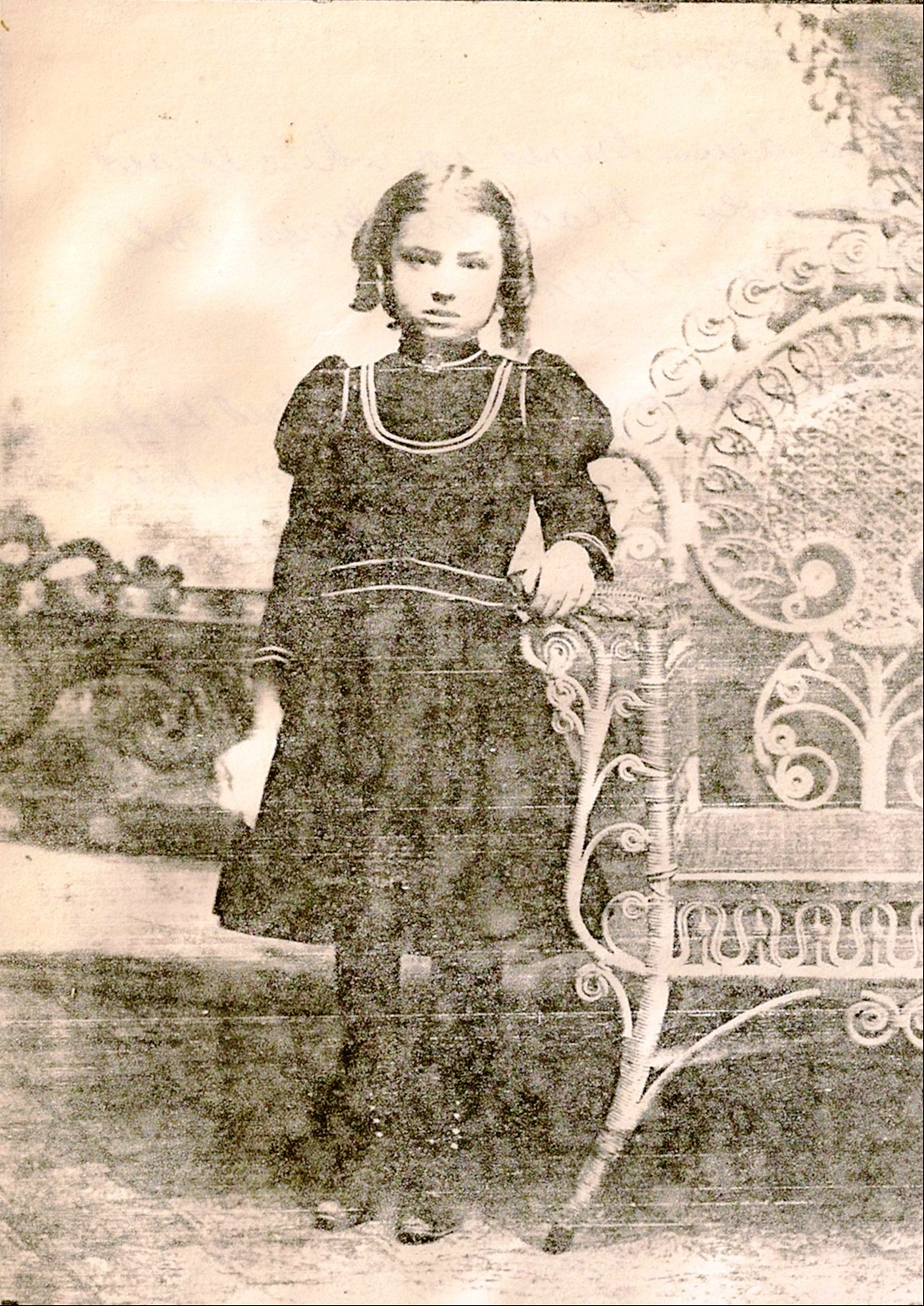
Mildred Gertrude Springer, circa 1892.

Mildred Gertrude Springer, circa 1892.

Mildred was born on November 20th in New Albany, Indiana to parents Frank and Zerilda Eleanora “Ella” (Rakestraw) Springer.1  She and her mother were both very ill at the time of her birth.2

1893

Frank Springer left for the World’s Fair in Chicago and allegedly did not come back.3  (Mildred received almost monthly correspondence from him between 1904 and 1918, possibly even later, and he did come back for visits periodically).  Ella was extremely ill and was considered to be an invalid.2,4

1894

Mildred was adopted by her grandparents, Francis Marion and Mary Elizabeth (Gilliland) Rakestraw.4  Just two and a half weeks later, on June 13th, her mother died of consumption.5

1900

Mildred Gertrude Springer, circa 1900.

Mildred Gertrude Springer, circa 1900.

Mildred was living with her grandparents, her Uncle Willie, and her cousins, Charlie and William.6  This seems to have been the normal living arrangement for the family, as Willie was unmarried for most of the time between 1890 and 1910.

1910

Mildred was living with her grandparents and cousins.7  Willie had moved to Illinois.  At some point during the year, Charlie went to live with Willie.

1911

Francis Marion Rakestraw died, leaving Mary Elizabeth, his wife, Mildred Springer (age 18), and William Rakestraw (age 16).8

1918

Mary Elizabeth and Mildred moved to 811 West 8th Street in New Albany, Indiana.9  William moved to Louisville, Kentucky.  Mary Elizabeth and Mildred became friends with Sanford “Sandy” Wiseheart, who lived down the street at 922.  When Sandy went to France to fight, they corresponded.

1920

George William

George William “Willie” Rakestraw and Mildred Gertrude Springer, circa 1920.

Mildred was still living with Mary Elizabeth on West 8th Street until she and Sandy were married on May 5th.10,11

1921

Mildred gave birth to her first child, Mildred Lorena Wiseheart, on May 9th.12

1923

Mildred gave birth to her second child, Sanford William “Bud” Wiseheart, on May 30th.12

1925

Mildred gave birth to her third child.12

1928

Mildred gave birth to her fourth child.12

1930

Sandy, Mildred and family were living on County Line Road in Clark County, Indiana.12  Mildred gave birth to her fifth child, James Roscoe “Jimmy” Wiseheart, on November 13th.13

1932

Jimmy died of pneumonia on December 12th.13

1934

Mildred gave birth to her sixth child, Mary Katherine Wiseheart, on October 3rd.14

1936

Mary Katherine drowned in the neighbor’s fish pond on July 9th.14

1940

Sandy, Mildred and family were again living at 922 West 8th Street in New Albany, Indiana.15

1944

Mildred had no idea where her father was, or if he was even still living.16

1951

Mildred died on November 3rd of cancer of the gallbladder.1

I’d like to end with what my grandfather, Mildred’s son, said about her:

She had a, I don’t know what you call it, maybe call it a vivid imagination, but she, sometimes at night, she’d take a flashlight and be lookin’ around and she’d say, ‘There’s somebody out there,’ and once a while she’d say, ‘I smell a real strong gag, they’re smoking something.’ And my dad, he’d blow up. I was the only one left at home, the others had all gotten married young and so she was always, like she’d save the last bananer or something and say, ‘Buddy, I saved that for you, that’s the last one.’ And two or three different times she’d say, ‘Buddy, do you think your daddy’s plottin’ against me to have me put away,’ or something. I said, ‘Oh, Mom, he wouldn’t do nothing like that,’ and then I get out walking with him on a job and he’d say, ‘I don’t know what the hell I’m gonna do, I’m afraid I’m gonna have to put your mother away.’ I’d say, ‘Oh, Pap, she ain’t that bad,’ and it was like that for three or four years. Course he blamed it on her father, Frank Springer. I think his problem started when his wife Eleanora died. She was twenty-eight. My mother was two years old when her mother died, so Frank Springer became a wanderer. He’d just wander around and people said there was something wrong with him mentally. And she always had that kind of reflection since people find an excuse to say he was mentally unbalanced and they sort of thought that my mom inherited that. It wasn’t really that way.  My mother was an intelligent person and she could draw and was pretty good in artwork and stuff, she just didn’t go anywhere and associate with people.


Sources

1. Floyd County Health Department. Floyd County, Indiana Death Records. Vol. H-12. p. 10. Microfilm.  Accessed 4 Aug 2014, Stuart Barth Wrege Indiana History Room.

2. Springer, Frank. Letter to Ella Springer. 4 Dec. 1892. MS. New Albany, Indiana.

3. Paoli News 22 Nov. 1893: 3. NewspaperArchive.com. Web. 27 Dec. 2014.

4.  New Albany Daily Ledger 26 May 1894, Saturday Evening ed.: 5. Print.column 3.

5.  “Deaths (Obituary).” New Albany Evening Tribune 14 June 1894, Thursday ed.: 4. Print. column 2.

6.  1900 United States Federal Census (database-online). Ancestry.com, 2009. Web. 07 Mar. 2011. New Albany, Floyd, Indiana. p. 9B.

7.  1910 United States Federal Census (database-online). Ancestry.com, 2009. Web. 07 Mar. 2011. New Albany, Floyd, Indiana. p. 14A.

8.  Floyd County Health Department. Floyd County, Indiana Death Records. Vol. CH-22. p. 17. Microfilm.  Accessed 4 Aug 2014, Stuart Barth Wrege Indiana History Room.

9.  Caron, C.K. Caron’s Directory of the City of New Albany for 1919-20. New Albany, IN: C.K. Caron, 1919. 297. Print.

10.  1920 United States Federal Census (database-online). Ancestry.com, 2009. Web. 24 Sep. 2014. New Albany, Floyd, Indiana. p. 11A.

11.  Floyd County Clerk. Floyd County, Indiana Marriages. Vol. 20. p. 375. Microfilm.  Accessed 12 Aug 2014, Stuart Barth Wrege Indiana History Room.

12.  1930 United States Federal Census (database-online). Ancestry.com, 2009. Web. 07 Mar. 2011. Silver Creek, Clark, Indiana. p. 14B.

13.  Clark County Health Department.  Clark County, Indiana Death Records. Roll 20, Book 2, p.11.  Microfilm. Jeffersonville Township Public Library.

14.  Floyd County Health Department. Floyd County, Indiana Death Records. Vol. CH-37. p. 97. Microfilm.  Accessed 25 Jan 2015, Stuart Barth Wrege Indiana History Room.

15.  1940 United States Federal Census (database-online). Ancestry.com, 2009. Web. 28 Jul. 2014. New Albany, Floyd, Indiana. p. 10B.

16.  Wiseheart, Mildred, Letter, 1944.  MS.  New Albany, Indiana.

Frances Lydia Browning: An Unconventional Proposal (52 Ancestors #23)

This week, I’ve decided to focus on an ancestor who received an unconventional, though probably not uncommon in those days, marriage proposal.  The two parties involved are my great great grandparents, Frances Lydia “Fannie” Browning and William Henry Wiseheart.  Before I get into the proposal, I’ll briefly go over their backgrounds.

Fannie was born on June 14, 1853, in Kentucky, to Daniel and Ossiann (Salisbury) Browning.1  Ossiann died when Fannie was about twelve.2,3,4  Daniel remarried, to Nancy Catherine Ringold, in 1865.3

While a 16-year-old Fannie was still living at home with her father and stepmother, in Long Run, Kentucky, a 37-year-old WilliamWiseheart was living with his wife, Sarah (Myers), and six month old daughter, Kitty, in Washington, Indiana.4,5  William’s wife died circa 1872, leaving William to care for a young daughter on his own.  William also had a disability from a Civil War injury.  He ended up in Kentucky.5,6  Presumably, he moved back there to seek the assistance of family.

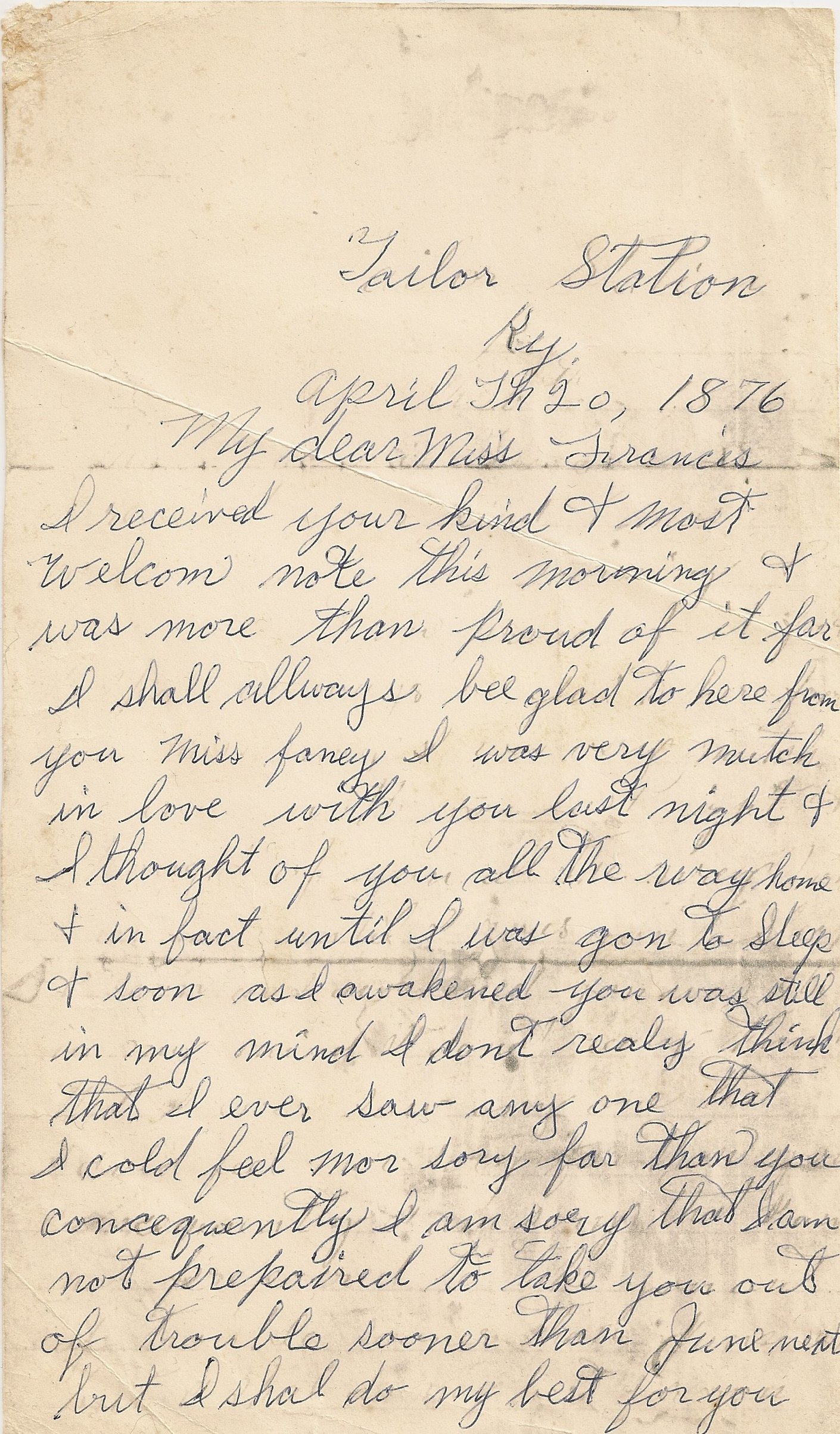
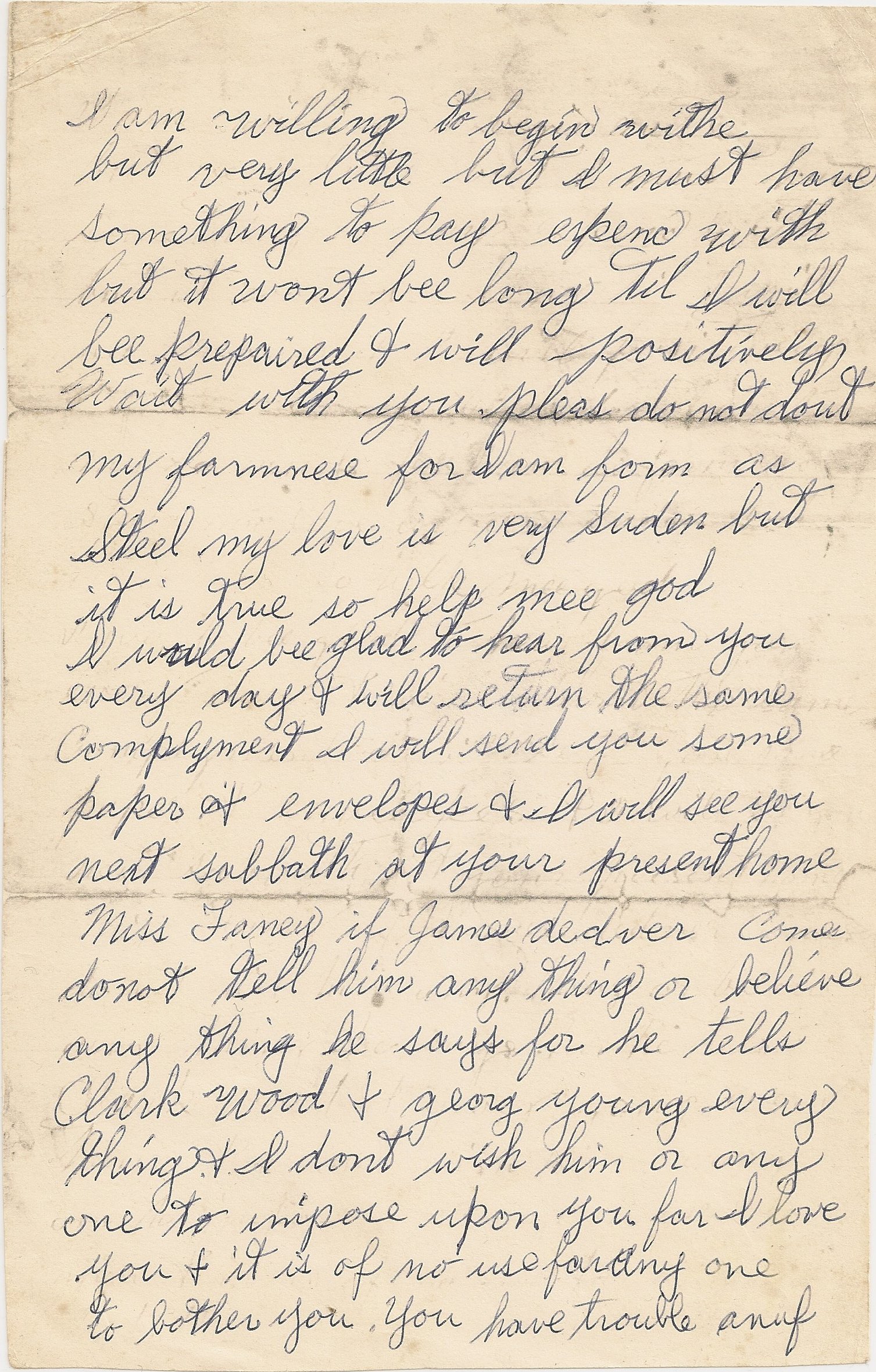
Shortly after moving back to Kentucky, he met Fannie Browning.  I often wonder how they met.  Maybe they were neighbors.  Maybe they attended the same church.  Maybe one of William’s family members knew Fannie somehow and set them up.  Whatever happened, Fannie received a letter from William that I refer to as a proposal.  In it, he describes his feelings for Fannie and talks about taking her “out of trouble.”  He then closes with “I remain your intended companion until death.”  It may not be an outright proposal, but it is certainly a letter of intent.

Letter, William H. Wiseheart to Frances Browning, 20 Apr 1876, p. 1 Letter, William H. Wiseheart to Frances Browning, 20 Apr 1876, p. 2 Letter, William H. Wiseheart to Frances Browning, 20 Apr 1876, p. 3

What is really interesting to me is that this letter dated April 20, 1876 indicates that William would not be able to marry Fannie until June of 1877, however, they did marry not quite one month later on May 10th in Long Run, Kentucky.6  Perhaps his circumstances improved.  Perhaps her circumstances worsened.

Another thing I had wondered about over the years was the age difference between William and Fannie.  He was 42 and she was 23 when they married.  Knowing that William had a young child and Fannie had some sort of “trouble” explains that, I think, aside from a fairly large age difference being a somewhat common phenomenon in that day and age.

Fannie and William had ten children of their own, of which two were stillbirths, two died after three days, one died after eleven days, and the other five survived to adulthood.  The surviving children were Daniel Signal (1877), Mary Elizabeth (ca 1878), Rosey or Rosa H. (1879), Joseph Martin (1886), and Sanford Wesley (1890).7,8,9

Fannie died of chronic valvular heart disease on December 4, 1920, at the age of 67.1

Frances Lydia Browning

Frances Lydia Browning


Sources

1.  Floyd County Health Department. “Frances Wiseheart.” Floyd County, Indiana Death Records. Vol. CH-33. 55. Microfilm.  Accessed 5 January 2015 at the Stuart Barth Wrege Indiana History Room.

2.  1860 United States Federal Census. Ancestry.com, 2009. Web. 7 Mar. 2011. 2nd District (Long Run), Jefferson, Kentucky. p.101. Family #706, lines 10-14.

3.  “Indiana Marriages, 1811-2007,” index and images, FamilySearch (https://familysearch.org/ark:/61903/1:1:KFZ5-1MZ : accessed 9 June 2015), Daniel Browning and Nancy C Ringo, 20 Sep 1865; citing , Scott, Indiana, county clerk offices, Indiana; FHL microfilm 549,440.

4.  1870 United States Federal Census. Ancestry.com, 2009. Web. 30 Dec. 2014. Boston Precinct (Long Run), Jefferson, Kentucky. p.11. Family #62, lines 2-9.

5.  1870 United States Federal Census. Ancestry.com, 2009. Web. 9 Jun. 2015. Washington, Owen, Indiana. p.6. Family #54, lines 32-34.

6.  “Kentucky Marriages, 1785-1979,” index, FamilySearch (https://familysearch.org/ark:/61903/1:1:F4QC-G98 : accessed 9 June 2015).  Wm. H. and Fannie Browning, 10 May 1876; citing Long Run, Jefferson, Kentucky, reference Bk11, P257, L10; FHL microfilm 482,712.

7.  1880 United States Federal Census. Ancestry.com, 2009. Web. 3 Jun. 2015. Boston Precinct, Jefferson, Kentucky. p.2B. Family #18, lines 45-50.

8.  1900 United States Federal Census. Ancestry.com, 2009. Web. 7 Mar. 2011. New Albany, Floyd, Indiana. p.5B. Family #108, lines 70-74.

9.  1910 United States Federal Census. Ancestry.com, 2009. Web. 7 Mar. 2011. New Albany, Floyd, Indiana. p.16B. Family #339, lines 85-88.

Charles Rakestraw: Beginning Again (52 Ancestors #22)

Charles Rakestraw is my Floyd County, Indiana pioneer ancestor.  I registered for First Families of Floyd, Clark, and Harrison Counties through him last year.  This year, the Southern Indiana Genealogical Society asked me to talk about him at their July program, Stories of the First Families.  They also asked me to provide a photo of him or his tombstone for their display board.  I have no photo of him or his tombstone, which makes me wonder what I could give them instead.  The first family member of his for which I have those pictures is his grandson. I really want to represent him with a photo of some kind.  Since he was a ship carpenter, perhaps a New Albany steamboat that he could have worked on, or something to do with carpentry. Charles Rakestraw is an ancestor about whom I know a lot and nothing at the same time.  How is that possible?  He had a lot of new beginnings, but the details of his life after one beginning and before the next seem to be non-existent.

Birth – The Very Beginning

Charles was born circa 1800 in Pennsylvania to Joseph and Rebecca (Gilbert) Rakestraw.1,5,8  Joseph and Rebecca were Quakers, which ordinarily would mean that the Meeting minutes would have a record of Charles’ birth.  However, Joseph and Rebecca were also second cousins and were disowned by the Society of Friends for marrying a close relation. Currently, the chain of evidence I have that Charles was indeed the son of Joseph and Rebecca, and for his birth year and place, is:

  • Charles Rakestraw lived in New Albany, Indiana in 1840.  He was between the ages of 40 and 50.  There is a mark in the 30 to 40 column on the female side, which is presumably his wife.3
  • A 44-year-old “Sintha Rakestraw” appears on the 1850 Mortality Schedule.6  In 1850, Charles is living with a daughter and son-in-law.5
  • Charles Rakestraw married “Sinthy Irey” in Columbiana County, Ohio in 1821.7
  • Charles and Syntha are living in Hanover, Columbiana, Ohio in 1830.2
  • Most of Charles and Syntha’s children were born in Ohio; the others were born in New Albany.2,3,4,5
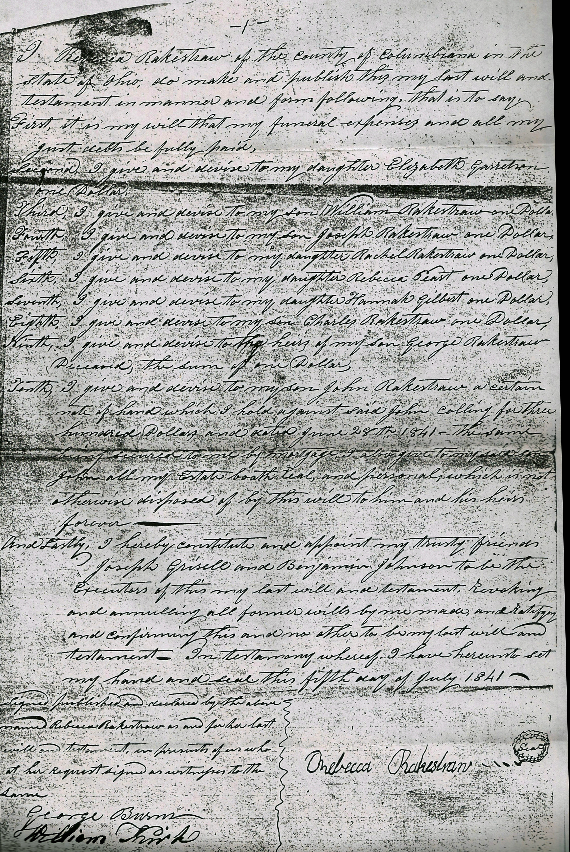
  • Rebecca Rakestraw’s last will and testament, dated July 5, 1841, lists a son Charles as an heir.8
  • Joseph and Rebecca moved to New Garden, Columbiana, Ohio before 1829.1
  • Rebecca gave birth to nine children in Northampton County, Pennsylvania and two children in Lancaster County, Pennsylvania sometime before she and Joseph moved to Ohio.1

It’s a work in progress, but I haven’t given up the search.

A Move to Ohio

Certainly, the Rakestraws were in Ohio by 1829 because Joseph died in the spring of 1829 and was buried in New Garden Friends Cemetery.1 According to William Walton, a cousin of Rebecca, Rebecca married Joseph in 1786.  They settled in Northampton County, where nine children were born to them.  At the least, they would have lived here seven years, if Rebecca would have had baby after baby.  More likely they were born every one or two years, so averaging that I’m using fourteen years, which brings us to 1800.  They then moved to Lancaster County, where they lived for about twenty years, which brings us to 1820.1 Depending on how long they actually did live in Northampton County, Charles would have been a teenager or young adult at the time of the move.

A Marriage

Assuming 1820 as the year for the Ohio move, Charles would not have been there long before his first marriage.  He married Syntha Irey on December 6, 1821.7

A Move to Indiana

Charles and his family moved to New Albany, Indiana sometime between 1835 and 1838.2,3,4,5  This is based on Lucinda, the youngest of the Ohio-born children, having been born circa 1835, and Elizabeth, the oldest of the Indiana-born children, having been born circa 1838.  They were most definitely here in 1840.3

A Death

Syntha died of consumption on December 11, 1849, which caused Charles to adjust his living situation.6  With three younger children, Charles needed to be sure they were taken care of.  His son William, age nine, was sent to live with an older brother, Milton.4  Charles and his two young daughters, Elizabeth and Minerva, went to live with his daughter Adeline and son-in-law, Henry Hardy.5

A Second Marriage

Charles wasn’t long in this situation before he re-married.  He married Dorothy Houston on October 19, 1850.9

The End, or Maybe Another Beginning

I lose Charles after his marriage to Dorothy.  He is not listed on the 1860 Census, which leads me to believe he died before this time.  I cannot find any obituaries or other records of death for him.  An obituary for Dorothy shows that she was still going by Dorothy Houston and does not mention Charles at all.10  There is a rumor that he was buried out at Fairview Cemetery in New Albany, but cemetery records have yielded no results and I can find no tombstone for him.


Sources

1.  Walton, William, and Frank H. Severance. “Memoirs of the Captives.” The Captivity and Sufferings of Benjamin Gilbert and His Family, 1780-83. Reprinted from the Original Edition of 1784. Cleveland: Burrows Brothers, 1904. 177-78. Print.

2.  1830 U.S. Federal Census, Hanover, Columbiana, Ohio, p. 486, Ancestry.com.

3.  1840 U.S. Federal Census, New Albany, Floyd, Indiana, p. 255, Ancestry.com.

4.  1850 U.S. Federal Census, Jeffersonville, Clark, Indiana, pp. 313-314, Ancestry.com.

5.  1850 U.S. Federal Census, New Albany, Floyd, Indiana, p. 421, Ancestry.com.

6.  1850 U.S. Federal Census Mortality Schedule, New Albany, Floyd, Indiana, p. 325, Ancestry.com.

7.  Columbiana County, Ohio Marriages, Volume 2, p. 103, FamilySearch.org.

8.  Last Will and Testament of Rebecca Gilbert Rakestraw, 5 July 1841.

9.  Floyd County, Indiana Marriages, Volume 3, p. 305, Stuart Barth Wrege Indiana History Room.

10.  Obituary, Dorothy Houston, New Albany Daily Standard, Wednesday 13 December 1871, p. 4, column 7, NewspaperArchive.com.