Sanford Wiseheart: Wise, Resourceful, and Industrious (52 Ancestors #09)

“Pap used to say, ‘If you can’t find work, make work.'”  These are words I frequently heard from my grandpa about his father.

Sanford Wesley “Sandy” Wiseheart was born on October 30, 1890 in Elizabeth, Indiana to parents William Henry and Frances Lydia “Fannie” (Browning) Wiseheart.  In the 1910 Census, he was still living with his parents.  He was a peddler working on his own account and owned his own wagon.  Grandpa told me that when his dad was younger he used to buy things in town and load them up on a wagon and sell them at a slight profit to the people who couldn’t make it into town.

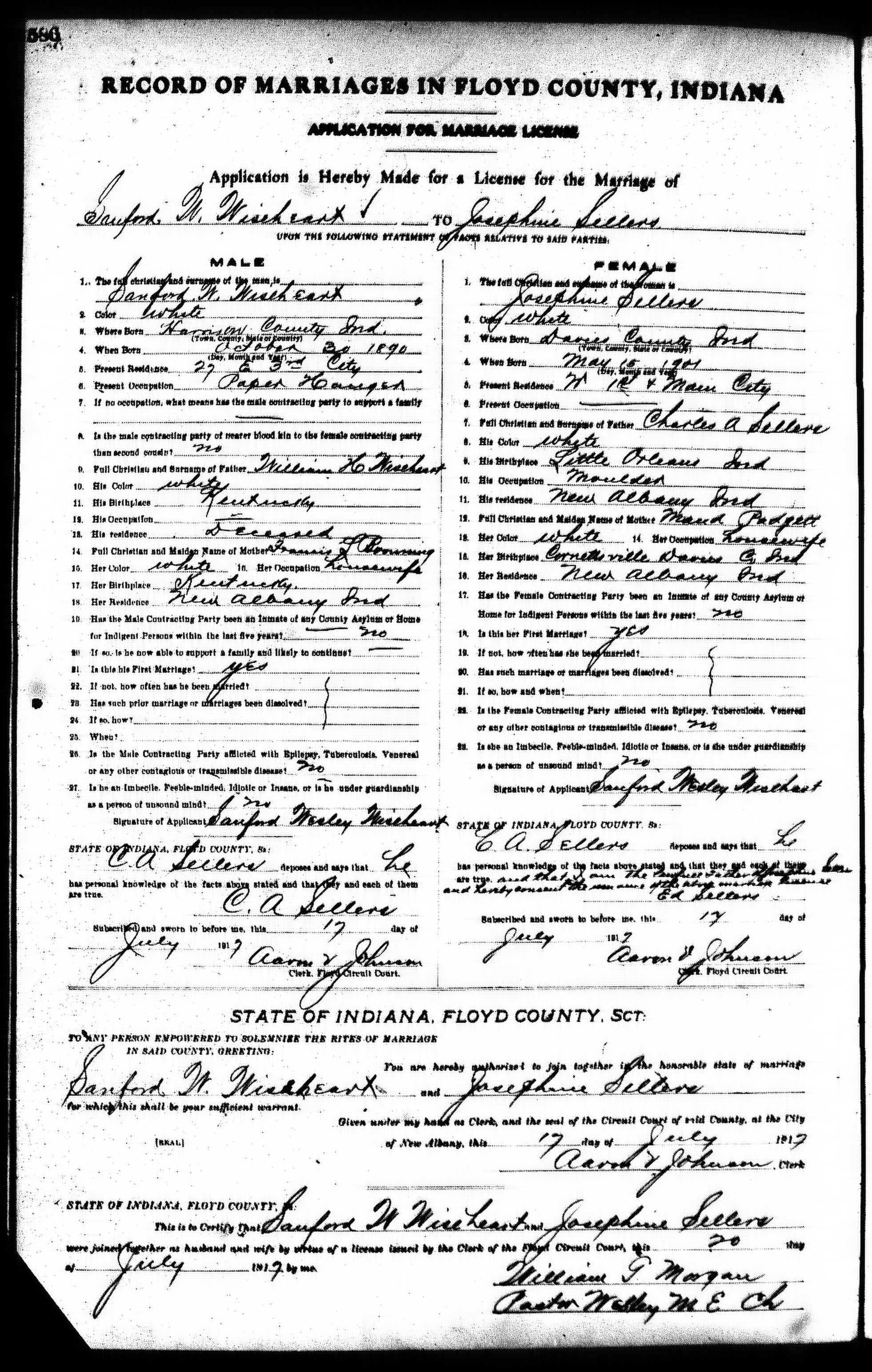
In 1917, Sandy filled out a Draft Registration Card.  His occupation was “driver for David Brubeck.”  According to the 1917 New Albany City Directory, David Brubeck was the owner of Brubeck Ice Cream Company.  About a month later, on Sandy’s marriage application with his first wife, his occupation is listed as paper hanger, that is one who hangs wallpaper.

In August of 1918, Sandy went to France and served in the occupation of Privenelle Sector, west of Moselle (Second Army Offensive).

Sanford Wesley Wiseheart (ca. 1914)

Sanford Wesley Wiseheart (ca. 1918)

While there, he was a medical transporter in Field Hospital 22.  He frequently wrote to his mother and to his friend, Mildred Springer.  One such letter contained the following:

if you could of saw what I have over here you would learn that there is no use to worry about anything we must just keep a brave heart and meet our trouble half way for we cannot change what must be.

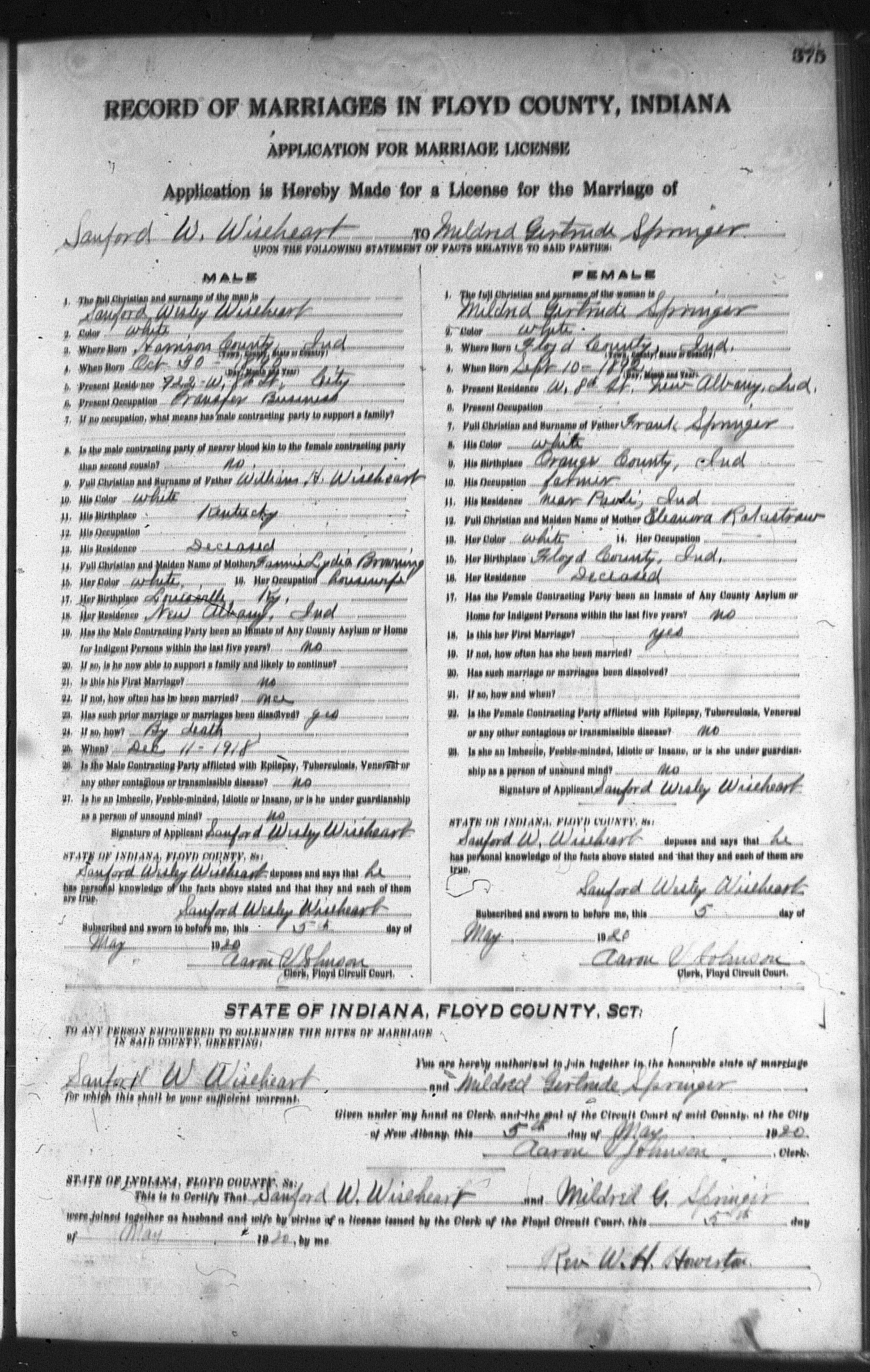
Sandy married Mildred Gertrude Springer, his second marriage, on May 5, 1920 in Floyd County, Indiana.  Here, Sandy’s occupation was “transfer business,” which is delivery service.  On the 1930 Census, he was a salesman of medicines and toiletries.

Grandpa also told me that during the 1937 flood, Sandy and one of his friends borrowed a neighbor’s rowboat and took hay around to the stranded cows.

The 1940 Census lists Sandy as being a general contractor, working on his own account, who repairs and builds homes.  In 1941, he bought a farm and the family raised crops and chickens as well.

Sandy Wiseheart on the farm.

Sanford Wiseheart on the farm.

Sandy wasn’t afraid of hard work, and he did whatever job was necessary and available in order to provide for his family.

Wiseheart, Sanford - business card

Frank Springer: The Search Continues

I’ve posted a few times before about my great great grandfather, Frank Springer.  He disappeared from public records in 1893 and didn’t resurface until 1920.  Family letters (which I will post as soon as I have them scanned and in chronological order) place him in Oklahoma, Missouri, and Indiana during these years.

The mystery still remains as to what happened to him after 1920.  He does not appear on the 1930 or 1940 Census.  My grandpa remembered having met him in about 1931, so I’m operating under the assumption that he died after 1931.  A recently found letter reveals that Mildred Wiseheart, his daughter, did not know where he was or whether he was dead or alive in 1944.

Letter, Mildred Springer to Arthur Dillard, 25 Jun 1944, p.1

Letter, Mildred Springer to Arthur Dillard, 25 Jun 1944, p.1

Now my questions are:  When did he die?  Where did he die?  What happened to him between 1920 and the time of his death?  These are questions to which I may never have an answer, but that won’t deter me from searching.

James Roscoe Wiseheart: One Little Shoe

James Roscoe Wiseheart was born to parents Sanford Wesley and Mildred Gertrude (Springer) Wiseheart on November 13, 1930.  He had two older sisters and two older brothers, one of whom was my grandfather.  The family lived in Clark County, Indiana at the time.  Jimmy didn’t live long and I know very little about him.  Grandpa said that Jimmy was given his middle name, Roscoe, after his father’s good friend, Roscoe Treece.  Jimmy died at the age of two from convulsions due to a fever that was brought on by lobar pneumonia.¹  He was the first of two Wiseheart children to die young.  The other was Mary Katherine, who was born after Jimmy died.

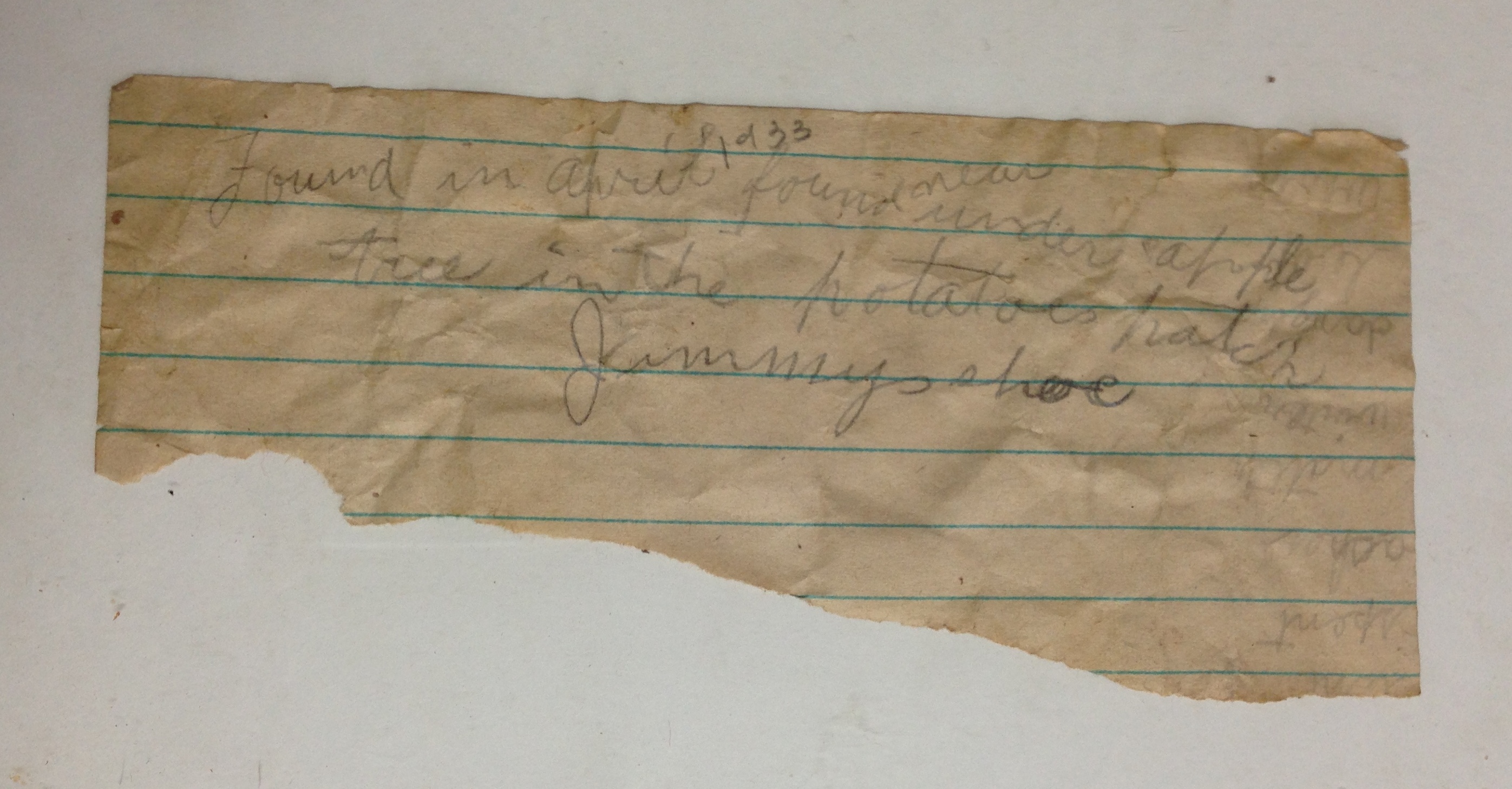
Recently, as my dad, my uncle and I were going trough the Rakestraw trunk, we came across a photograph of Jimmy in his coffin (which I will not post) and one little shoe that had been found in the potato patch just four months after his death.  How heartbreaking it must’ve been to find the shoe, and how precious.

The note that had been tucked into the shoe.

The note that had been tucked into the shoe.

Jimmy's shoe.

Jimmy’s shoe.

2015-02-22 12.46.49


1.  Clark County, Indiana Deaths, Roll 20, Book 2, p.11, Jeffersonville Township Public Library.

Jonathan Lindley: From Orange County to Orange County (52 Ancestors #08)

I haven’t done any real research on my Lindley line yet.  I suppose I always thought they’re fairly well documented and it will all still be there when I’m ready.  Jonathan Lindley was my sixth great grandfather and my eighth great uncle.  I am descended from his daughter, Hannah, and his nephew, Owen.  My grandpa told me a story about Jonathan Lindley on more than one occasion.

In the spring of 1811, Jonathan Lindley and his wife, she was Deborah Dicks (or Dix), moved their whole family and a large number of freed slaves from North Carolina up here to Indiana, up in Orange County.  They were Quakers, see, and they didn’t believe that people should be slaves.  They wanted to make sure that these freed slaves got up here safely.  They also wanted to live in a state where slavery was illegal.  I don’t know exactly how many went or what all their names were, but one of them freed slaves was called Alexander Polecat.  He was a character.  Always crackin’ jokes.

When they got to the Ohio River, they had to camp a while on the Kentucky side.  The water was too high to cross, see.  So, they camped there the first night and everything was fine, but the next mornin’, Jonathan Lindley’s dog was missin’.  Well they looked around and they called for him but he never did come, so they figured he must’ve been scared off by an animal or somethin’.  Some time later, they got a letter from an old neighbor down in North Carolina sayin’ the dog come home.  Now, isn’t that somethin’, a dog findin’ his way back home all those miles?

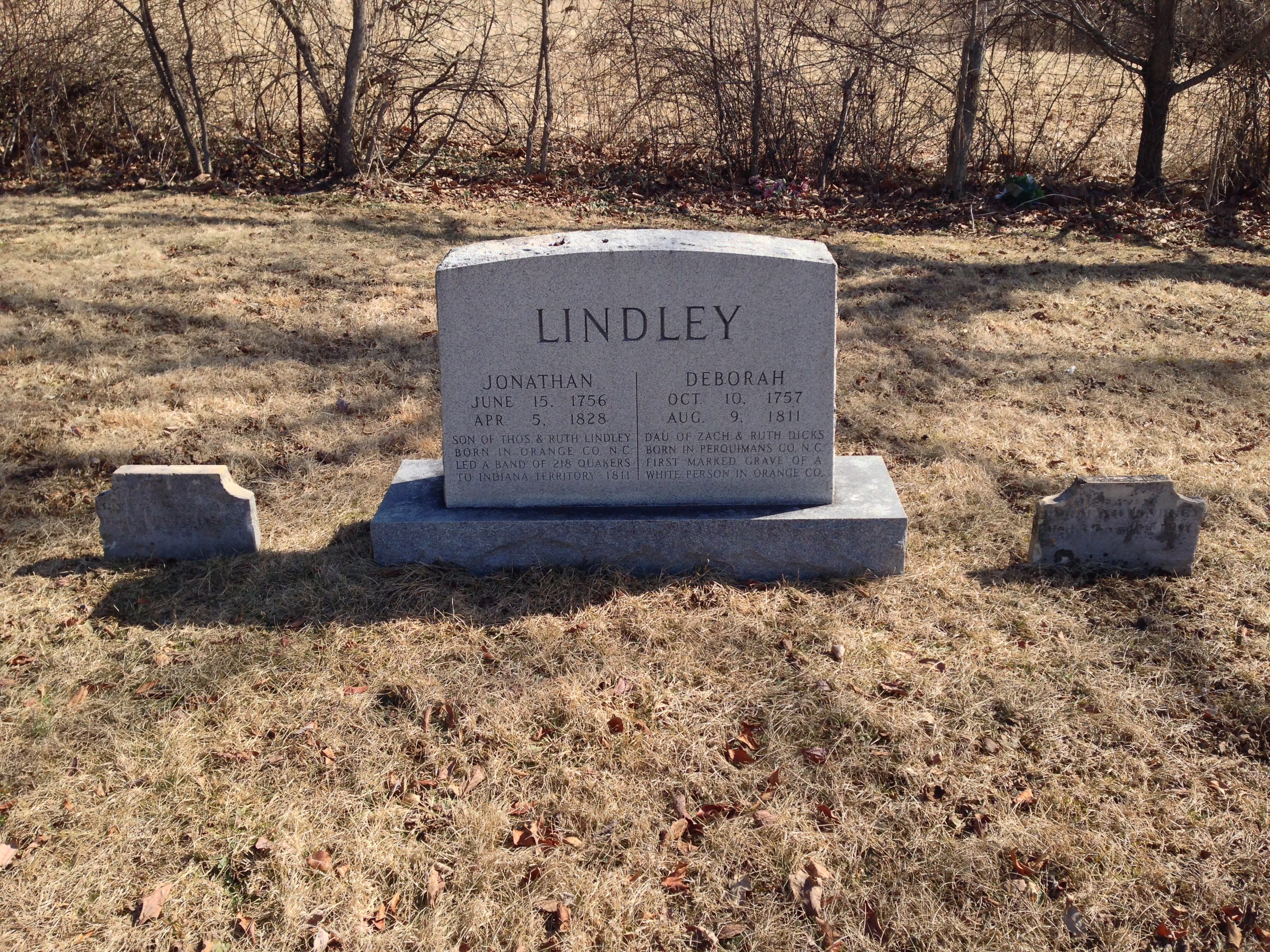
In February of 2014, I went to Orange County, Indiana with my dad.  We stopped at Lick Creek Friends Cemetery to see Jonathan and Deborah Lindley’s memorial stone.

Jonathan and Deborah Lindley memorial stone with original tombstones on either side.  Photo taken by Melissa Wiseheart, 28 Feb 2014.

Jonathan and Deborah Lindley memorial stone with original tombstones on either side. Photo taken by Melissa Wiseheart, 28 Feb 2014.

I will get around to researching the Lindleys.  My focus, for the moment, is telling the stories of those ancestors whose lives are relatively unknown.

Rebecca Gilbert: Quaker Daughter, Seneca Daughter (52 Ancestors #07)

Rebecca Gilbert is my favorite ancestor to research.  I feel close to her, not because we have any similarities, but because she is the first ancestor of mine who had a story that I could read.  All I had in the beginning of my research was a pedigree chart from my grandmother and a handful of notes.  One day, after Sunday lunch, my grandpa told me he had a book about my sixth great grandmother, Rebecca Gilbert.  The book was Captured by the Indians:  The Seldom Told Stories of Horatio Jones and the Benjamin Gilbert Family by George Henry Harris and William Walton (2003).  He lent it to me and, as I read and learned about what she had gone through, she became real to me.  She was no longer just a name on a pedigree chart.  I wanted to learn more about her, but I wasn’t entirely sure where to start.

A few months later, I was helping a patron at work who wanted to research Native American ancestry.  It was then that I noticed a smallish, red bound book with gilt lettering on the spine, which read, “Gilbert Narrative.”  When the patron had finished, I took my break and went back for the book.  The book was The Captivity and Sufferings of Benjamin Gilbert and His Family, 1780-83 by William Walton and Frank H. Severance (1904).  This one included a copy of the original text, plus an illustration of Benjamin being led off by Indians, a photograph of the Gilbert homestead in Byberry, the ancestry of Benjamin Gilbert, memoirs of the surviving captives, a family tree for Benjamin’s children, and historical notes.  It should have contained a map of their travels, but it had long since been torn out.

Suddenly, I had more information about my sixth great grandmother.  It had been right under my nose for two years.  I spent my breaks over the next week reading this book and writing things down.  This reprint also included a bibliography of all related publications.  Since this book differed so much from the one my grandfather had shown me, I wondered what other editions might reveal.  I began my search for these other books.  Luckily, Internet Archive had digitized some of them.  They have recently added the original as well.

Each one has something to add to the story, whether for the best or not.  Before I begin the story I should note that the family were Quakers and they never used the names of the days of the week or the months of the year since most of those names were derived from the names of pagan gods.  They also had an old and new style of dating, which can be confusing at times.  I’m writing the dates here exactly as they appear in the text.

The basic story of the Gilbert family is that the family were surprised at about sunrise on the 25th day of the 4th month, 1780 by a party of eleven Indians.  These Indians were Rowland Monteur and John Monteur (Mohawk); Samuel Harris, John Huston, and John Huston, Jr. (Cayuga); John Fox (Delaware); and five unnamed Seneca.  They raided and burned all of the buildings on the property.  They took captive fifteen people:  Benjamin Gilbert and his wife, Elizabeth; their children, Joseph, Jesse, Rebecca, Abner, and Elizabeth; Jesse’s wife, Sarah; Elizabeth’s sons from a previous marriage, Thomas and Benjamin Peart; Benjamin Peart’s wife, Elizabeth, and their daughter, Elizabeth; Benjamin Gilbert’s nephew, Benjamin Gilbert; Abigail Dodson, a neighbor’s daughter; and Andrew Harrigar, a hired hand.

The Indians bound their hands and forced the captives to walk northward toward Fort Niagara.  The journey was difficult, with little rest and not much to eat.  Andrew Harrigar managed to escape on the tenth day.  On the 24th day of the 5th month, Colonel Guy Johnson and Colonel Butler secured the release of Benjamin and Elizabeth Gilbert and their son, Jesse.  The rest of the captives were given over to various Indian families.  Rebecca and her cousin, Benjamin, were given to Rowland Monteur and his wife, who was the daughter of the Seneca Chief Siangorochti (Sayenqueraghta) and a Cayuga mother of high rank.  They lived with the Seneca on Buffalo Creek (Buffalo River), about four miles from Fort Erie.  They were adopted into the family of Siangorochti as replacements for family members that had been killed.  The story, according to William Walton, another of Rebecca’s cousins, is that Benjamin was happy in his new life while Rebecca suffered much and only wanted to get back home.

Another account, given by Rebecca’s fourth great grandson, Everitt Kirk Harris, states that “she was reluctant to leave her adopted relatives and customs.”  This account was passed down through the family.

Regardless of the conditions, there are some facts.  Benjamin Gilbert, Rebecca’s father, died on the 8th day of the 6th month, 1780.  Her adopted father, Rowland Monteur, died in September of 1781 (according to Severance’s notes).  Rebecca and Benjamin were released on the 1st day of the 6th month, 1782, and sailed for Montreal two days later.  They were the last two members of the Gilbert family to be released.  The entire surviving Gilbert family arrived in Byberry, Pennsylvania on the 28th day of the 9th month, 1782.

Walton’s third edition gives a synopsis of Rebecca’s life after returning home.

Walton, William.  A Narrative of the Captivity and Sufferings of Benjamin Gilbert and His Family, Who Were Taken by the Indians in the Spring of 1780.  Third Edition.  Philadelphia:  Printed by John Richards, 1848.  pp. 222-223.

Walton, William. A Narrative of the Captivity and Sufferings of Benjamin Gilbert and His Family, Who Were Taken by the Indians in the Spring of 1780. Third Edition. Philadelphia: Printed by John Richards, 1848. pp. 222-223.

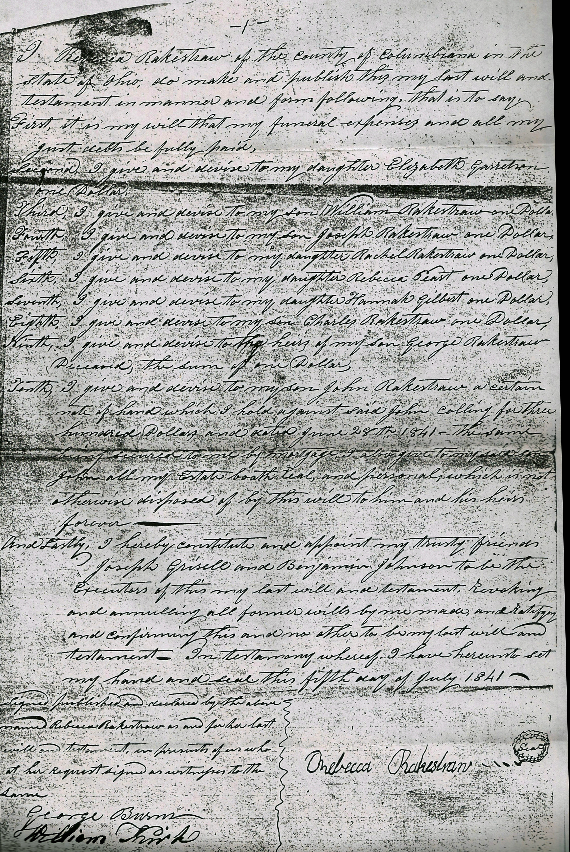
Rebecca’s will names only nine children:  Elizabeth, William, Joseph, Rachel, Rebecca, Hannah, Charles, George, and John.

Last Will and Testament of Rebecca Rakestraw, 5 Jul 1841

Last Will and Testament of Rebecca Rakestraw, 5 Jul 1841

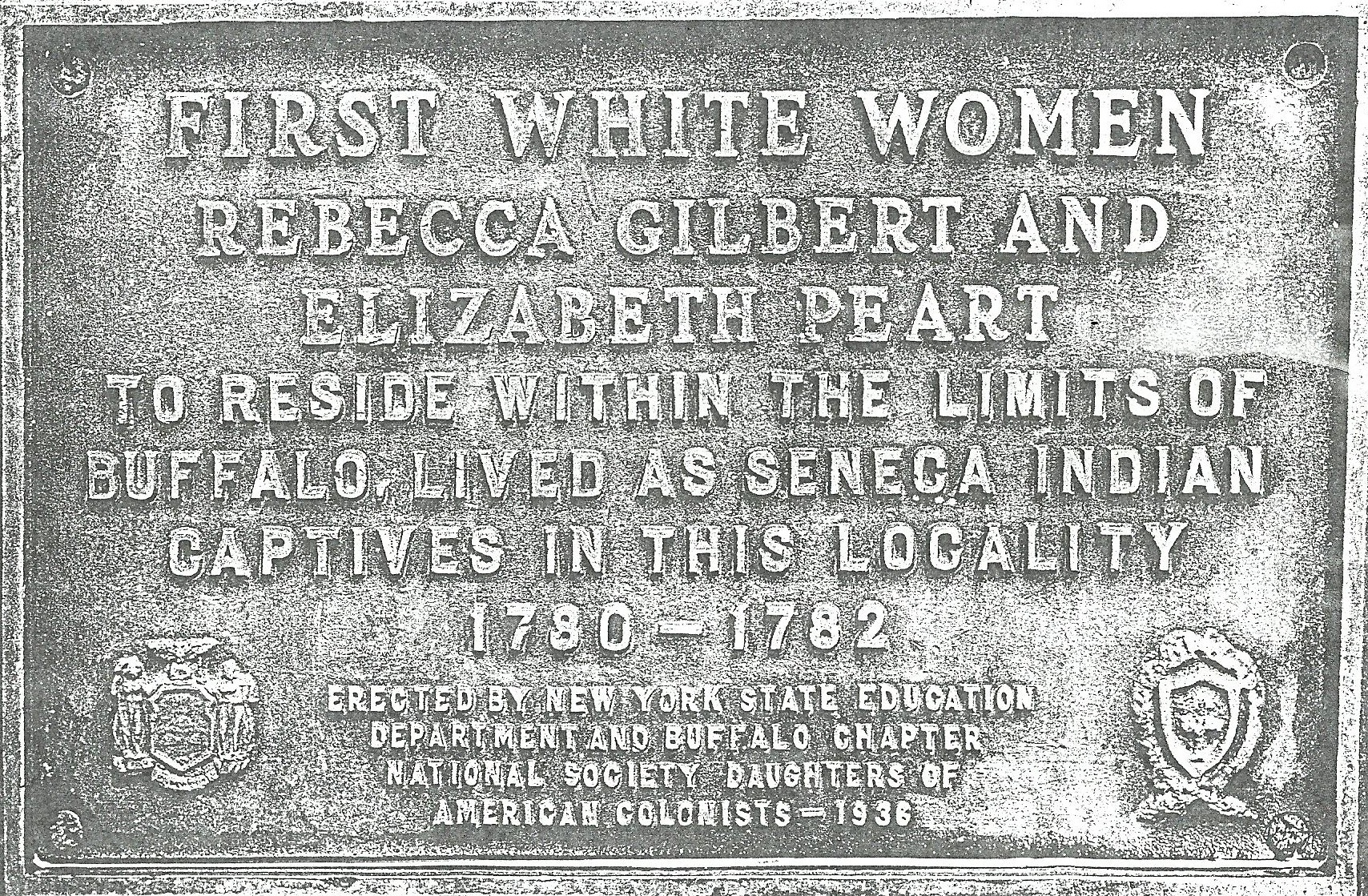
I feel as though I have a complete story for Rebecca.  I am, however, left with a question.  Why are only nine of Rebecca’s eleven children named in her will?  Only three possible reasons come immediately to mind.  Either the person who wrote the synopsis was incorrect and there were only nine children, the other two children died without heirs before the date of the will, or Rebecca did not count them as her children for some reason.  Even though I have a fairly complete story for Rebecca, I continue to look for information.  One item on my bucket list is to follow the path that Rebecca and her family followed.  At the very least, I want to see the monument in The Seneca Indian Park in Buffalo, New York.  I found an image of the plaque recently.

First White Women Monument, Seneca Indian Park, Buffalo, New York, Ancestry.com.

First White Women Monument, Seneca Indian Park, Buffalo, New York, Ancestry.com.