Syntha Irey: The Synthesis of a Name (52 Ancestors #15)

The Rakestraws have always been a difficult bunch to try to track down, the women in particular.  Like her great granddaughter, Syntha (Irey) Rakestraw lived a short and mostly undocumented life.  Also like her great granddaughter, her name is different on every record.

Syntha was born on April 8, 1803.  Her father was Phillip (or Philip) Irey of Butler Township in Columbiana County, Ohio.  She married Charles Rakestraw on December 6, 1821.  The couple and some of their children moved to New Albany, Indiana sometime between 1832 and 1840.  I’m still not sure how many children they had, but I have been able to prove eight and have leads on two more.  Syntha died of consumption on December 11, 1849, and was buried at Fairview Cemetery on the 17th.  I don’t know whether or not she originally had a tombstone, but she currently shares a stone with her daughter, Rebecca Dowerman, who died in 1901.

The first piece of documentation that I ever found for Syntha was the 1850 Mortality Schedule, on which her name is spelled “Sintha.”  I had only “known” that she was married to my Charles Rakestraw because of a pedigree chart that my grandma had given me years ago.

1850 Mortality Schedule, Ancestry.com

1850 Mortality Schedule, Ancestry.com

With a piece of evidence in hand, Sintha is how I spelled it until someone saw it on my Ancestry tree and sent me a very nasty message about how I was spelling Syntha incorrectly and that I should have more respect for my ancestors than to spell their names incorrectly.  Luckily, this didn’t turn me off to genealogy, but it did turn me off to having a publicly viewable tree on Ancestry.

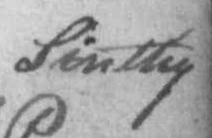
The next record I came across was the marriage record for Charles Rakestraw and Sinthy Irey.  Now, my grandpa always used to pronounce Missouri as miz-ur-ah and Sunday as sun-dee, so I can see how Sintha might have become Sinthy.  I still couldn’t figure out where Syntha had come from, though.

Columbiana County, Ohio Marriages, Vol. 2, p. 103, FamilySearch.org

Columbiana County, Ohio Marriages, Vol. 2, p. 103, FamilySearch.org

The next piece of the puzzle came when I borrowed the Rakestraw box of paperwork from my grandpa so that I could scan it all into my computer.  Among the papers was a copy of Phillip Irey’s will, which appears to have been part of a probate record.  For some reason, whoever copied it was only concerned with the will.  In the will, Phillip names his daughter, Syntha Rakestraw.

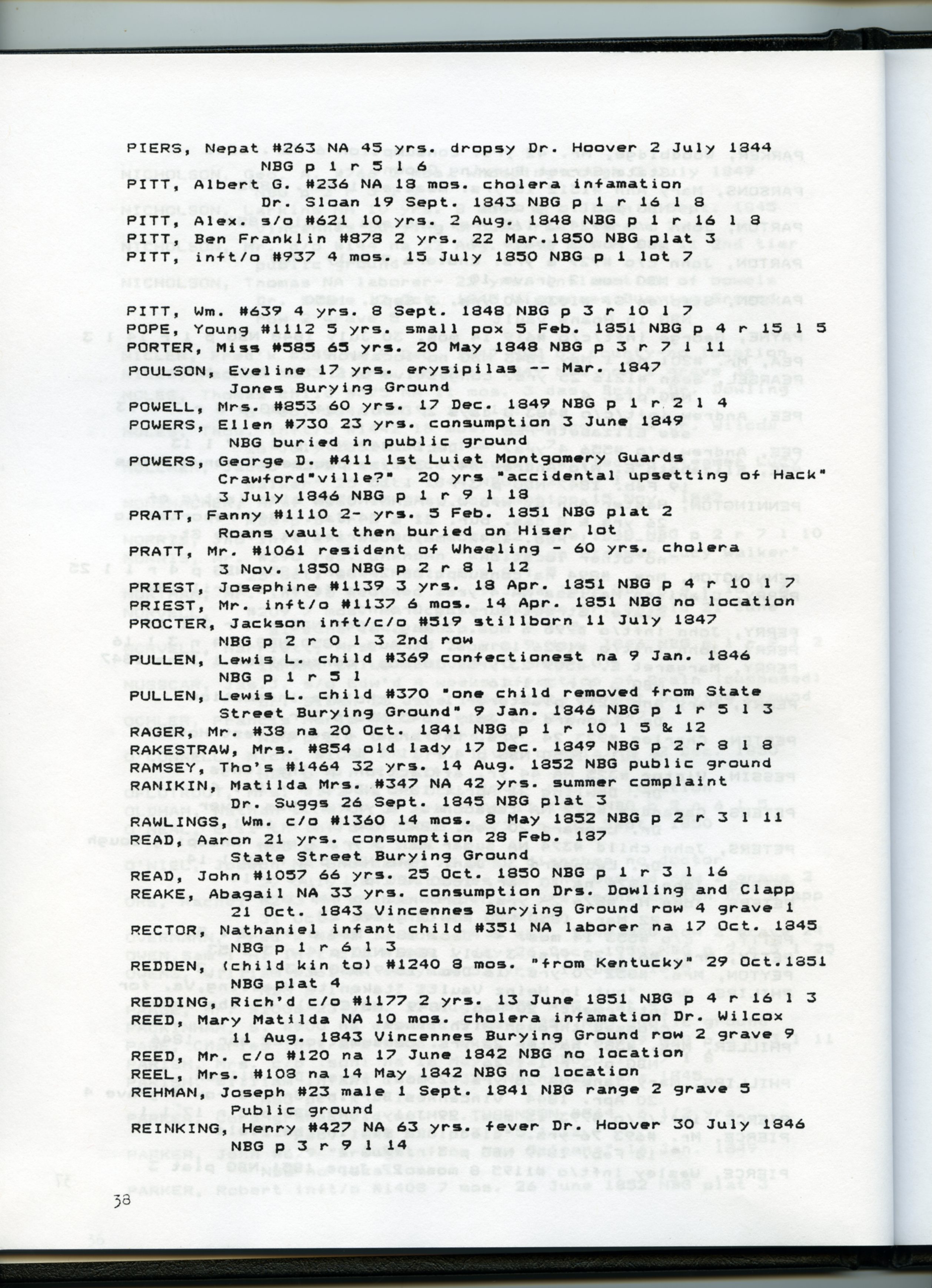
At last, I knew where Syntha had come from!  One day, while working, I came across a roll of microfilm labeled Fairview Cemetery Records, 1841-1864.  I thought this strange because the Southern Indiana Genealogical Society had indexed all of the Fairview Cemetery record books and their first index started in 1852.  So, like any history/genealogy obsessed, mystery loving librarian, I put the roll on and started to scroll through it.  I took note of some names and dates, doing a random sampling.  One of the pages that I happened to stop on was an interment record for a Mrs. Rakestraw who had been buried on December 17, 1849.  Even though this record said the cause of death was “old lady,” which actually made me picture an old lady beating her to death with a purse, and Syntha had died of consumption, I was sure this had to be her.  I included her name and interment date on my sample list.
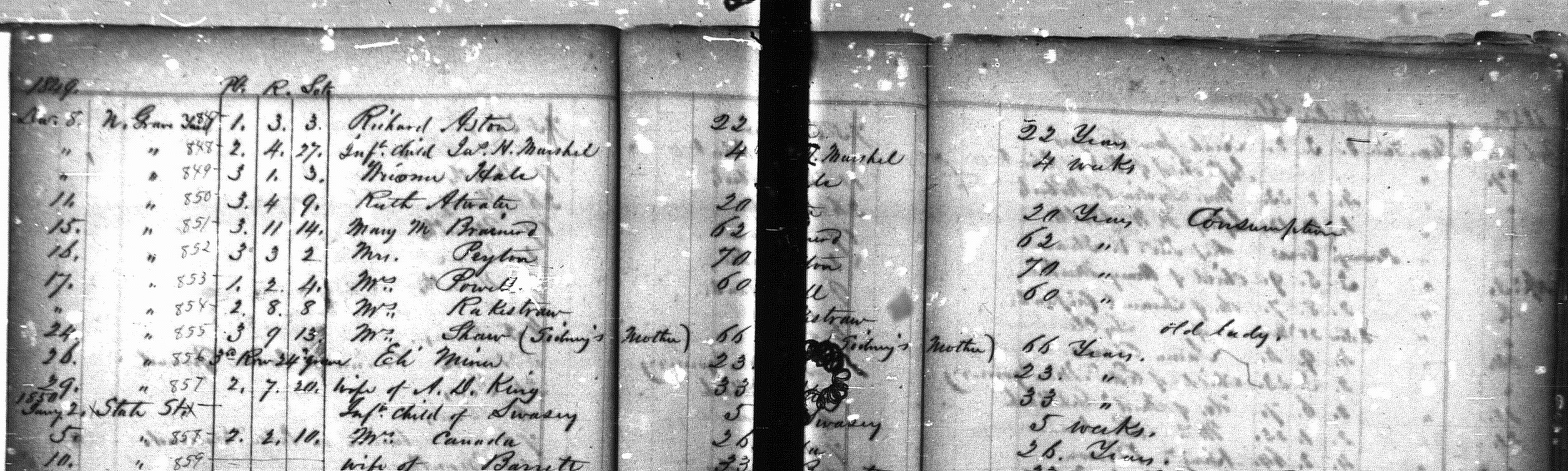
Fairview Cemetery Records, 1841-1864, microfilm, Stuart Barth Wrege Indiana History Room

Fairview Cemetery Records, 1841-1864, microfilm, Stuart Barth Wrege Indiana History Room

I began to go through the books on the cemetery index shelf to see if anything matched my sampling.  I finally found matching names in Persons Buried in the Ground by the City of New Albany, which was a transcription of records for burials at the State Street Burying Ground that were later moved to Fairview, and early Fairview burials.  Unfortunately, this didn’t clear up the Sintha/Syntha issue.

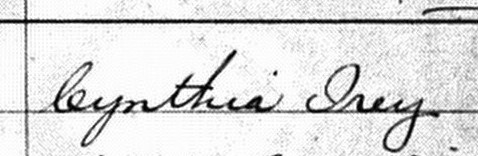
Then, last year, I decided to research my Rakestraw line to prove that they were here before December 31, 1840 to get a certificate from the Southern Indiana Genealogical Society’s First Families Program.  In so doing, I had a hard time proving that Milton was the son of Charles and Syntha.  I had to use a lot of siblings to prove connections.  One of the records I used was Rebecca Dowerman’s death record.  She was Milton’s sister, and her death record listed her parents names as Chas. Rakestraw and Cynthia Irey.  Cynthia.  Well, I guess I can see how that happened.  The informant may not have really known Rebecca’s mother’s name, or they might have said Syntha and the clerk heard it differently.  We all know how easily names can be butchered.  I still had no second source for proving how to spell her name.

After I had completed the research for the First Families Program, I made plans to go to Fairview and try to find Syntha’s tombstone.  My dad went with me.  He said he remembered visiting a bunch of ancestor’s graves with his mom and he thought he could remember where they were.  We did find a tombstone for Rebecca Dowerman with Cyntha Rakestraw also listed on it.  So, now I also had Cyntha in the mix.
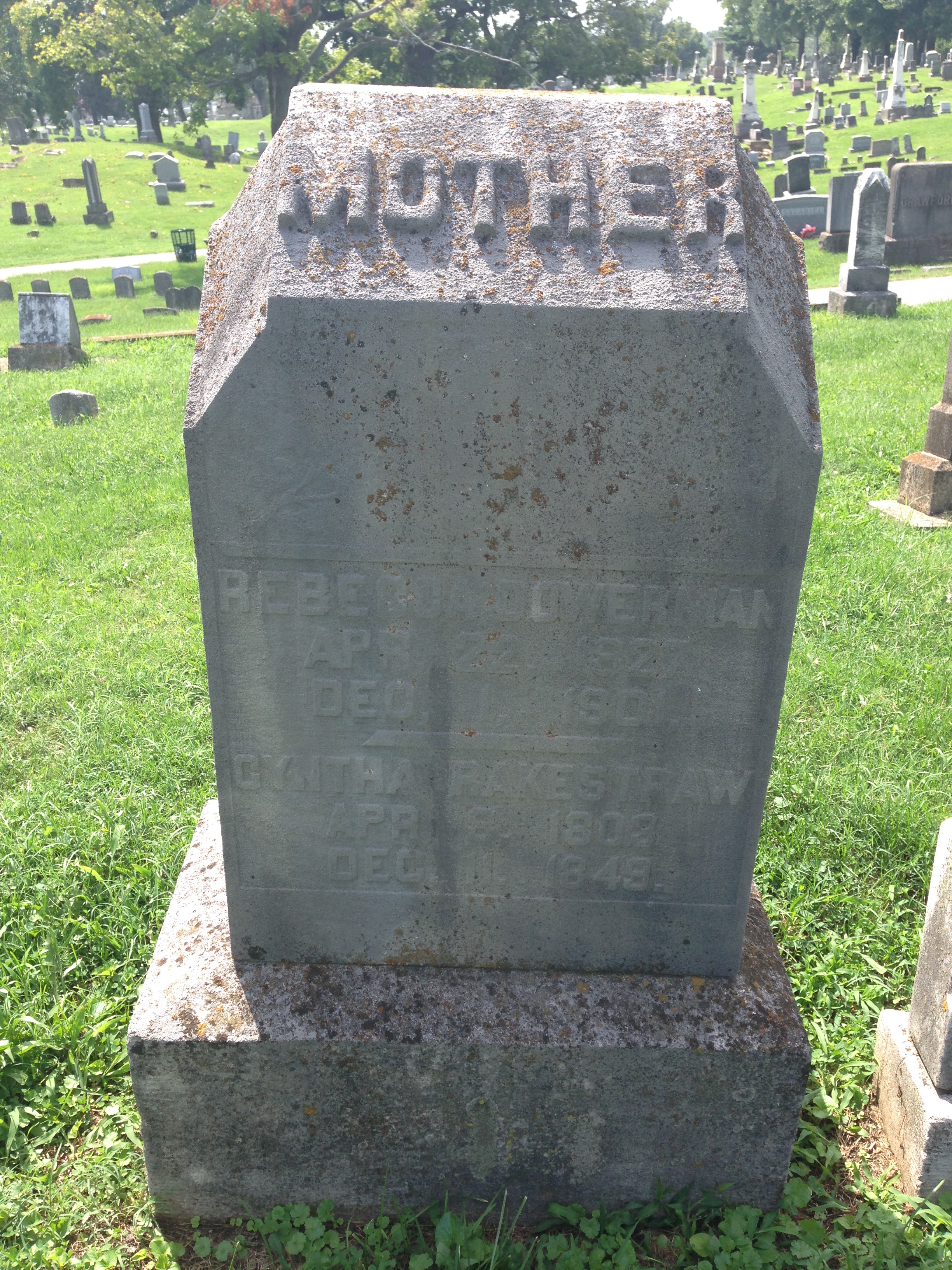
Tombstone, Rebecca Dowerman and Cyntha Rakestraw, Fairview Cemetery, photo taken by Melissa Wiseheart, 1 September 2014
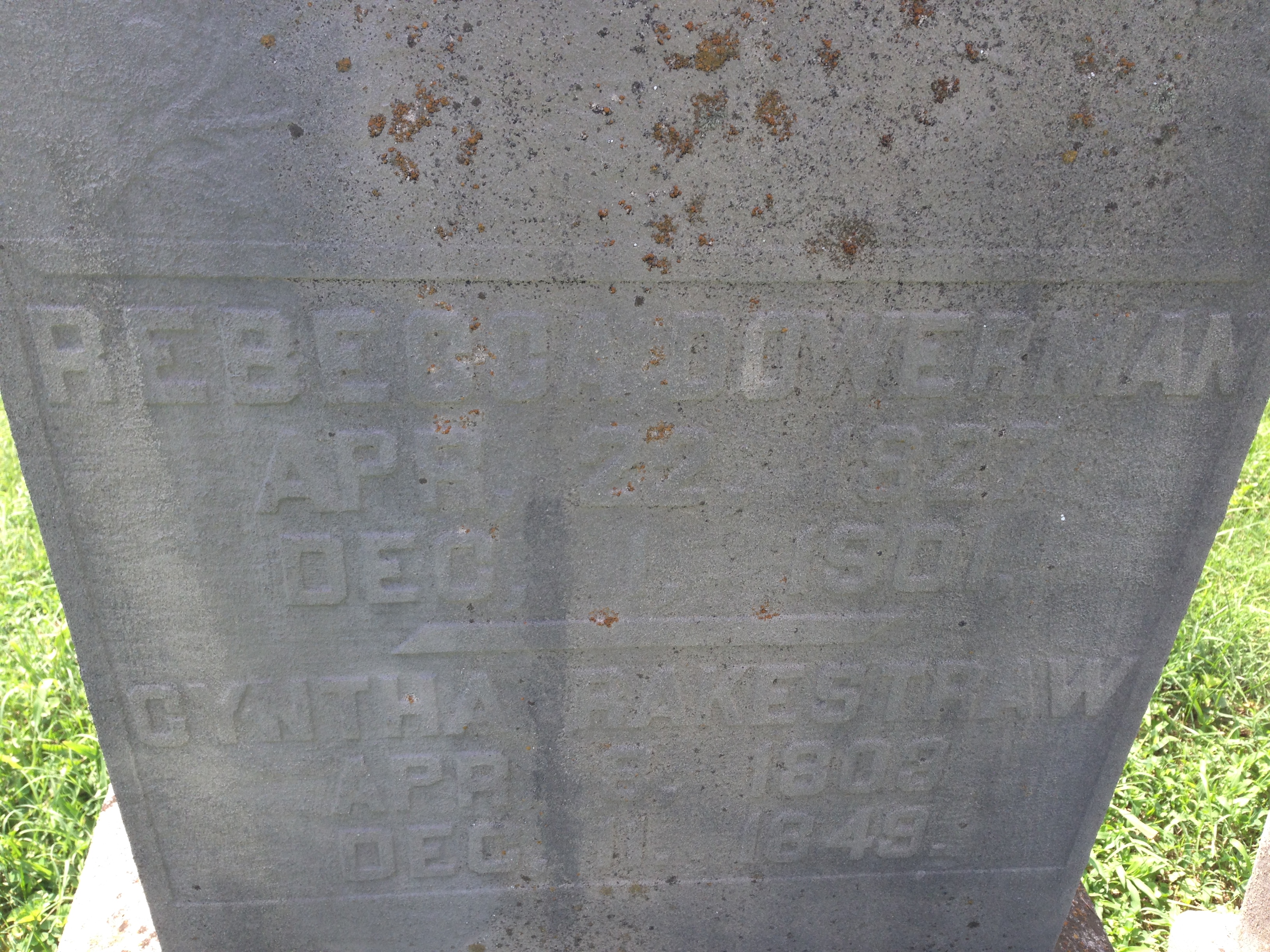
Tombstone, Rebecca Dowerman and Cyntha Rakestraw, Fairview Cemetery, photo taken by Melissa Wiseheart, 1 September 2014

Tombstone, Rebecca Dowerman and Cyntha Rakestraw, Fairview Cemetery, photo taken by Melissa Wiseheart, 1 September 2014

Tombstone, Rebecca Dowerman and Cyntha Rakestraw, Fairview Cemetery, photo taken by Melissa Wiseheart, 1 September 2014

A different name for every source.  In case you are having a hard time keeping track, here are the variations:

rakestraw, sintha 1850 mortality schedule crop copy

Rakestraw, Charles - Columbiana County, Ohio Marriages, Vol. 2, p103 copy

Last Will & Testament, Philip Irey, 1841

Dowerman, Rebecca - Floyd County, Indiana Deaths, Book H-4, page 50 - part 5 copy

2014-09-01 14.48.07 copy

I finally settled on Syntha because, in the absence of corroborating sources, I broke the name into parts and synthesized it in the most logical way I could think to.  I most frequently saw it spelled with an “S” instead of a “C.”  I most frequently saw it spelled “yn” over “in.”  I most frequently saw it spelled “tha” over “thy” or “thia.”  So, S-yn-tha.  Syntha.  It coincidentally agrees with the person who had rather harshly corrected me, but that didn’t influence my decision.  I’m always on the lookout for records and would be excited to see if something finally agrees with one of these spellings.

George William Rakestraw: The One with the Confusing Timeline (52 Ancestors #13)

George William Rakestraw was the brother of my great great grandmother, Zerilda Rakestraw Springer.  Unlike his sister, he is very well documented.  Even so, I’ve had a difficult time researching him.  He had an uncle who was also named George William, so he went by William or Willie, but he also had a son named William, who seemed to go by Willie as a child.  Willie also had a son, Charles Marion and a cousin, Charles Marion.  I understand wanting to honor family members, but at some point, it’s just too much.  After hours upon hours of searching, deciphering, and some math, I have Willie mostly figured out.

George William Rakestraw, circa 1900.

George William Rakestraw, circa 1900.

George William “Willie” Rakestraw was born on August 20, 1873 in New Albany, Indiana, to parents Francis Marion and Mary Elizabeth (Gilliland) Rakestraw.  He had dark hair and blue eyes.  He was the baby of the family, as his sister was five years older.

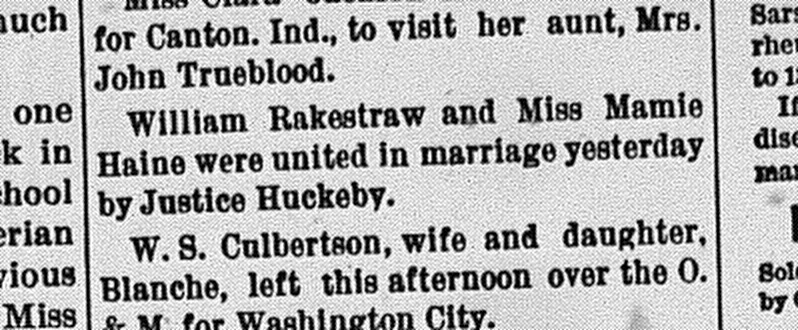
An article appeared in the New Albany Evening Tribune, saying that Willie had married a Mamie Haine on February 2, 1891.

New Albany Evening Tribune, Tuesday, 3 February 1891, p. 4, column 3, Stuart Barth Wrege Indiana History Room

New Albany Evening Tribune, Tuesday, 3 February 1891, p. 4, column 3, Stuart Barth Wrege Indiana History Room

I could not find a marriage record for them in Floyd county, surrounding counties, or Illinois, where I though Mamie might be from.  Willie would’ve been seventeen at the time, so he also would’ve needed parental permission to marry.

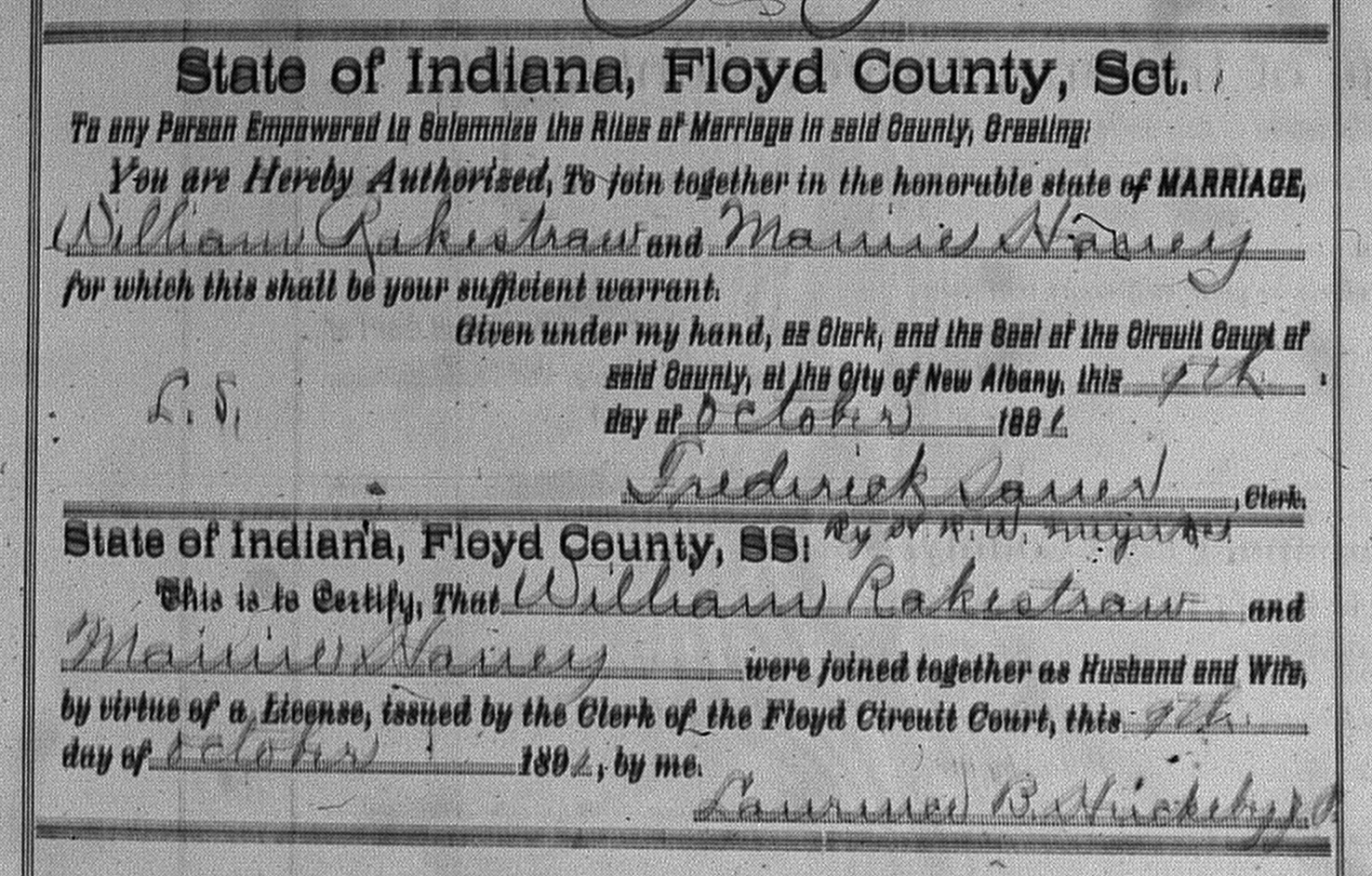
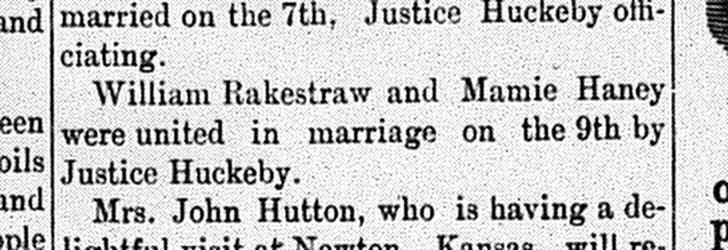
I did find that Willie married Mamie Haney in Floyd County, Indiana on October 9, 1891.  It also appeared in the paper the following day.

Floyd County, Indiana Marriages, Vol. 10, p. 55, Stuart Barth Wrege Indiana History Room

Floyd County, Indiana Marriages, Vol. 10, p. 55, Stuart Barth Wrege Indiana History Room

New Albany Daily Ledger, Saturday, 10 October 1891, p. 4, column 3, Stuart Barth Wrege Indiana History Room

New Albany Daily Ledger, Saturday, 10 October 1891, p. 4, column 3, Stuart Barth Wrege Indiana History Room

It seems their honeymoon period was short-lived because the paper on October 24, 1891 reports that Mamie had filed suit against Willie for support.

New Albany Daily Ledger, Saturday, 24 October 1891, p. 8, columns 2-3, Stuart Barth Wrege Indiana History Room

New Albany Daily Ledger, Saturday, 24 October 1891, p. 8, columns 2-3, Stuart Barth Wrege Indiana History Room

I couldn’t find what became of that suit, but I believe that Mamie went to Illinois without Willie and was pregnant at the time.  I’ve looked at several family trees that say Mamie gave birth to Otto William Rakestraw in Mound City, Illinois on December 25, 1891.  I have a copy of a photo of Otto Rakestraw that I got from my grandfather, but I have no proof of his relationship.  I’ve sent letters out to try and obtain a copy of a birth record and I hope to hear from someone soon.  Willie is listed as being in New Albany in both the 1890 and 1892 Caron’s City Directories, which is how I know he didn’t go with Mamie.

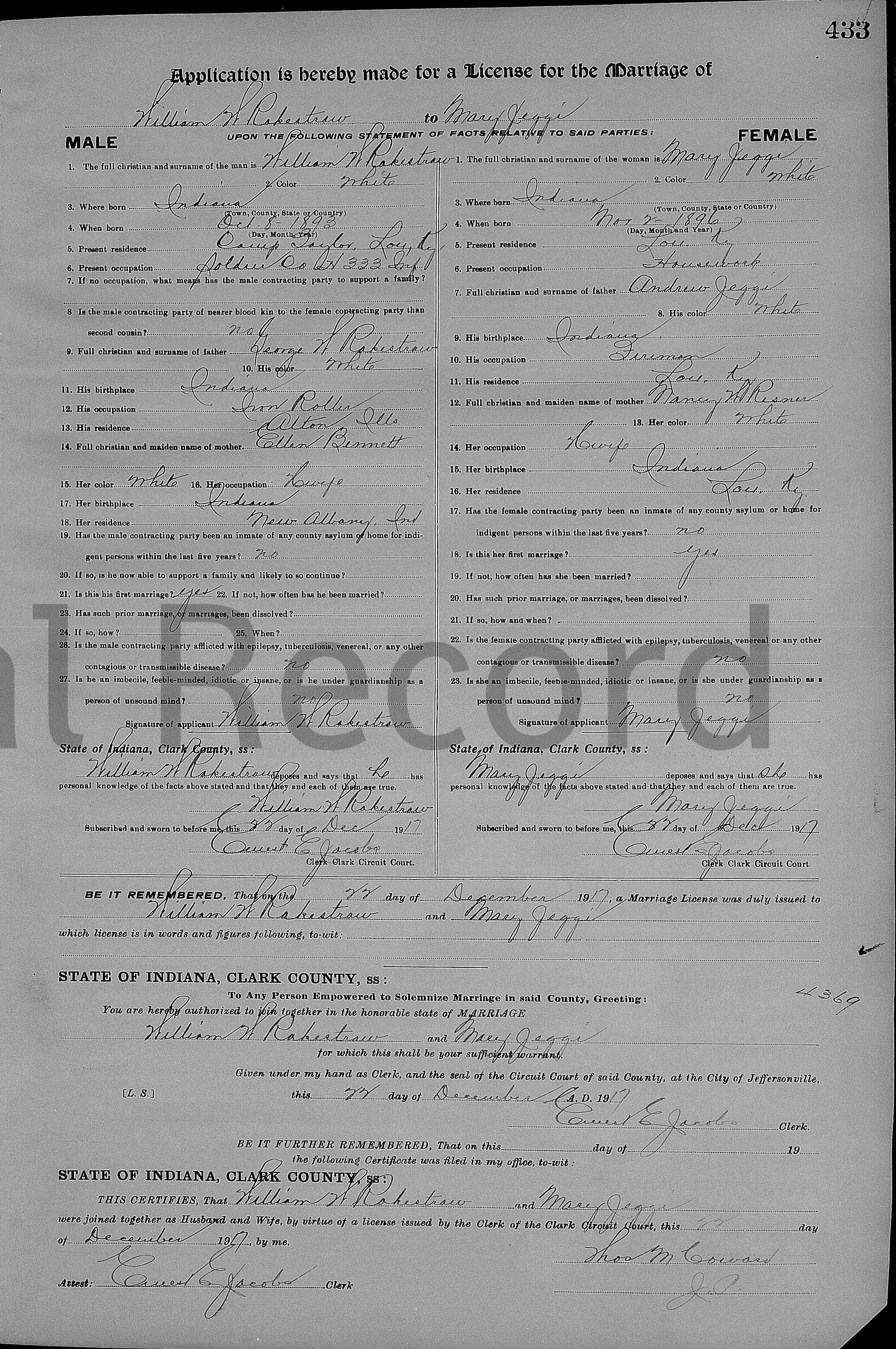
Here is where the timeline gets messy.  That’s right, it wasn’t messy before.  On October 8, 1893, William W. Rakestraw was born, the son of Willie by Lillian Margaret Bennett.  At least, according to both of William W.’s marriage records (1917 and 1933).  The 1900 Census and the transcription of the Rakestraw Family Bible both give October 8, 1894.  I’m inclined to believe the marriage records, as Census are often wrong and I don’t have access to the original Rakestraw Family Bible to know if there were any transcription errors.  There is no birth record on file for him, and his death record gives his birth date as October 8, 1898 (I’m thinking this was written by the informant as 1893 and misread by the clerk as 1898).  I’m still holding out hope for a primary source to prove one or the other.

In those same family trees that mention Otto’s birth, it is written that Willie and Mamie were granted a divorce from Mound City on October 23, 1893.  I have inquiries out on this as well, but it seems logical to me that infidelity would cause Mamie to file for divorce.

Willie married Lillie Bennett on April 14, 1894 in Floyd County, Indiana.

Floyd County, Indiana Marriages, Vol. 10, p. 363, Stuart Barth Wrege Indiana History Room

Floyd County, Indiana Marriages, Vol. 10, p. 363, Stuart Barth Wrege Indiana History Room

There are articles (I’ll get to them in a bit) that give marriage dates of January and April 1893, but since Willie and Mamie were still married that wouldn’t be possible, or at least not legal.  I also couldn’t find any marriage records for Willie and Lillie on those dates.

Charles Marion Rakestraw was born on January 22, 1896 in New Albany, Indiana.  He is the second son of Willie and Lillie.

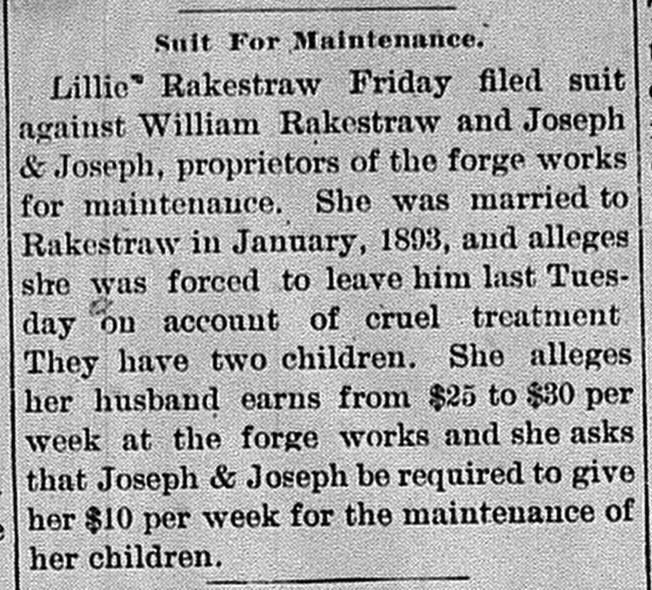
Things go downhill for Willie and Lillie the following year.  On April 9, 1897, Lillie filed suit against Willie for maintenance.  The suit was dismissed on June 11, 1897.

New Albany Weekly Tribune, Friday, 9 April 1897, p. 7, column 2, Stuart Barth Wrege Indiana History Room

New Albany Weekly Tribune, Friday, 9 April 1897, p. 7, column 2, Stuart Barth Wrege Indiana History Room

New Albany Weekly Tribune, Friday, 11 June 1897, p. 7, column 4, Stuart Barth Wrege Indiana History Room

New Albany Weekly Tribune, Friday, 11 June 1897, p. 7, column 4, Stuart Barth Wrege Indiana History Room

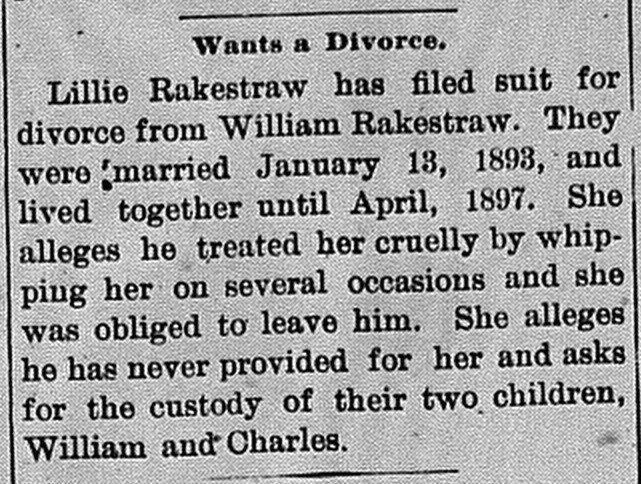
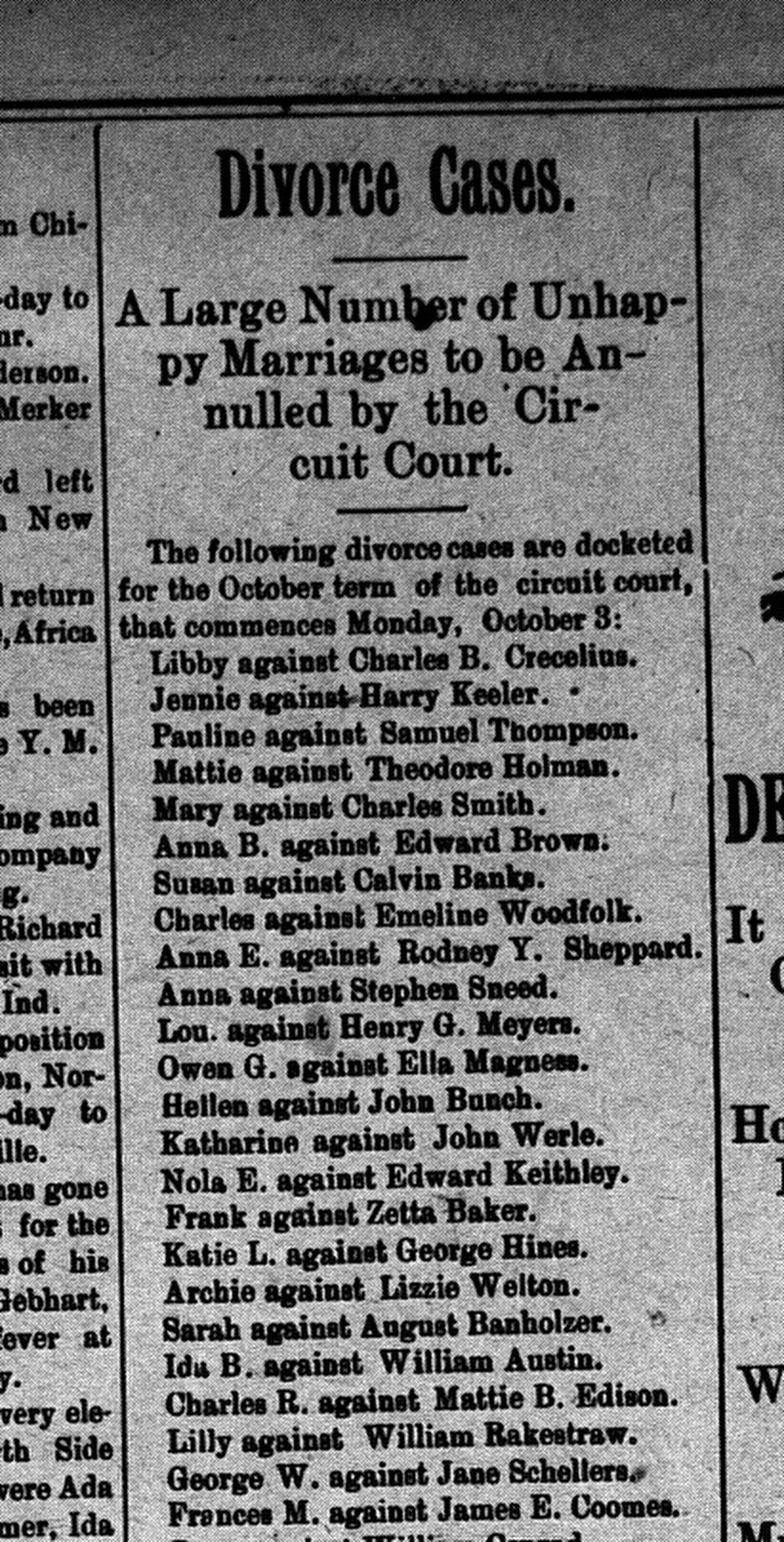
Lillie then filed for divorce on December 1, 1897.  This must have been a long process.  It was listed on the court docket on January 14, 1898 and then again on October 1, 1898 and still the divorce was not granted.

New Albany Daily Ledger, Wednesday, 1 December 1897, p. 4, column 4, Stuart Barth Wrege Indiana History Room

New Albany Daily Ledger, Wednesday, 1 December 1897, p. 4, column 4, Stuart Barth Wrege Indiana History Room

New Albany Weekly Tribune, Friday, 3 December 1897, p. 5, column 2, Stuart Barth Wrege Indiana History Room

New Albany Weekly Tribune, Friday, 3 December 1897, p. 5, column 2, Stuart Barth Wrege Indiana History Room

New Albany Weekly Tribune, Friday, 14 January 1898, p. 7, column 4, Stuart Barth Wrege Indiana History Room

New Albany Weekly Tribune, Friday, 14 January 1898, p. 7, column 4, Stuart Barth Wrege Indiana History Room

New Albany Daily Ledger, Saturday, 1 October 1898, p. 4, column 5, Stuart Barth Wrege Indiana History Room

New Albany Daily Ledger, Saturday, 1 October 1898, p. 4, column 5, Stuart Barth Wrege Indiana History Room

On February 20, 1899, Louise Rakestraw was born.  Three weeks later, Lillie petitioned to dismiss the divorce case.

New Albany Daily Ledger, Tuesday, 14 March 1899, p. 4, column 4, Stuart Barth Wrege Indiana History Room

New Albany Daily Ledger, Tuesday, 14 March 1899, p. 4, column 4, Stuart Barth Wrege Indiana History Room

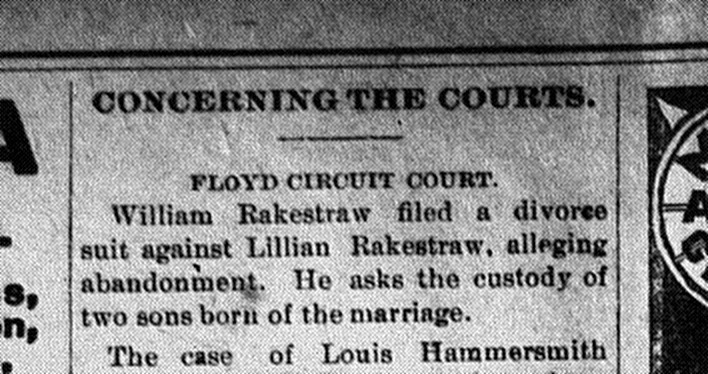
On May 24, 1899, Willie filed for divorce and it was granted by the court on June 17, 1899.  He asked for and was granted custody of William and Charles.

New Albany Daily Ledger, Wednesday, 24 May 1899, p. 4, column 2, Stuart Barth Wrege Indiana History Room

New Albany Daily Ledger, Wednesday, 24 May 1899, p. 4, column 2, Stuart Barth Wrege Indiana History Room

New Albany Public Press, Wednesday, 31 May 1899, p. 4, column 3, Stuart Barth Wrege Indiana History Room

New Albany Public Press, Wednesday, 31 May 1899, p. 4, column 3, Stuart Barth Wrege Indiana History Room

New Albany Daily Ledger, Saturday, 17 June 1899, p. 4, column 1, Stuart Barth Wrege Indiana History Room

New Albany Daily Ledger, Saturday, 17 June 1899, p. 4, column 1, Stuart Barth Wrege Indiana History Room

Lillie and baby Louise went to live with Lillie’s mother.  Willie, William, and Charles moved in with Willie’s parents and his niece, Mildred Springer.

On June 5, 1902, Willie married Lorena Bender in Louisville, Kentucky.  By 1910, Willie and Lorena were living in Madison County, Illinois, but William and Charles were still living with Willie’s parents.  Charles did spend some time in Illinois with his dad, as this letter, dated December 15th, indicates.

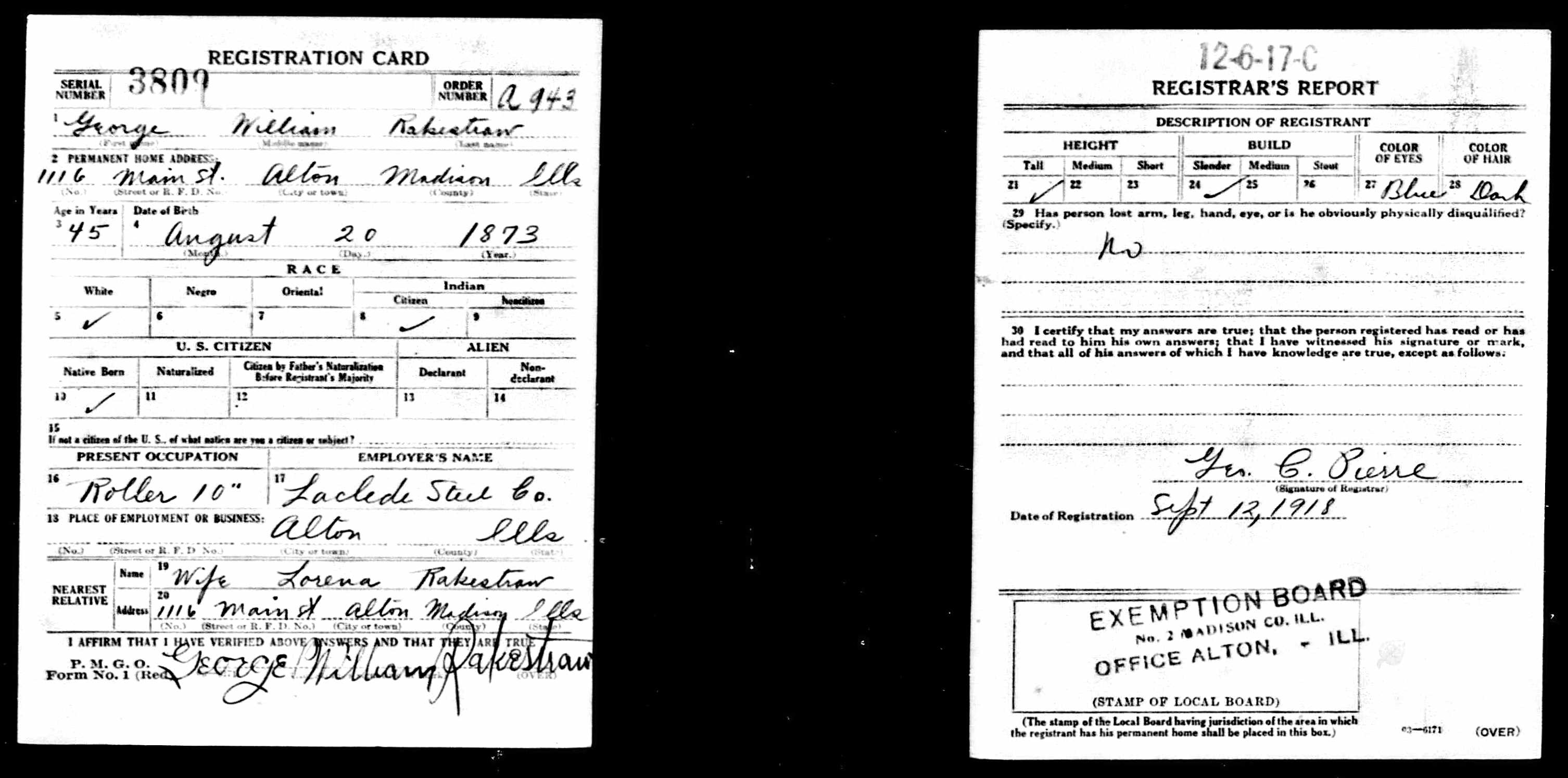
Willie and Lorena moved to Louisville at some point after 1918 (Willie’s draft registration shows he was still in Illinois).  Willie and William ran a music store in Louisville until Willie’s death in 1935.

Tombstone, Cave Hill Cemetery, Louisville, Jefferson, Kentucky, George William Rakestraw, 1874-1935, photo courtesy of Rob M, Findagrave.com

Tombstone, Cave Hill Cemetery, Louisville, Jefferson, Kentucky, George William Rakestraw, 1874-1935, photo courtesy of Rob M, Findagrave.com

I still have to wonder about Otto and Louise.  Why did Willie not seek custody for either of them?  Why didn’t he even acknowledge them?  With all of my grandfather’s stories that had been passed down through the Rakestraw family, I had never heard of either one until I started researching Willie.  William’s obituary said that he was survived by a sister, Louise, so I suppose he must have had some contact with her.  I guess these are questions to which I may never know the answers.

Zerilda Rakestraw: Almost a Ghost (52 Ancestors #11)

If I had only official documents to go on, I’d know next to nothing about my great great grandmother.  Using the usual vitals, census, and obituary, her life could be summed up as follows.  Zerilda Eleanora Rakestraw was born circa 1869, the daughter of Francis Marion and Mary Elizabeth (Gilliland) Rakestraw.  She married Frank Springer on February 28, 1892.  She gave birth to Mildred Gertrude Springer on November 20, 1892.  She died of consumption on June 13, 1894 and was buried at Fairview Cemetery.

The biggest hurdles I had in my research were the lack of official documents.  The state of Indiana didn’t require birth records until 1882.  There was no birth record.  The 1890 Census would’ve been the first census to list her occupation.  There is no surviving copy of the 1890 Census for Indiana.  For reasons I can’t fathom, her death was never reported to the city or the county Health Department.  No death record.  Another hurdle was that Zerilda changed her name, and not legally.

Fortunately, I had some good information from my grandfather, who had heard it from Zerilda’s mother.  There are also a handful of more unconventional records for her.  Additionally, the Rakestraws saved a lot of things, for which I am eternally grateful.  And now, I present the life of Zerilda Rakestraw, as complete as I believe it will ever be.

1868

Serralda Ella Nora Rakestraw was born on  June 5, 1868 in New Albany, Indiana to parents Francis Marion and Mary Elizabeth (Gilliland) Rakestraw.  (This is according to a transcription of the Rakestraw Family Bible.  I don’t know where the Bible is currently located.  I have been spelling it Zerilda Eleanora based on the official documents that bear her name.  I’ve been thinking about whether or not I should change how I write it).

1870

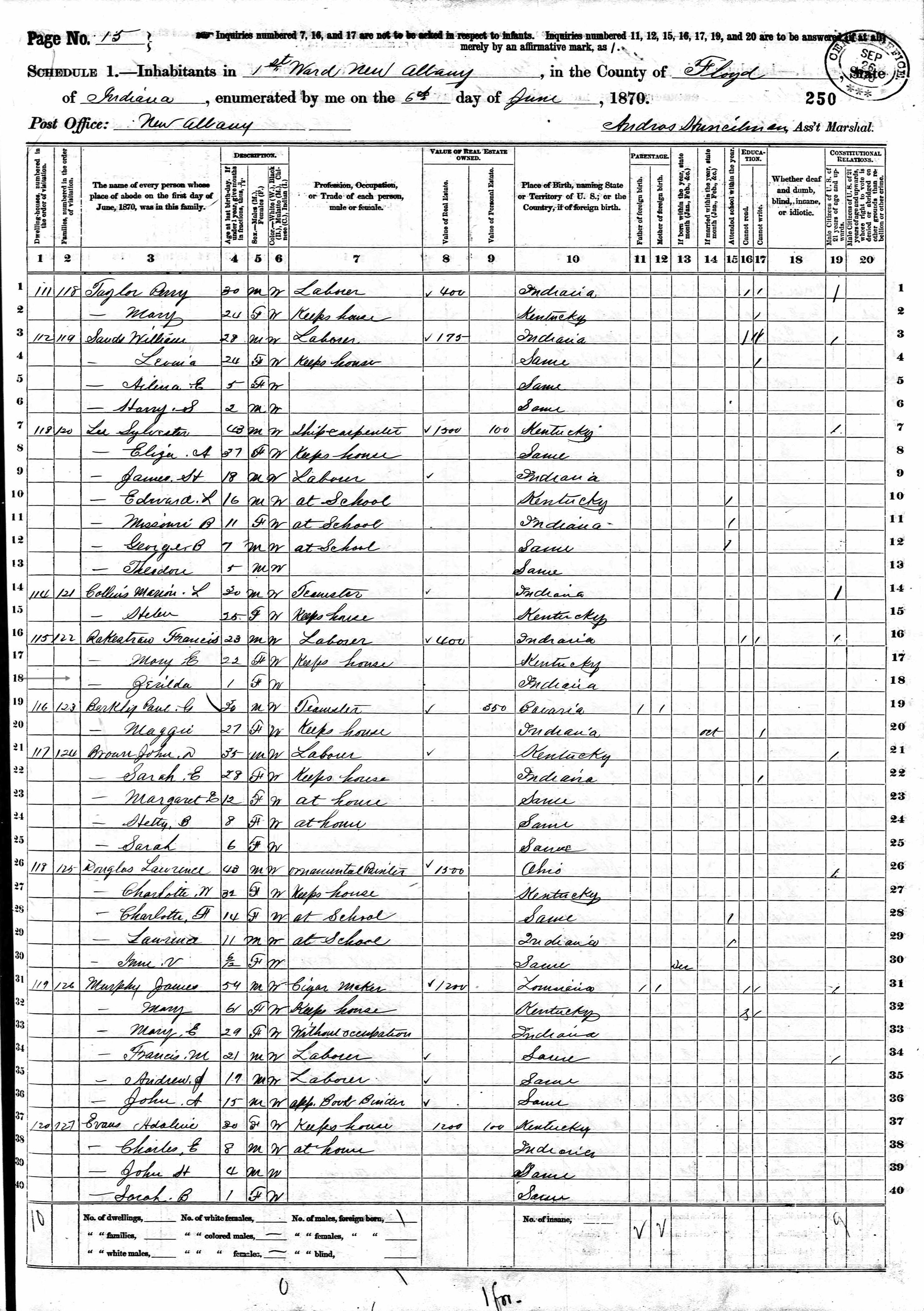
She appears on the Census, with her parents, as Zerilda, age 1.

1880

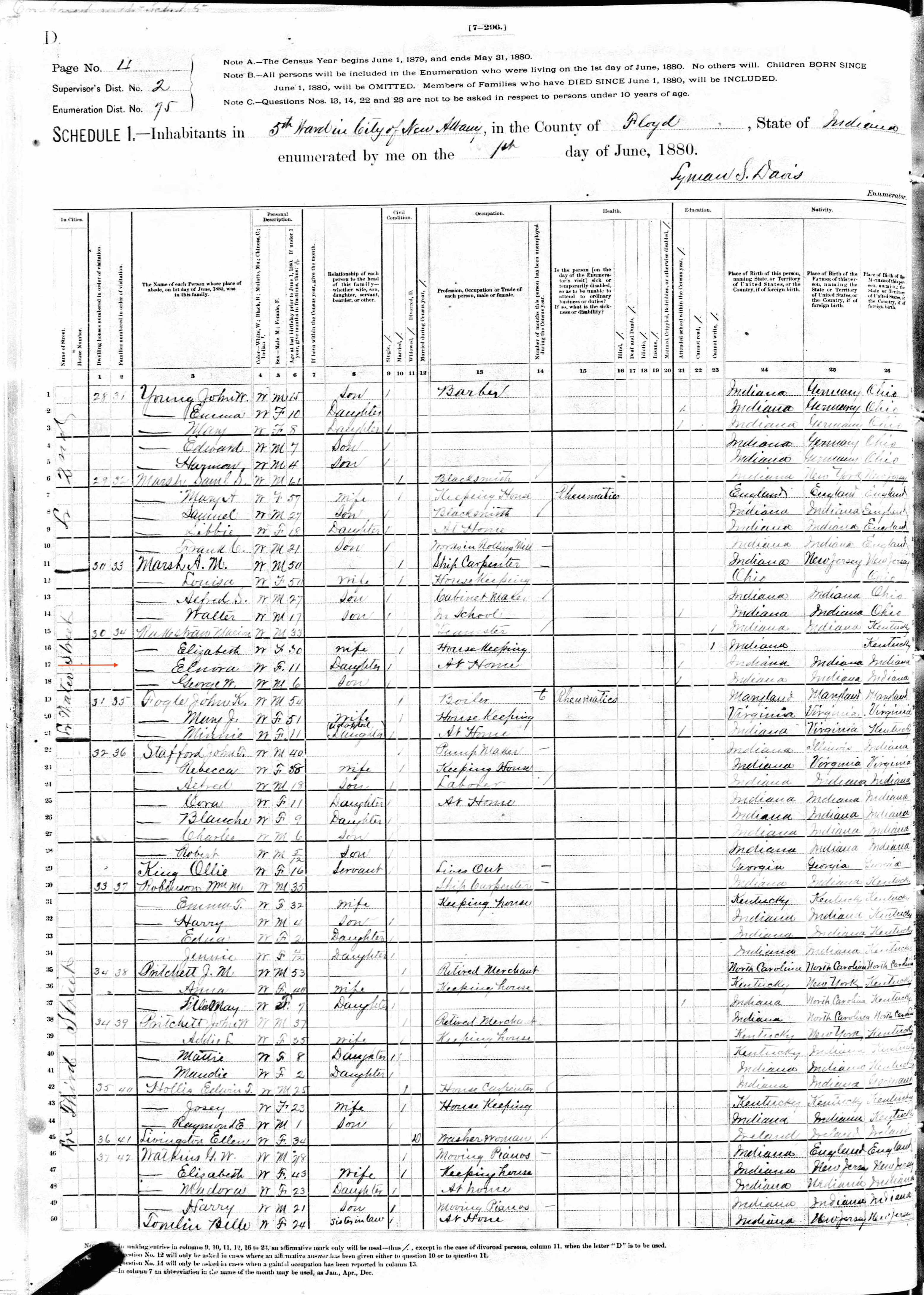
On the Census, she is living with her parents and her younger brother.  She is listed as Elnora, age 11.

1890 (ish)

Here, I have no documentation.  My grandfather said that she taught school in Louisville for a year or so before she married.  I could not find any mention of her in New Albany or Louisville City Directories.  He also said that she hated her first name and, as an adult, decided to go by Ella Nora Rakestraw.  This may have started before adulthood, since she seems to have gone by her middle name(s) on the 1880 Census.  I have a couple of photos to share here.

Zerilda Eleanora Rakestraw (ca. 1890)

Zerilda Eleanora Rakestraw (ca. 1890)

Grandpa said this is the photo she had taken for the school.  Presumably for a yearbook or similar type of thing.

Zerilda Rakestraw's desk bell.  Purchased circa 1890.

Zerilda Rakestraw’s desk bell. Purchased circa 1890.

1891

By December of 1891, Ella had met Frank Springer.  It would seem that they were long-distance courting by this letter from Frank, dated December 17, 1891.

1892

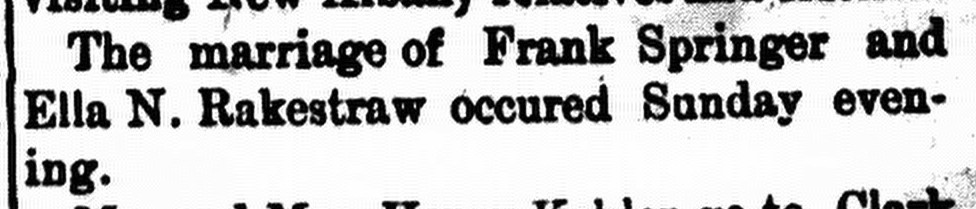
Frank and Ella were married on February 28, 1892.

Frank Springer and Ella Rakestraw Marriage License

Frank Springer and Ella Rakestraw Marriage License

Floyd County, Indiana Marriages, Volume 10, p.114, Stuart Barth Wrege Indiana History Room

Floyd County, Indiana Marriages, Volume 10, p.114, Stuart Barth Wrege Indiana History Room

New Albany Daily Ledger, 29 February 1892, p.4, column 6, Stuart Barth Wrege Indiana History Room

New Albany Daily Ledger, Monday, 29 February 1892, p.4, column 6, Stuart Barth Wrege Indiana History Room

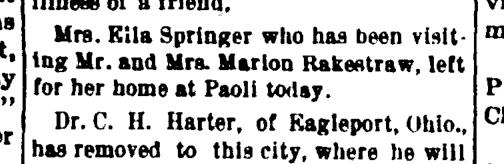
Within a week, Frank and Ella had moved to his brother’s farm, outside of Paoli, Indiana.

Paoli Republican, Wednesday, 9 March 1892, p.3, column 5, NewspaperArchive.com

Paoli Republican, Wednesday, 9 March 1892, p.3, column 5, NewspaperArchive.com

Ella’s mother, Mary, wrote to her on March 23, 1892.  After receiving this letter, Ella wrote back, saying that she was very sick.  She had weak spells and was often sick to her stomach.

In April, Ella received a letter from her cousin Othela, congratulating her on her marriage to Frank and expressing concern for her illness.

Sometime in May, Ella had gone back to New Albany to stay with her parents, probably having realized that she was pregnant and would need her mother’s help.  Frank wrote to her shortly after her arrival.

It seems that Frank visited from time to time, but didn’t stay long.  From a letter written circa June 1892 and a letter dated July 3, 1892, it is evident that Ella’s mother did not want Frank around.

On November 20, 1892, Ella gave birth to a daughter, Mildred Gertrude Springer.  Frank was present for the birth of his daughter, as this letter dated November 27, 1892, suggests.

In December, both Ella and baby Mildred were sick.

Zerilda Springer, circa 1892.

Zerilda Springer, circa 1892.

Unfortunately, I’ve only been able to find this photocopy and not the original.  Since the quality is so bad, I cannot tell if this is just Ella, or if Mildred is perhaps in a bassinet to the left.

1893

In a letter dated January 22, 1893, Frank writes that he is sorry to hear that Ella and the baby are both still sick.  He also writes that he will come for them when the weather is better.

New Albany Evening Tribune, Thursday, 23 March 1893, p.4, column 2, NewspaperArchive.com

New Albany Evening Tribune, Thursday, 23 March 1893, p.4, column 2, NewspaperArchive.com

Here the letters have stopped and it would seem that Ella was home with Frank from here on, however, she must have gone back to stay with her parents before the end of May in 1894.  And, in researching Frank’s story, I learned that he did leave home sometime in 1893 for the World’s Fair in Chicago, so it makes sense that Ella would not stay alone on the farm with the baby.

1894

New Albany Evening Tribune, Friday, 25 May 1894, p.3, column 2, NewspaperArchive.com

New Albany Evening Tribune, Friday, 25 May 1894, p.3, column 2, NewspaperArchive.com

New Albany Daily Ledger, Friday, 26 May 1894, p.5, column 3, Stuart Barth Wrege Indiana History Room

New Albany Daily Ledger, Friday, 26 May 1894, p.5, column 3, Stuart Barth Wrege Indiana History Room

This one should read “adoption of Mildred G. Springer,” but as we all know, the papers sometimes get things wrong.

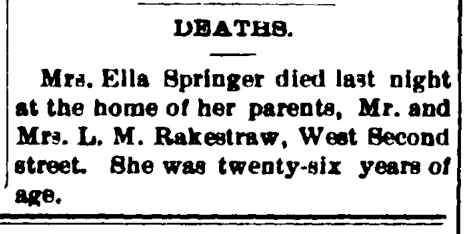
On June 13, 1894, just two and a half weeks after her parents adopted Mildred, Ella died of consumption.  She was buried at Fairview Cemetery in New Albany, Indiana.

New Albany Evening Tribune, Thursday, 14 June 1894, p.4, column 2, Stuart Barth Wrege Indiana History Room

New Albany Evening Tribune, Thursday, 14 June 1894, p.4, column 2, Stuart Barth Wrege Indiana History Room

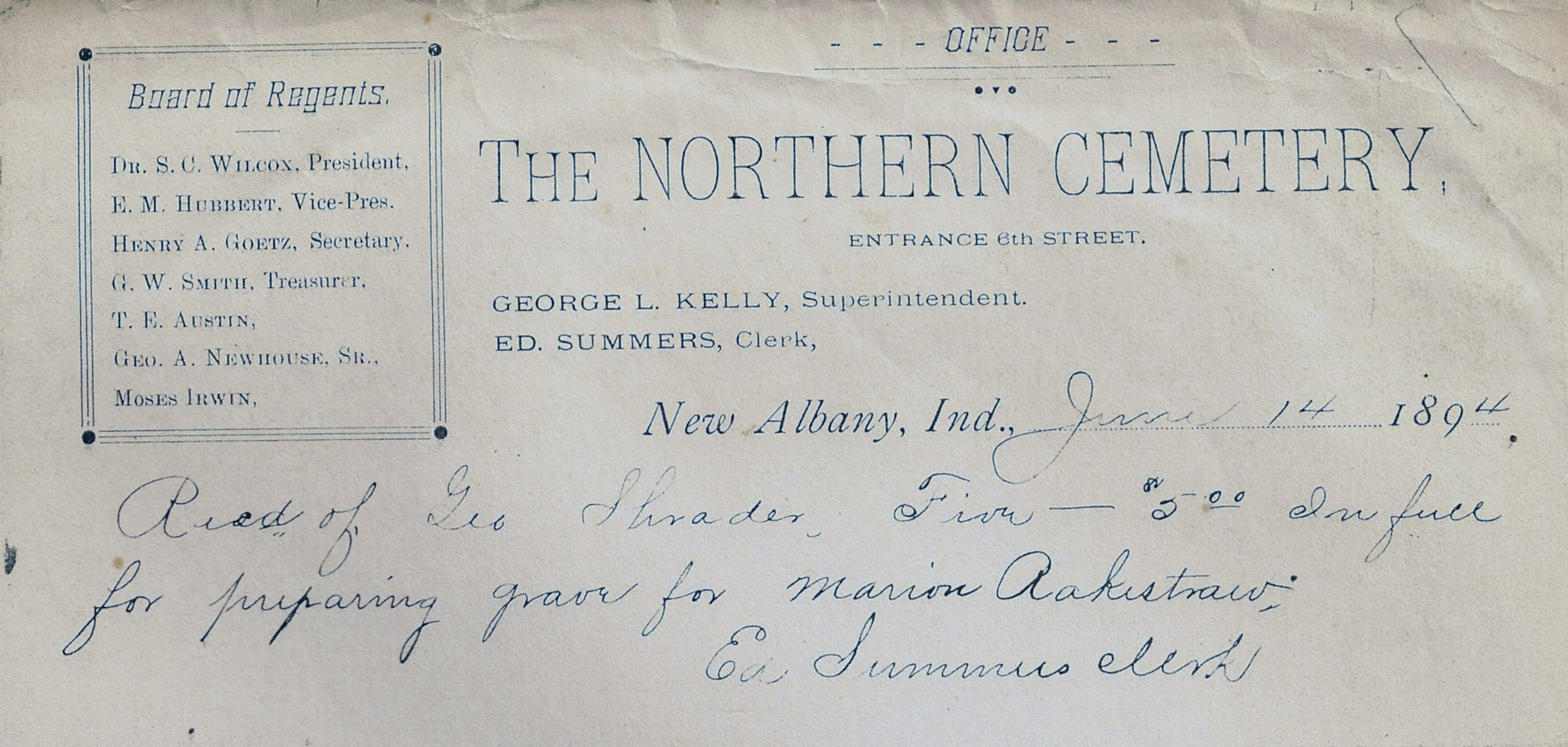
Receipt from The Northern Cemetery (Fairview Cemetery) for payment on grave preparations.

Receipt from The Northern Cemetery (Fairview Cemetery) for payment on grave preparations.

Fairview Cemetery Index, Volume 4, p.71, Stuart Barth Wrege Indiana History Room

Fairview Cemetery Index, Volume 4, p.71, Stuart Barth Wrege Indiana History Room

It took me quite some time to find her in Fairview, as her tombstone reads “Ellen N. Springer” and Frank is not buried there.

Tombstone of Ella Springer, Fairview Cemetery, photo courtesy of Douser, Findagrave.com

Tombstone of Ella Springer, Fairview Cemetery, photo courtesy of Douser, Findagrave.com

So ends the short life of Zerilda Eleanora (Rakestraw) Springer.

Sanford Wiseheart: Wise, Resourceful, and Industrious (52 Ancestors #09)

“Pap used to say, ‘If you can’t find work, make work.'”  These are words I frequently heard from my grandpa about his father.

Sanford Wesley “Sandy” Wiseheart was born on October 30, 1890 in Elizabeth, Indiana to parents William Henry and Frances Lydia “Fannie” (Browning) Wiseheart.  In the 1910 Census, he was still living with his parents.  He was a peddler working on his own account and owned his own wagon.  Grandpa told me that when his dad was younger he used to buy things in town and load them up on a wagon and sell them at a slight profit to the people who couldn’t make it into town.

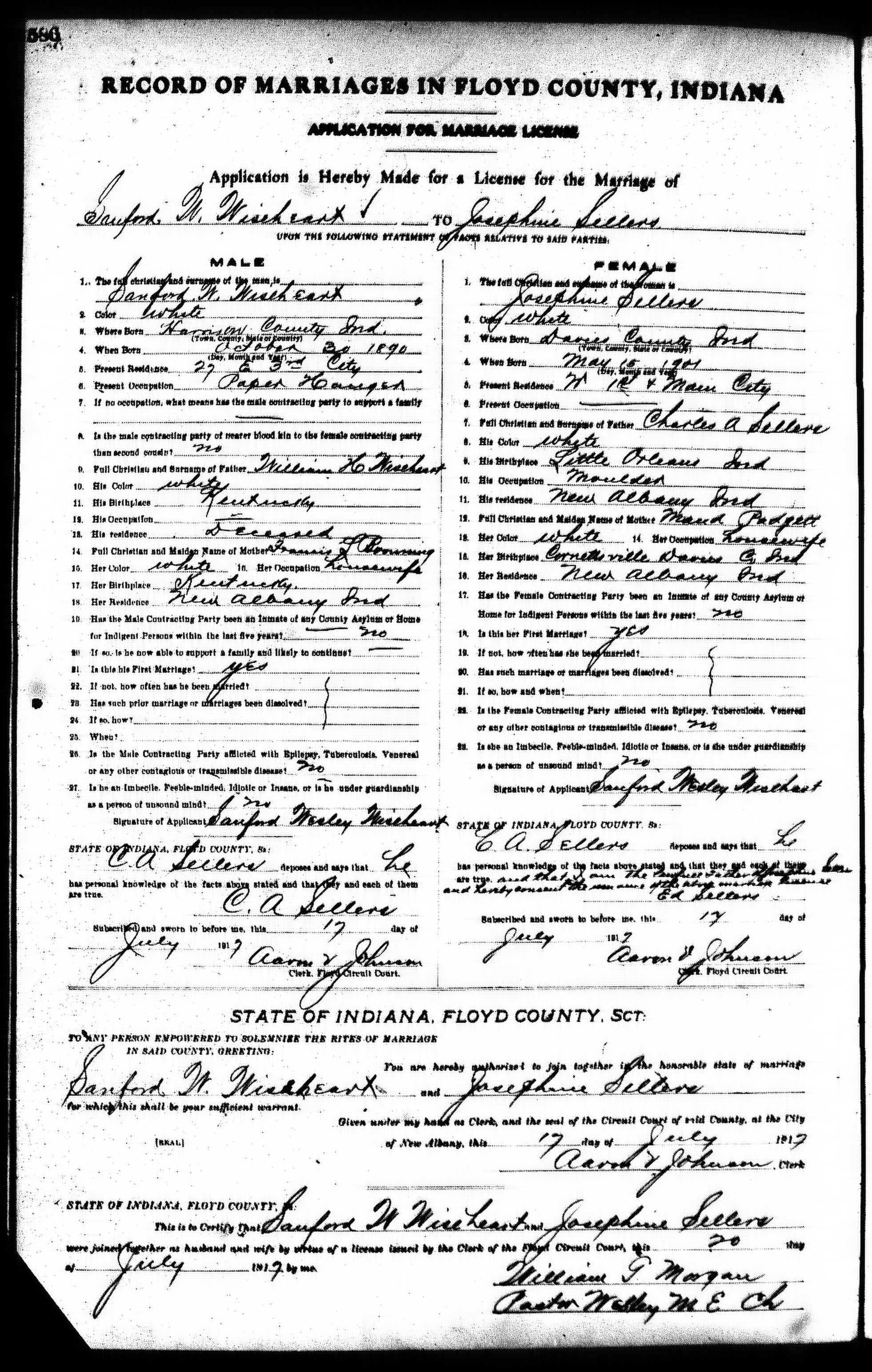
In 1917, Sandy filled out a Draft Registration Card.  His occupation was “driver for David Brubeck.”  According to the 1917 New Albany City Directory, David Brubeck was the owner of Brubeck Ice Cream Company.  About a month later, on Sandy’s marriage application with his first wife, his occupation is listed as paper hanger, that is one who hangs wallpaper.

In August of 1918, Sandy went to France and served in the occupation of Privenelle Sector, west of Moselle (Second Army Offensive).

Sanford Wesley Wiseheart (ca. 1914)

Sanford Wesley Wiseheart (ca. 1918)

While there, he was a medical transporter in Field Hospital 22.  He frequently wrote to his mother and to his friend, Mildred Springer.  One such letter contained the following:

if you could of saw what I have over here you would learn that there is no use to worry about anything we must just keep a brave heart and meet our trouble half way for we cannot change what must be.

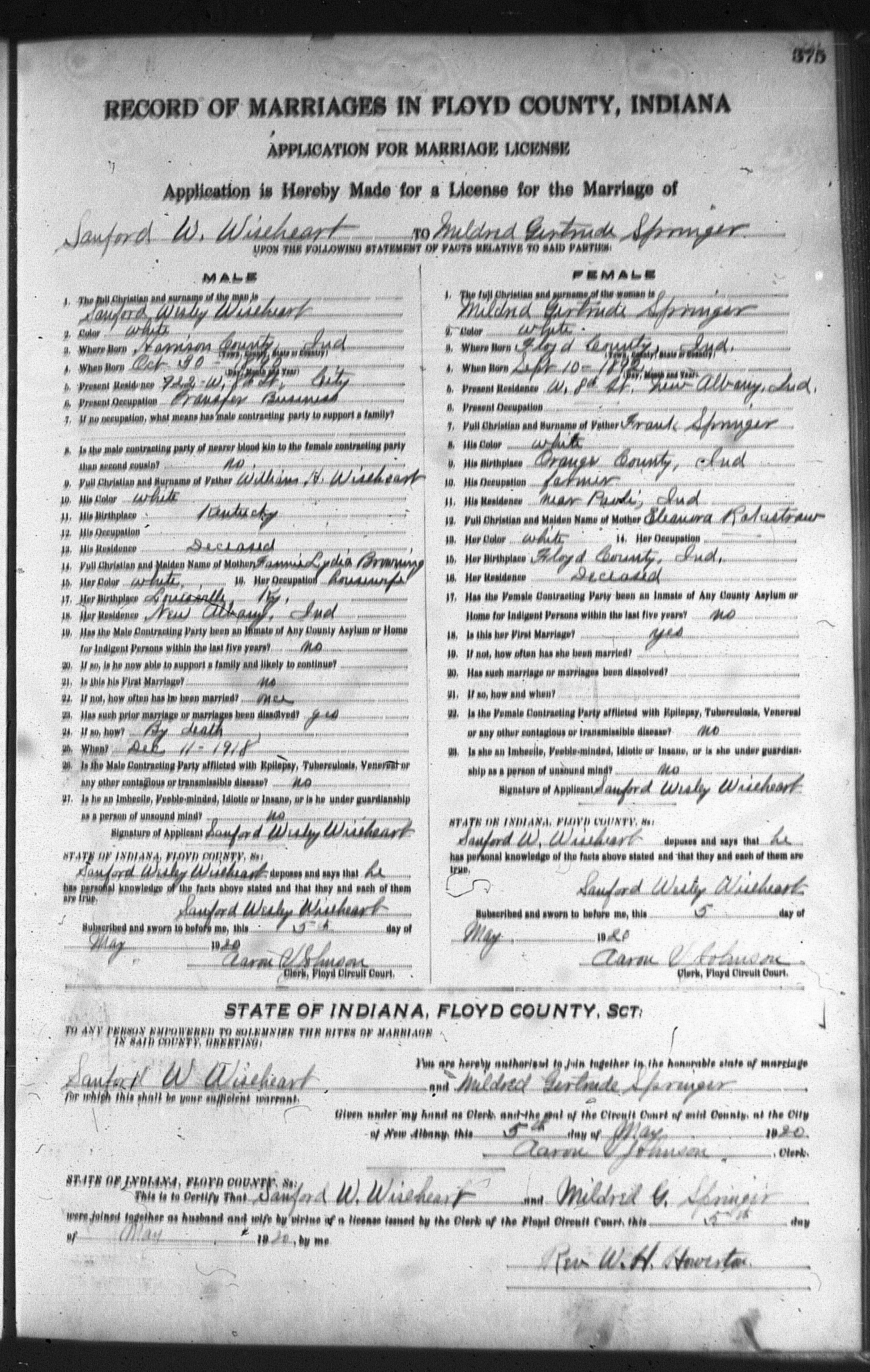
Sandy married Mildred Gertrude Springer, his second marriage, on May 5, 1920 in Floyd County, Indiana.  Here, Sandy’s occupation was “transfer business,” which is delivery service.  On the 1930 Census, he was a salesman of medicines and toiletries.

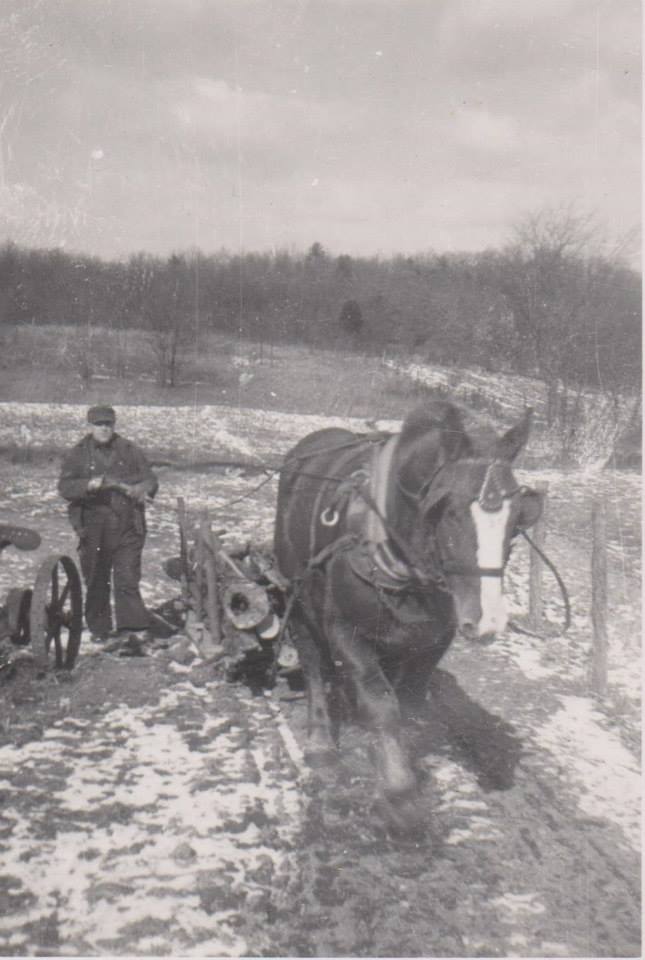
Grandpa also told me that during the 1937 flood, Sandy and one of his friends borrowed a neighbor’s rowboat and took hay around to the stranded cows.

The 1940 Census lists Sandy as being a general contractor, working on his own account, who repairs and builds homes.  In 1941, he bought a farm and the family raised crops and chickens as well.

Sandy Wiseheart on the farm.

Sanford Wiseheart on the farm.

Sandy wasn’t afraid of hard work, and he did whatever job was necessary and available in order to provide for his family.

Wiseheart, Sanford - business card

An Example of Best Practice Genealogy from My Great Great Grandfather

Some time around one hundred years ago, Daniel Wiseheart asked his father, William Henry (my great great grandfather), if he could borrow the family Bible.  William lent it to him.  A letter from Daniel states that the family Bible was destroyed in the 1917 tornado (or cyclone) that struck New Albany, Indiana.  As I read this letter, I was dismayed.  Until that point, I held out hope that one of Uncle Dan’s descendants might still have the Bible.

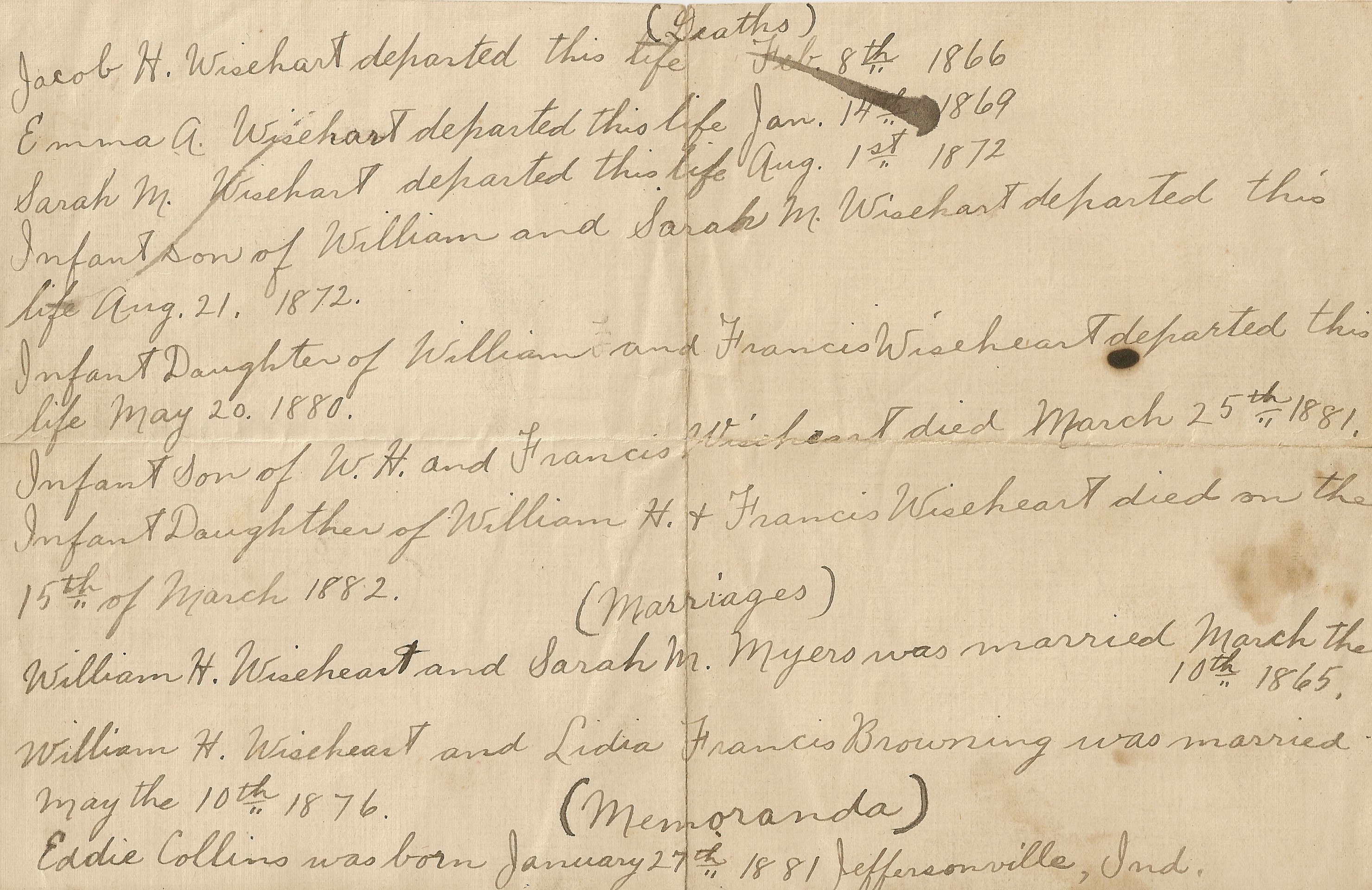
A couple of days ago, as my uncle and I went through the Rakestraw trunk looking for letters relating to Frank Springer, we found that William H. Wiseheart had copied down all of the information from the family Bible onto a piece of paper.  Words cannot express the joy I felt with that discovery!

I’m also grateful that my great great grandpa had the foresight to copy the information.  I can take a lesson from him.  Make sure to copy everything before you loan it, or make copies for the person who wants to do the borrowing.

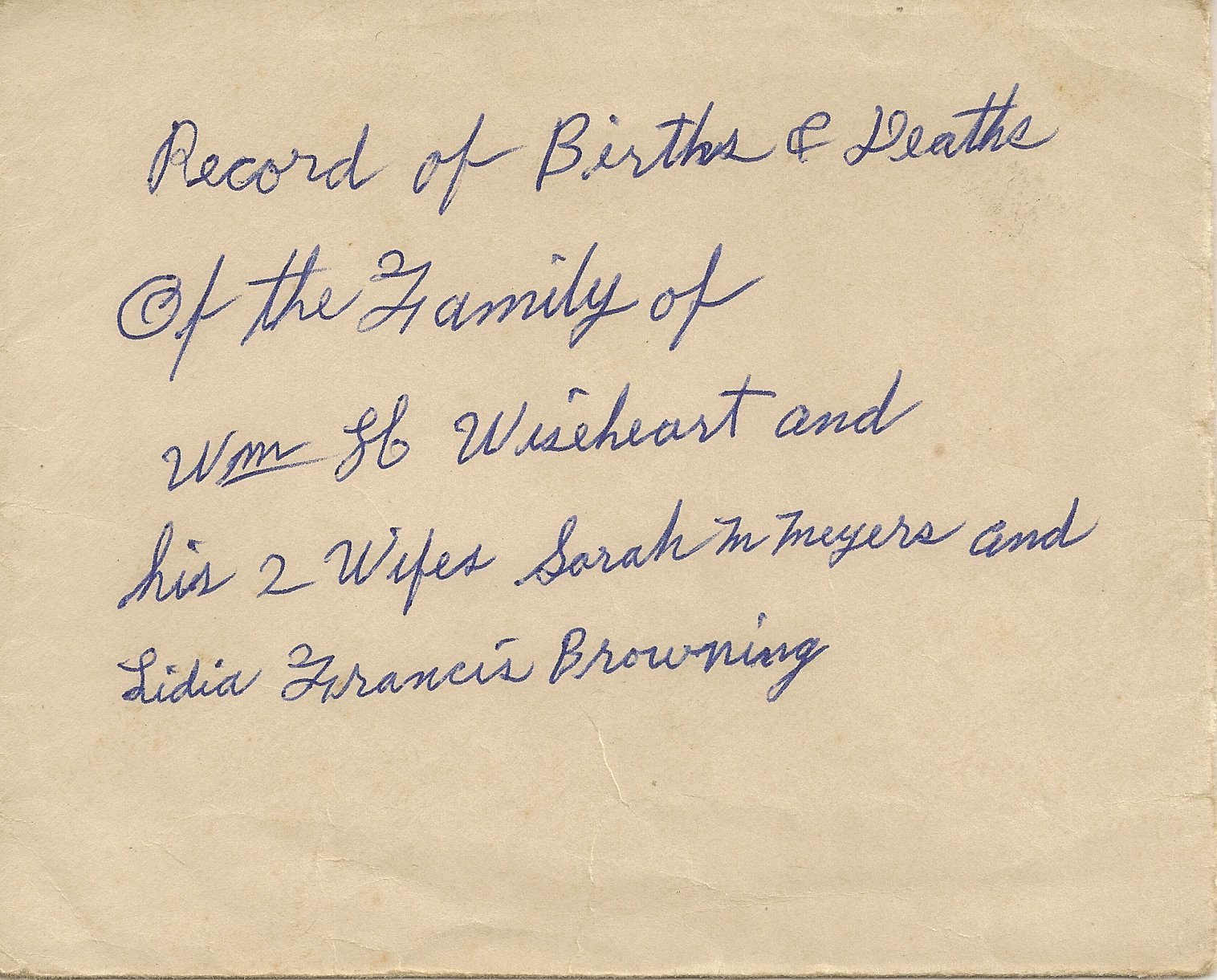
The following images are the envelope the paper was in, and the front and back of the page.  I don’t know whose writing is the blue ink, but the information is accurate based on my research thus far.

Envelope containing transcription of William H. Wiseheart Family Bible.

Envelope containing transcription of William H. Wiseheart Family Bible.

Transcription of the William H. Wiseheart Family Bible by William H. Wiseheart.  Births.

Transcription of the William H. Wiseheart Family Bible by William H. Wiseheart. Births.

Transcription of the William H. Wiseheart Family Bible by William H. Wiseheart.  Deaths, Marriages, and Memoranda.

Transcription of the William H. Wiseheart Family Bible by William H. Wiseheart. Deaths, Marriages, and Memoranda.