Jonathan Lindley: From Orange County to Orange County (52 Ancestors #08)

I haven’t done any real research on my Lindley line yet.  I suppose I always thought they’re fairly well documented and it will all still be there when I’m ready.  Jonathan Lindley was my sixth great grandfather and my eighth great uncle.  I am descended from his daughter, Hannah, and his nephew, Owen.  My grandpa told me a story about Jonathan Lindley on more than one occasion.

In the spring of 1811, Jonathan Lindley and his wife, she was Deborah Dicks (or Dix), moved their whole family and a large number of freed slaves from North Carolina up here to Indiana, up in Orange County.  They were Quakers, see, and they didn’t believe that people should be slaves.  They wanted to make sure that these freed slaves got up here safely.  They also wanted to live in a state where slavery was illegal.  I don’t know exactly how many went or what all their names were, but one of them freed slaves was called Alexander Polecat.  He was a character.  Always crackin’ jokes.

When they got to the Ohio River, they had to camp a while on the Kentucky side.  The water was too high to cross, see.  So, they camped there the first night and everything was fine, but the next mornin’, Jonathan Lindley’s dog was missin’.  Well they looked around and they called for him but he never did come, so they figured he must’ve been scared off by an animal or somethin’.  Some time later, they got a letter from an old neighbor down in North Carolina sayin’ the dog come home.  Now, isn’t that somethin’, a dog findin’ his way back home all those miles?

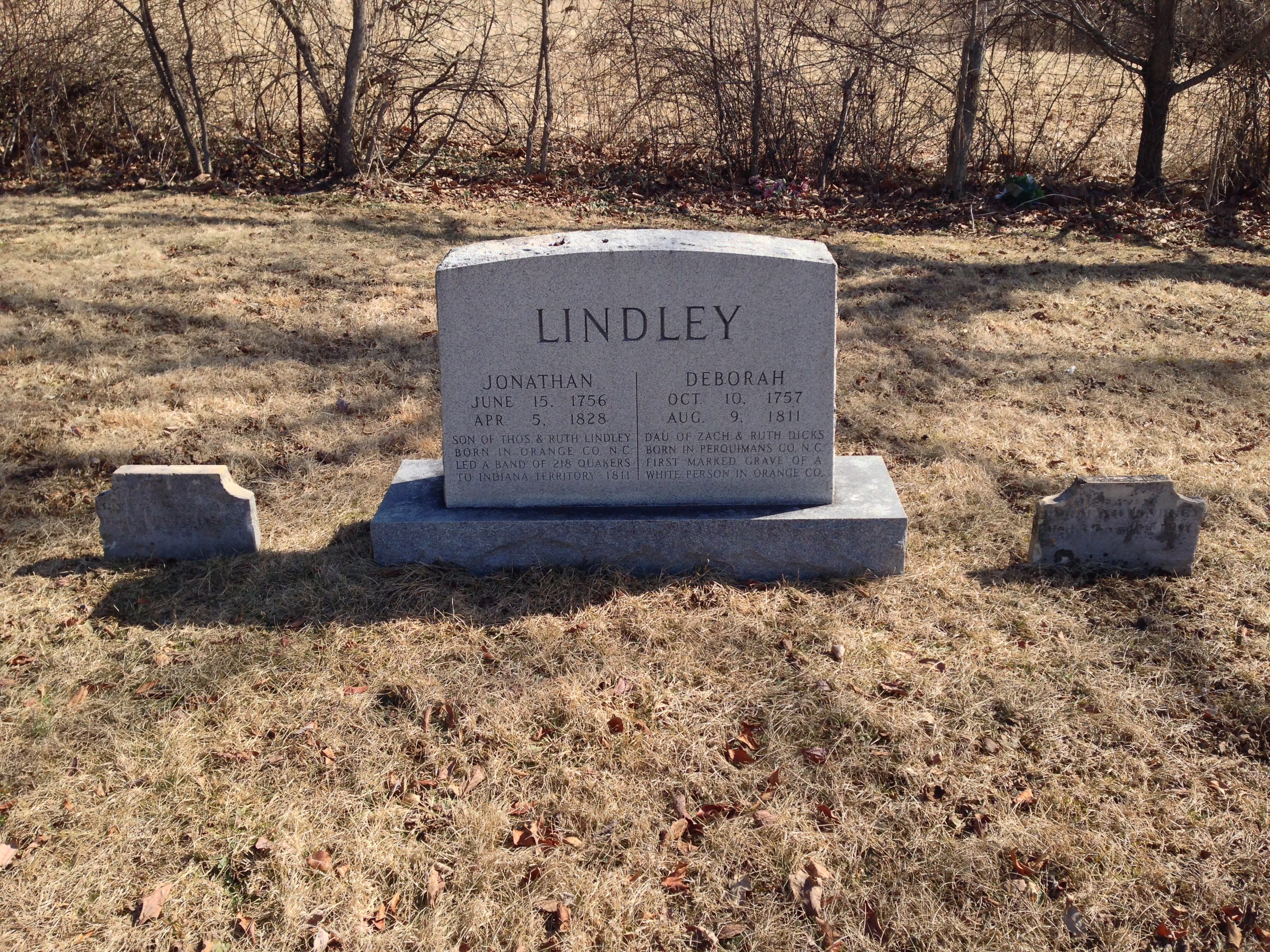
In February of 2014, I went to Orange County, Indiana with my dad.  We stopped at Lick Creek Friends Cemetery to see Jonathan and Deborah Lindley’s memorial stone.

Jonathan and Deborah Lindley memorial stone with original tombstones on either side.  Photo taken by Melissa Wiseheart, 28 Feb 2014.

Jonathan and Deborah Lindley memorial stone with original tombstones on either side. Photo taken by Melissa Wiseheart, 28 Feb 2014.

I will get around to researching the Lindleys.  My focus, for the moment, is telling the stories of those ancestors whose lives are relatively unknown.

Rebecca Gilbert: Quaker Daughter, Seneca Daughter (52 Ancestors #07)

Rebecca Gilbert is my favorite ancestor to research.  I feel close to her, not because we have any similarities, but because she is the first ancestor of mine who had a story that I could read.  All I had in the beginning of my research was a pedigree chart from my grandmother and a handful of notes.  One day, after Sunday lunch, my grandpa told me he had a book about my sixth great grandmother, Rebecca Gilbert.  The book was Captured by the Indians:  The Seldom Told Stories of Horatio Jones and the Benjamin Gilbert Family by George Henry Harris and William Walton (2003).  He lent it to me and, as I read and learned about what she had gone through, she became real to me.  She was no longer just a name on a pedigree chart.  I wanted to learn more about her, but I wasn’t entirely sure where to start.

A few months later, I was helping a patron at work who wanted to research Native American ancestry.  It was then that I noticed a smallish, red bound book with gilt lettering on the spine, which read, “Gilbert Narrative.”  When the patron had finished, I took my break and went back for the book.  The book was The Captivity and Sufferings of Benjamin Gilbert and His Family, 1780-83 by William Walton and Frank H. Severance (1904).  This one included a copy of the original text, plus an illustration of Benjamin being led off by Indians, a photograph of the Gilbert homestead in Byberry, the ancestry of Benjamin Gilbert, memoirs of the surviving captives, a family tree for Benjamin’s children, and historical notes.  It should have contained a map of their travels, but it had long since been torn out.

Suddenly, I had more information about my sixth great grandmother.  It had been right under my nose for two years.  I spent my breaks over the next week reading this book and writing things down.  This reprint also included a bibliography of all related publications.  Since this book differed so much from the one my grandfather had shown me, I wondered what other editions might reveal.  I began my search for these other books.  Luckily, Internet Archive had digitized some of them.  They have recently added the original as well.

Each one has something to add to the story, whether for the best or not.  Before I begin the story I should note that the family were Quakers and they never used the names of the days of the week or the months of the year since most of those names were derived from the names of pagan gods.  They also had an old and new style of dating, which can be confusing at times.  I’m writing the dates here exactly as they appear in the text.

The basic story of the Gilbert family is that the family were surprised at about sunrise on the 25th day of the 4th month, 1780 by a party of eleven Indians.  These Indians were Rowland Monteur and John Monteur (Mohawk); Samuel Harris, John Huston, and John Huston, Jr. (Cayuga); John Fox (Delaware); and five unnamed Seneca.  They raided and burned all of the buildings on the property.  They took captive fifteen people:  Benjamin Gilbert and his wife, Elizabeth; their children, Joseph, Jesse, Rebecca, Abner, and Elizabeth; Jesse’s wife, Sarah; Elizabeth’s sons from a previous marriage, Thomas and Benjamin Peart; Benjamin Peart’s wife, Elizabeth, and their daughter, Elizabeth; Benjamin Gilbert’s nephew, Benjamin Gilbert; Abigail Dodson, a neighbor’s daughter; and Andrew Harrigar, a hired hand.

The Indians bound their hands and forced the captives to walk northward toward Fort Niagara.  The journey was difficult, with little rest and not much to eat.  Andrew Harrigar managed to escape on the tenth day.  On the 24th day of the 5th month, Colonel Guy Johnson and Colonel Butler secured the release of Benjamin and Elizabeth Gilbert and their son, Jesse.  The rest of the captives were given over to various Indian families.  Rebecca and her cousin, Benjamin, were given to Rowland Monteur and his wife, who was the daughter of the Seneca Chief Siangorochti (Sayenqueraghta) and a Cayuga mother of high rank.  They lived with the Seneca on Buffalo Creek (Buffalo River), about four miles from Fort Erie.  They were adopted into the family of Siangorochti as replacements for family members that had been killed.  The story, according to William Walton, another of Rebecca’s cousins, is that Benjamin was happy in his new life while Rebecca suffered much and only wanted to get back home.

Another account, given by Rebecca’s fourth great grandson, Everitt Kirk Harris, states that “she was reluctant to leave her adopted relatives and customs.”  This account was passed down through the family.

Regardless of the conditions, there are some facts.  Benjamin Gilbert, Rebecca’s father, died on the 8th day of the 6th month, 1780.  Her adopted father, Rowland Monteur, died in September of 1781 (according to Severance’s notes).  Rebecca and Benjamin were released on the 1st day of the 6th month, 1782, and sailed for Montreal two days later.  They were the last two members of the Gilbert family to be released.  The entire surviving Gilbert family arrived in Byberry, Pennsylvania on the 28th day of the 9th month, 1782.

Walton’s third edition gives a synopsis of Rebecca’s life after returning home.

Walton, William.  A Narrative of the Captivity and Sufferings of Benjamin Gilbert and His Family, Who Were Taken by the Indians in the Spring of 1780.  Third Edition.  Philadelphia:  Printed by John Richards, 1848.  pp. 222-223.

Walton, William. A Narrative of the Captivity and Sufferings of Benjamin Gilbert and His Family, Who Were Taken by the Indians in the Spring of 1780. Third Edition. Philadelphia: Printed by John Richards, 1848. pp. 222-223.

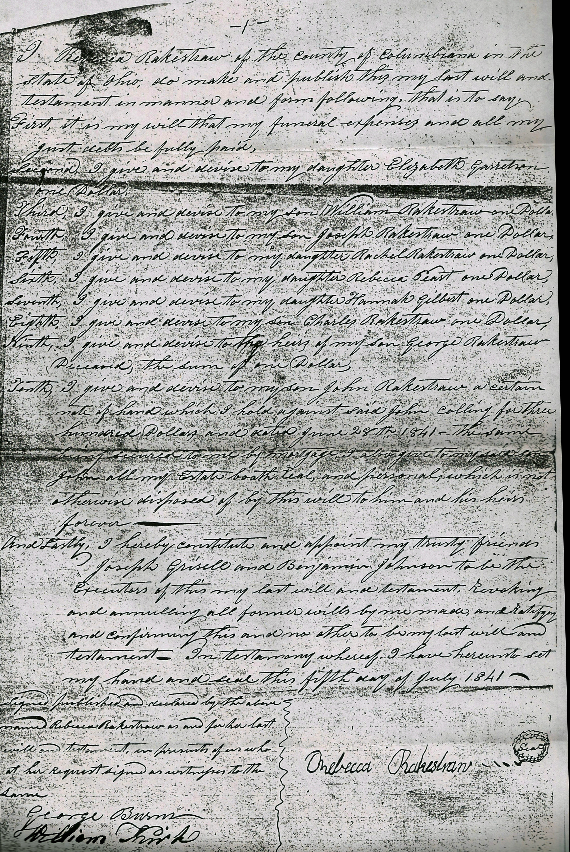
Rebecca’s will names only nine children:  Elizabeth, William, Joseph, Rachel, Rebecca, Hannah, Charles, George, and John.

Last Will and Testament of Rebecca Rakestraw, 5 Jul 1841

Last Will and Testament of Rebecca Rakestraw, 5 Jul 1841

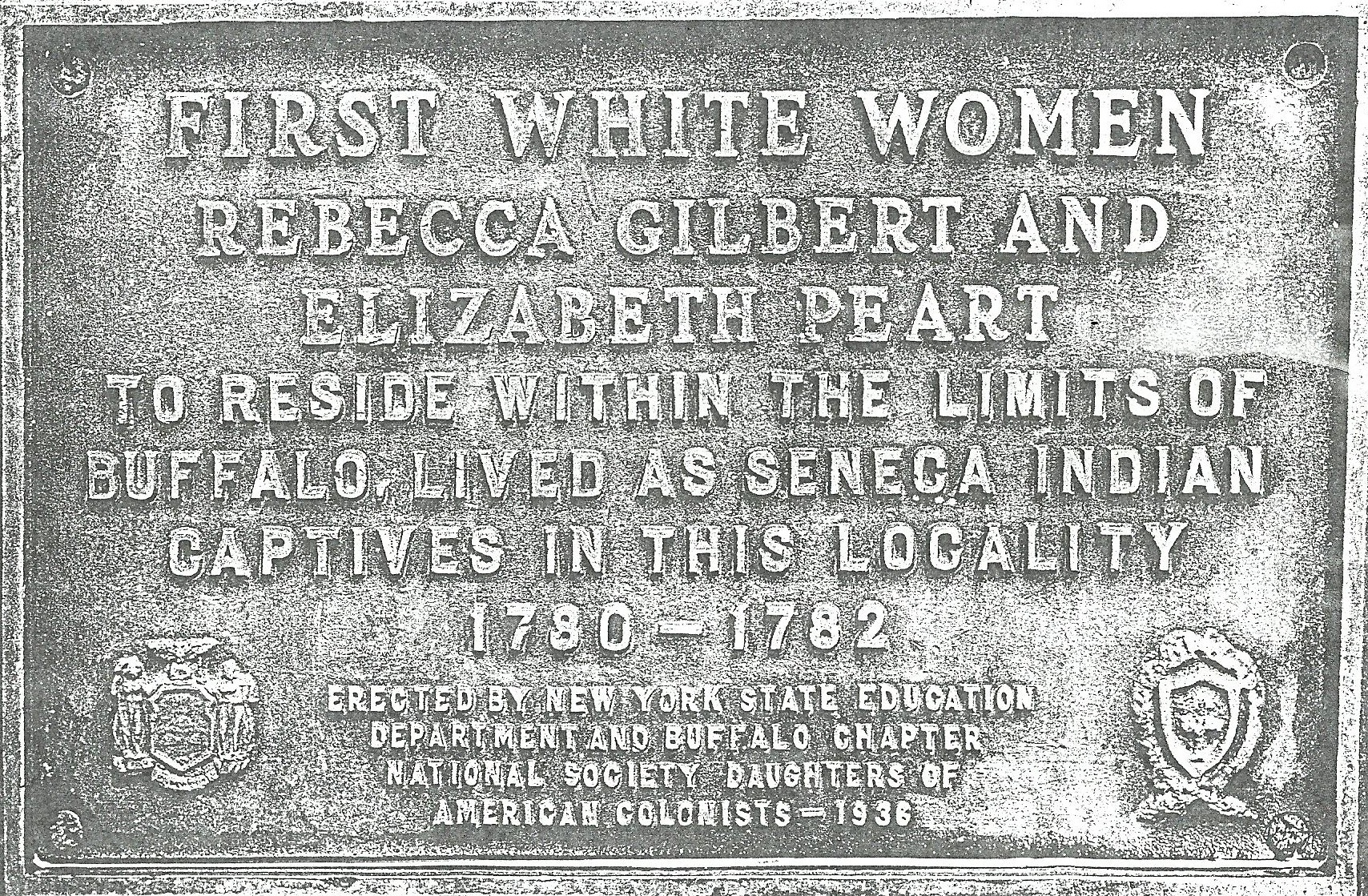
I feel as though I have a complete story for Rebecca.  I am, however, left with a question.  Why are only nine of Rebecca’s eleven children named in her will?  Only three possible reasons come immediately to mind.  Either the person who wrote the synopsis was incorrect and there were only nine children, the other two children died without heirs before the date of the will, or Rebecca did not count them as her children for some reason.  Even though I have a fairly complete story for Rebecca, I continue to look for information.  One item on my bucket list is to follow the path that Rebecca and her family followed.  At the very least, I want to see the monument in The Seneca Indian Park in Buffalo, New York.  I found an image of the plaque recently.

First White Women Monument, Seneca Indian Park, Buffalo, New York, Ancestry.com.

First White Women Monument, Seneca Indian Park, Buffalo, New York, Ancestry.com.

Marie Neider: The Dancing Queen (52 Ancestors #06)

I know very little about my great grandmother, Marie Neider.  She was born in Lampertheim, Germany to parents Christian and Elisabeth Neider on January 25, 1922.  She had three daughters, one of whom died at the age of one, and one adopted son.  She was married to Rolf Wolfgang Wölfert genannt Schmidt.  She died in November of 1993, when I was ten years old.

My only memories of Oma (Marie) are vague at best.  She and Opa (Rolf) flew here from Germany to visit for a while when I was about one and a half.  I remember walking with Oma and Opa down a sidewalk.  I remember stopping to smell the roses on the rose bush with them.  I remember them giving me Äpfel (apples).  I remember Oma laughing a lot.

Years later, in 1989, I remember waiting with my family in the kitchen for a while.  The Berlin Wall had just come down and we were waiting for her phone call.  I remember my mom and grandmother talking to her, but I don’t remember getting to talk to her.  Although, I was six, so I may just not remember.

I recently asked my grandmother to tell me about her.  I’ve heard stories, both good and bad, over the years, but I really wanted to know what she was like.  She told me that Oma was a very social person.  She loved to go to parties and her favorite thing to do was dance.  Whenever she danced, she was happy.

Gottfried und Marie tanzen.

Gottfried und Marie tanzen.

There is much that I need to learn about her still.  I’m planning to take a class on German genealogy to learn how to find records over there.  My grandmother said that her sister has a book with information in it that she will see if she can get copies of for us.

Frank Springer: The Wanderer (52 Ancestors #01)

Frank Springer is my great great grandfather on my father’s side.  He was married to Zerilda Eleanora Rakestraw.  Their daughter, my great grandmother, Mildred Gertrude Springer, was my grandpa’s mother.  Frank was born in Orange County, Indiana circa 1869 and Zerilda “Ella” was born in Floyd County, Indiana in 1868.  Presumably, the two met when Ella went to visit relatives in Orange County.  This entire family has been difficult to research, due to various problems such as incorrectly printed information in the newspaper and changing of names without legally changing them.  Frank, however, is the biggest mystery.

Family legend says that Frank was a wanderer by nature and also had some mental issues.  He left his wife after about a year of marriage, and just after the birth of their daughter.  It is said that he went to California and nobody ever heard from him again.  There are no known photos of Frank, which adds to the mystique.  I think a timeline is the best way to approach this one.

1870

On the Census, Frank is one year old and living in Paoli Township, Orange County, Indiana with his parents, John Alexander and Mary (Lindley) Springer.  His siblings are Anna L., born 1863; Edward, born 1865; and Mary Elizabeth, born 1867.¹

1880

On the Census, Frank is ten years old and still living in Paoli Township with his parents.  Siblings are Anna L.; Edward; Charley, born 1873; Stella, born 1875; and Mattie, born 1877.²

1892

On February 28th, Frank marries Ella N. Rakestraw in New Albany, Floyd County, Indiana.³  (My grandfather told me that Ella hated her first name, Zerilda, and broke up her middle name into Ella Nora and started going by that).

By March 9, Frank and Ella had moved to Ed Springer’s farm, which he had recently vacated, near Paoli.4

On November 20th, their daughter, Mildred Gertrude Springer, is born in New Albany.5

1893

On March 23rd, a blurb in the Paoli Republican said that Ella had visited her parents in New Albany and returned home to Paoli.6

On November 22nd, the Paoli News reported that Frank Springer had gone to the World’s Fair in Chicago.7

1894

In May, Francis Marion and Mary Elizabeth Rakestraw petitioned for the adoption of their granddaughter, Mildred, citing that Frank had abandoned her over a year ago and that her mother was an invalid.  The petition was granted.8,9

On June 13th, Ella died of consumption.10

1900

On the Census, Mildred is living with her grandparents in New Albany.11  I could not find any record of Frank.

1910

On the Census, Mildred is living with her grandparents in New Albany.12  I could not find any record of Frank.

In July, the Orleans Progress Examiner reported that Miss Mildred Springer had been visiting Edward Springer and his family.13  (Orleans is just outside Paoli).

1911

In March, the Orleans Progress Examiner reported that Mildred had been visiting her grandparents.14

1920

On the Census, Mildred is living with her grandparents in New Albany.16  Frank is living alone in Paoli Township.15

In May, at the time of Mildred’s marriage to Sanford Wesley Wiseheart, Frank is living “near Paoli.”17

1930

On the Census, Mildred is living with her husband and children in Silver Creek Township, Clark County, Indiana.  Mildred named her second son Frank.18  (I’m wondering if this an indication that she had some sort of relationship with her father, or if it’s more that she wished she had.  My grandpa said that Mildred always had a fear that her family would leave the house and never come back.)  I could not find any record of Frank.

1940

On the Census, Mildred is living with her husband and children in New Albany.19  I could not find any record of Frank.

To summarize, I have Frank Springer pinned down from 1870 to 1893 and he randomly pops back up again in 1920.  My theory is that he went to the World’s Fair in 1893 and got a taste for travel and saw what wondrous things there were in the world and decided to experience it.  By 1920, he would’ve been about fifty and was probably ready to settle down, so he came back home to Paoli.  I’m thinking the reason that I can’t find him in the 1930 Census is because he died sometime between 1920 and 1930.  I have yet to find any obituaries or a tombstone, so that’s my next course of action.


Sources

1.  1870 U.S. Federal Census, Paoli Township, Orange County, Indiana, p.24, Ancestry

2.  1880 U.S. Federal Census, Paoli Township, Orange County, Indiana, p.6, Ancestry

3.  Floyd County, Indiana Marriages, Vol. 10, p.114, Stuart Barth Wrege Indiana History Room

4.  Paoli Republican, Wednesday, 9 Mar 1892, p.3, c.5, NewspaperArchive

5.  Floyd County, Indiana Deaths, Book H-12, p.10, Stuart Barth Wrege Indiana History Room

6.  New Albany Evening Tribune, Thursday, 23 Mar 1893, p.4, c.2, Stuart Barth Wrege Indiana History Room

7.  Paoli News, Wednesday, 22 Nov 1893, p.3, c.2, NewspaperArchive

8.  New Albany Evening Tribune, Friday, 25 May 1894, p.3, c.2, NewspaperArchive

9.  New Albany Daily Ledger, Saturday, 26 May 1894, p.5, c.3, Stuart Barth Wrege Indiana History Room

10.  New Albany Evening Tribune, Thursday, 14 Jun 1894, p.4, c.2, Stuart Barth Wrege Indiana History Room

11.  1900 U.S. Federal Census, New Albany Township, Floyd County, Indiana, p.9B, Ancestry

12.  1910 U.S. Federal Census, New Albany Township, Floyd County, Indiana, p.14A, Ancestry

13.  Orleans Progress Examiner, Thursday, 28 Jul 1910, p.2, NewspaperArchive

14.  Orleans Progress Examiner, Thursday, 23 Mar 1911, p.3, NewspaperArchive

15.  1920 U.S. Federal Census, Paoli Township, Orange County, Indiana, p.21A, FamilySearch

16.  1920 U.S. Federal Census, New Albany Township, Floyd County, Indiana, p.11A, Ancestry

17.  Floyd County, Indiana Marriages, Vol. 20, p.375, Stuart Barth Wrege Indiana History Room

18.  1930 U.S. Federal Census, Silver Creek Township, Clark County, Indiana, p.14B, Ancestry

19.  1940 U.S. Federal Census, New Albany Township, Floyd County, Indiana, p.10B, FamilySearch