Two Marriages & A Murder

Three days ago, I posted about Serilda Gilliland marrying John Bridges twice and that John went to prison for murder.  I was able to unravel a little bit more today.  First, I looked up the Daniel G. Stewart who was a minister from 1835 to 1837 again, and he was actually Daniel S. Stewart and is not the same D.G. Stewart who married them.  I looked in a different city directory today (1848) and David G. Stewart was listed as a homeopathic doctor.  Having the correct first name, I looked him up in the newspaper index and found a listing for an obituary.  According to his obituary in the New Albany Daily Ledger Standard (9 Apr 1878, p.4, c.2-3), David G. Stewart was a doctor who moved to New Albany in 1832.  He joined the First Christian Church and regularly preached when the the pastor was absent.  He was not ordained.  Therefore, Serilda and John’s first marriage was not valid.  Now I know the mechanics of why they were married twice, but I’m still left wondering how he got out of prison for it.

Now, on to the murder trial…

The State of Indiana v. John Bridges:  Coroner’s Inquest

New Albany Daily Tribune, 17 Jan 1859, p.3, c.1, Stuart Barth Wrege Indiana History Room

New Albany Daily Tribune, 17 Jan 1859, p.3, c.1, Stuart Barth Wrege Indiana History Room

Genealogy Bullet Journaling

I was in the lounge at work the other day and a couple of my co-workers were talking about bullet journals.  I’d never heard about a bullet journal before.  My co-workers gave me a description, and I looked it up when I got home.  Basically, it’s a style of journaling wherein a person writes everything with bullets or checkboxes to save the time and energy it would take to go into detail about one’s day.  I could never journal like that.  However, I thought it could be slightly adapted to work for genealogy, so I gave it a try.

The first page of my bullet journal.  I left two pages open for this person, but some people only have one page.

The first page of my bullet journal. I left two pages open for this person, but some people only have one page.

I write my ancestor’s name as the page title.  If I have something I have to look up, I draw a box and write it down.  When I look for it, I mark the box with an X if I didn’t find it and a check if I did find it.  If I didn’t find it, I also write a quick note about why I couldn’t find it.  Doing so will prevent me from looking for it again in the future and wasting time.  If I find something that I didn’t think to look for while I’m doing my research, I add a bullet and write it down.  This indicates to me that it is a note and not something on which I need to take action.  Since a lot of my research is done on my breaks, this is very helpful for me.  I can look up one or two items and save the rest for later.  It also keeps me from getting distracted from my goals and researching a different person just so that I don’t forget to later.

In the genealogy class that I teach, one of the basic genealogy “do’s” is to make a list of what you want to research so that you can accomplish the goal and not get distracted, because, let’s face it, it’s easy to see multiple family names in an index or see suggestions on Ancestry.com and never get around to what we set out to research.  For me, I’ve always brought in a checklist and a blank sheet of paper or a notebook to make notes of the things I find that I need to look up later.  This journal combines both in a way that is easy for me to handle.  I don’t mean to sound like an advertisement here.  I just found this to be really useful and I thought I’d pass on what I’ve learned.

A Marriage Mystery

Last night, while doing research for a collection that I’m processing at work, I saw my great great great great grandmother’s name on a marriage record index page… twice… to the same man… fourteen years apart.  I quickly made a note to look them up later.  I knew that she had been married once to Leason Gillilland, from whom I am descended, and who died young.  I knew that she married John Bridges after Leason died.  Today, on my lunch break, I did look up the records.  The first one was John T.M. Bridges and Sirelda Gilland on October 15, 1857.  The second was John T.M. Bridges and Serrelda Gilliland on February 3, 1871.

Floyd County, Indiana Marriages, Vol. 4, p.485

Floyd County, Indiana Marriages, Vol. 4, p.485, Stuart Barth Wrege Indiana History Room

Floyd County, Indiana Marriages, Vol. 6, p.644

Floyd County, Indiana Marriages, Vol. 6, p.644, Stuart Barth Wrege Indiana History Room

This is weird.  I consulted a co-worker who has been doing genealogy far longer than I have and has taught me most of what I know about researching.  She agreed that it is weird.  At first we thought that maybe the first marriage was invalid.  The name of the minister is smudged out and we thought that possibly he wasn’t really a minister.  A cleaner copy of that marriage record is available on FamilySearch.org and the minister’s name can be read.  He is D. G. Stewart.  Daniel G. Stewart is listed in the back of the index as being a minister from 1835-1837.  In the 1857 New Albany city directory, he’s listed as a homeopathic physician.  While I was looking up the minister, my co-worker searched the newspaper index for me.  She found that John Bridges wasn’t such a great guy.

My grandfather had always told me that John was a drunk and that he was constantly in trouble.  He had heard stories about John from his great grandmother, Serilda’s daughter, who had helped raise him.  Today, I discovered that John murdered a man, was convicted, and went to the Indiana State Prison in Jeffersonville, Indiana.  I didn’t have a lot of time on my lunch, so I only read the brief descriptions of the over a dozen articles on the trial and his other run-ins with the law.  I’ll copy those as soon as I can.  The result of the trial is that he was convicted in 1859.  The 1860 Census lists him with the family, but in the last column, where it asks for a person’s condition, it says “convict.”  In the 1870 Census, he’s listed among other convicts as being in Indiana State Prison.  Yet, somehow, he married or re-married Serilda in 1871.  Maybe the marriage was annulled or they got a divorce when he went to jail?  Maybe the first marriage really wasn’t legal?  I’m not sure.  What I really want to know is did they get married in the jail, or was he released from prison after only twelve years when he was sentenced for murder?  I’m hoping the articles about the trial will shed some light on that.

Beata Salina: Lady in Waiting (52 Ancestors #02)

Beata Jacobine Salina was born in 1636 in Stockholm, Sweden to parents Dr. Baltzar Salinus and Elizabeth Carlsdotter.  Dr. Salinus was the court physician to King Charles X Gustaf (Karl X Gustav) of Sweden.  It was at court that she met Christopher Springer, who had been a member of the treasurer’s secretariat since 1633, and a court musician before that.1  Beata and Christopher were married on October 15, 1654.1,2  Shortly thereafter, Beata became fourth lady in waiting to Queen Hedvig Eleonora.2,4,5

Christopher, having been born in 1592, was considerably older than Beata.1,2  The couple started a family right away.  They had five children:  Elizabeth, born in 1655; Charles, born in 1658; Christopher, born in 1661; Baltzar, born in 1664; and Jacob, born in 1668.1

In 1669, just one year after Jacob’s birth, Christopher Springer died at the age of seventy seven.1,2,3  At the time of his death, he was Archives Inspector of the Royal Exchequer.1  Queen Dowager Hedvig hired Lady Beata as her royal housekeeper at Gripsholm Castle, across Lake Malar from Stockholm.1,3  It was here that Beata died in December of 1693.  She was buried near the castle, at the church at Mariefred.1

Gripsholm Castle by Carl Abraham Rothstein (1826-1877)

Gripsholm Castle by Carl Abraham Rothstein (1826-1877)

Lady Beata is sometimes listed as Beata Jacobine Hendrickson instead of Salina.2,4,5  I have yet to determine why.  It’s possible that she was married before she married Christopher, however, she would have been very young and that marriage would’ve had to have been very brief.  I have read that the family is well documented in the Stockholm municipal records and the Royal Archives, so perhaps I will be able to find out.


Sources

1.  Springer, Jessie Evelyn.  Charles Springer of Cranehook-on-the-Delaware:  His Descendants and Allied Families.  Edwardsville, Ill.:  1959.  HeritageQuest Online.

2.  Genealogical and Personal History of Fayette County, Pennsylvania.  New York:  Lewis Historical Publishing Co., 1912.  HeritageQuest Online.

3.  Swedish Colonial News, Vol. 1, No. 19, Spring 1999.  Philadelphia, Penn.:  The Swedish Colonial Society, 1999.  The Swedish Colonial Society.

4.  Badger, Matilda Phillips Jones.  Genealogy of the Linthicum and Allied Families.  Baltimore, Md.:  1936.  Internet Archive.

5.  Fairchild, Timothy Marsh.  The Name and Family of Fairchild.  Iowa City, Iowa:  Mercer Print Co., 1944.  HeritageQuest Online.

Not My Elizabeth

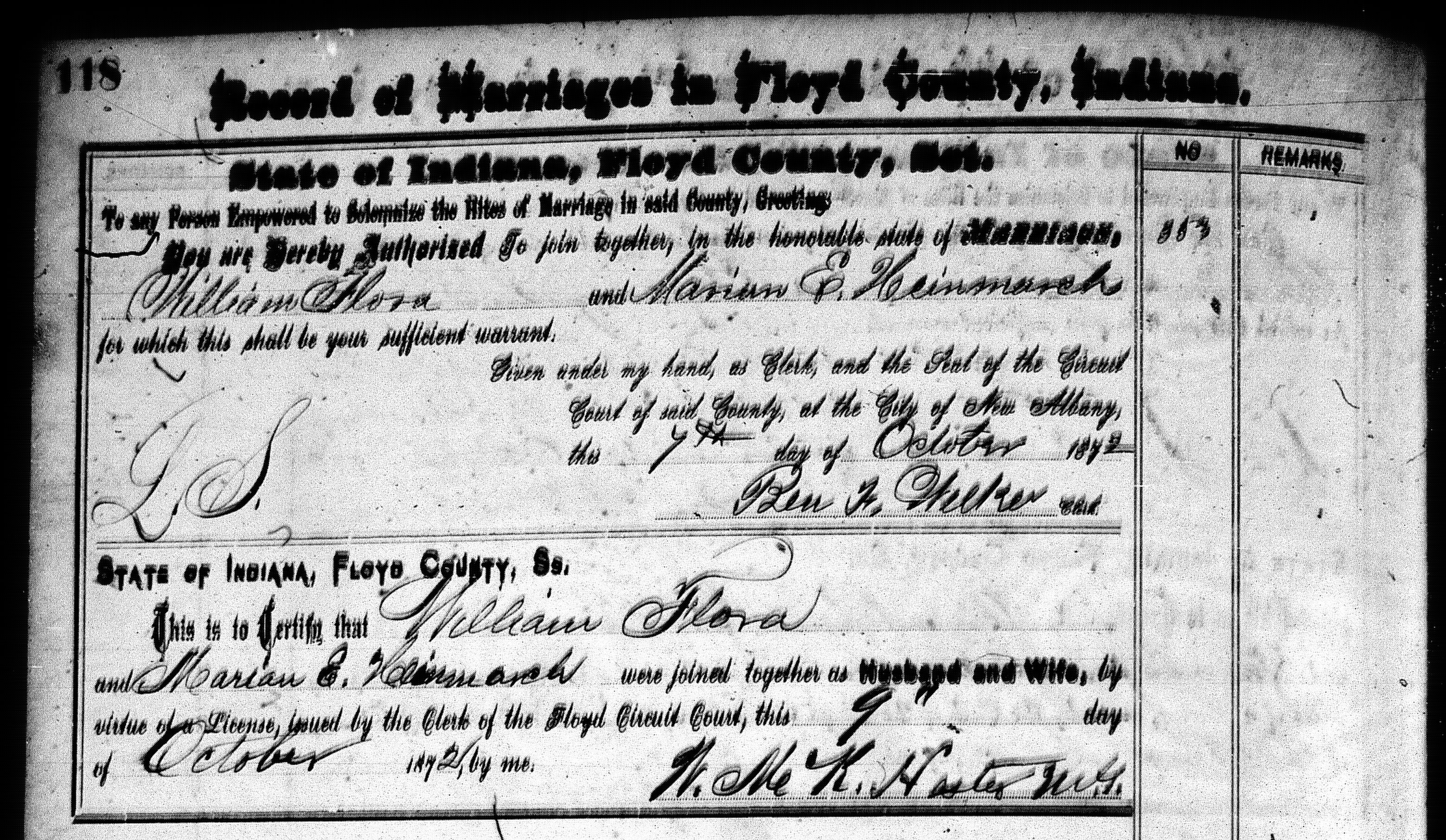
Today, while on my break at work, I followed the Marion Elizabeth Flora lead.  William Flora married Marian E. Heinmarch on October 9, 1872 in Floyd County, Indiana.

Flora, William - Floyd, Indiana Marriages, Vol. 7, p.118

Floyd County, Indiana Marriages, Vol. 7, p.118, Stuart Barth Wrege Indiana History Room

She isn’t the Elizabeth Rakestraw I’ve been searching for, so I’m guessing that her relation to the Rakestraws is through William Flora.  The search continues for Elizabeth Rakestraw, and a search for the connection between William Flora and my other Floras begins.