Why Don’t You Just Use Ancestry?

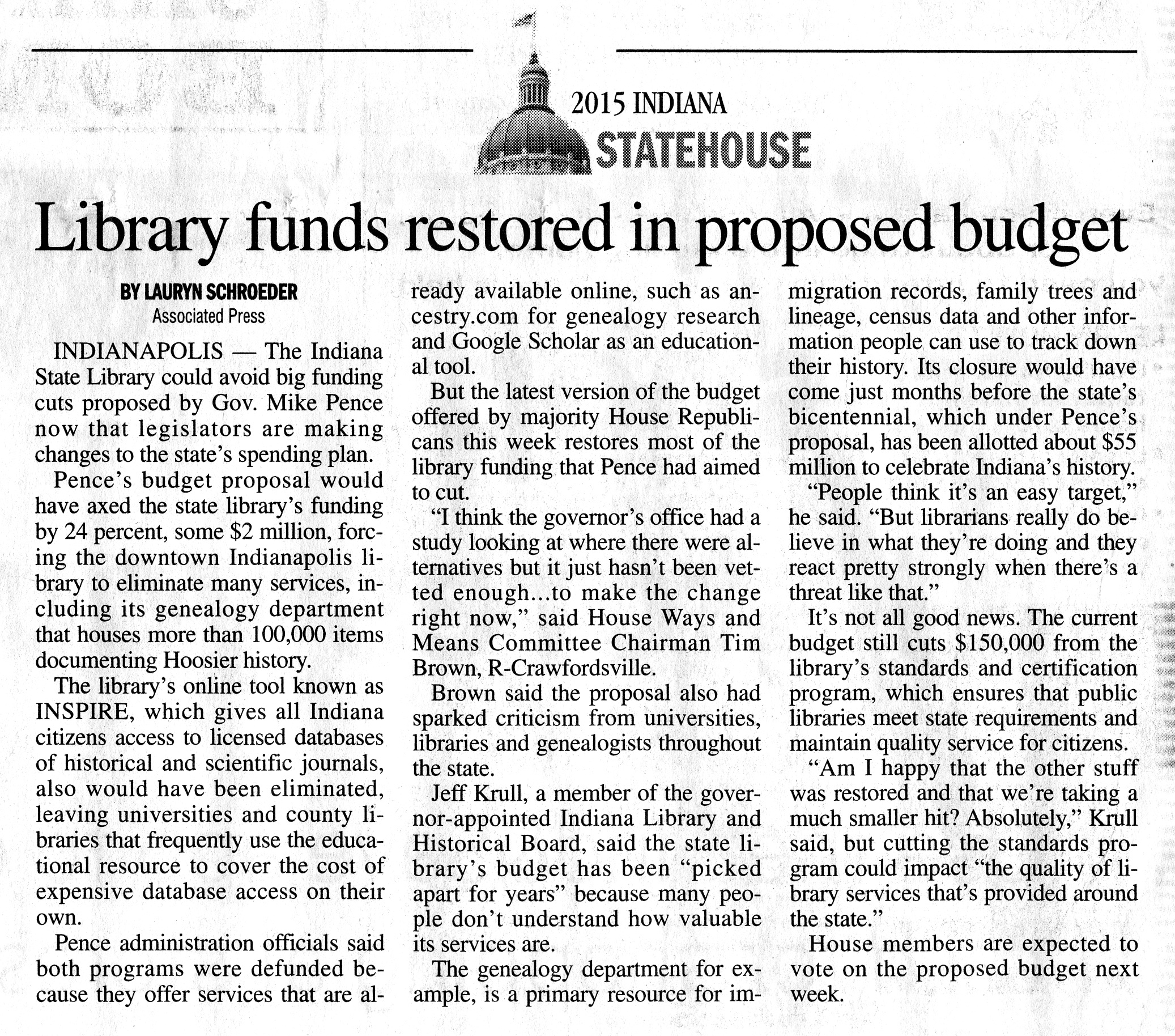
I get asked that question a lot, and in light of what’s been going on with the proposed Indiana state budget, I thought I’d take an opportunity to discuss why local history and genealogy departments cannot and should not be replaced by Ancestry.  I’ll be focusing on Floyd County, Indiana, as that is where I am.

The first thing I want to talk about is access.  Most of our library’s (New Albany-Floyd County Public Library) patrons, and this is probably true of most people, can’t afford the subscription to Ancestry.  They come to our library to access Ancestry Library Edition.  While this service would continue without the library’s Indiana Room (for local history and genealogy), the vast majority of the patrons who use it do so in the Indiana Room.  Why?  Because the Indiana Room staff know what databases are available through Ancestry and how to perform a search to yield the best results.  It’s true that this training could be given to Reference or Circulation staff, but, as genealogists know, if you aren’t into genealogy you aren’t going to provide the best genealogical services for your patrons.

This brings me to my next point.  Patrons utilize the Indiana Room because they can get help and advice from staff members.  We offer beginning genealogy courses at our library and are just starting to implement genealogy for kids, genealogy for teens, and more specific classes, such as Irish genealogy.  This allows first-timers, or those who just want a refresher, to get an idea of what is involved in the process and get one on one time with someone has been doing genealogy for years.  We also assist walk-ins and schedule one on one time with patrons.

It may be that you are researching someone who served in the Civil War.  You’ve typed his name in the search box on Ancestry and you’ve found him listed in the Report of the Adjutant General of the State of Indiana and maybe a couple of other things.  Is that all there is?  Probably not.  At the library, we have microfilmed local newspapers with an online index.  Your ancestor’s obituary might include his military service.  We also have Floyd County Civil War soldier records on microfilm (I have yet to find these on Ancestry, but maybe someday).  In some instances, we might have an archive collection that has information or even artifacts.  These are all things you wouldn’t know if you didn’t have someone to ask, and as great as Ancestry may be, contacting them is difficult at best.  Some of these things are also things that Ancestry just doesn’t have, at least not yet.

Another issue is that sometimes you can view an image and sometimes all you get is a transcription.  I searched for “Rakestraw” in the Indiana Marriages collection on Ancestry.

ancestry1

I clicked on the marriage record for Adalino Rakestraw and Henry Hardy, and this is what it showed.

ancestry2

The problem with this is that there is no original image.  Adaline Rakestraw married Henry Hardy, as the image from the microfilm at the library will show.

Floyd County, Indiana Marriages, Vol. 3, p.101, Stuart Barth Wrege Indiana History Room

Floyd County, Indiana Marriages, Vol. 3, p.101, Stuart Barth Wrege Indiana History Room

Ancestry is a wonderful tool, but it really needs to be viewed as a virtual library.  The same rules apply to it that apply to libraries nationwide.  Every library is unique.  While some libraries have duplicate information, such as Census, each library has something that other libraries do not have.  In our case, we have quite a bit, but to name just a few:

  • Asylum Records, 1866-1900
  • Cemetery Records
  • Church Records, 1816-1990
  • Cornelia Memorial Orphans Home Records, 1877-1954
  • Diaries & Journals
  • Family Bibles
  • Letters
  • Newspapers, 1817-2015 (with online index)
  • Yearbooks

Should you use Ancestry?  Absolutely!  Just don’t forget to visit your local library, historical society, or genealogical society.  As genealogists, it is our responsibility to be thorough in our research.  This means we need to use all repositories at our disposal for research.  At present, no single repository contains every piece of genealogical information available.

Sanford Wiseheart: Wise, Resourceful, and Industrious (52 Ancestors #09)

“Pap used to say, ‘If you can’t find work, make work.'”  These are words I frequently heard from my grandpa about his father.

Sanford Wesley “Sandy” Wiseheart was born on October 30, 1890 in Elizabeth, Indiana to parents William Henry and Frances Lydia “Fannie” (Browning) Wiseheart.  In the 1910 Census, he was still living with his parents.  He was a peddler working on his own account and owned his own wagon.  Grandpa told me that when his dad was younger he used to buy things in town and load them up on a wagon and sell them at a slight profit to the people who couldn’t make it into town.

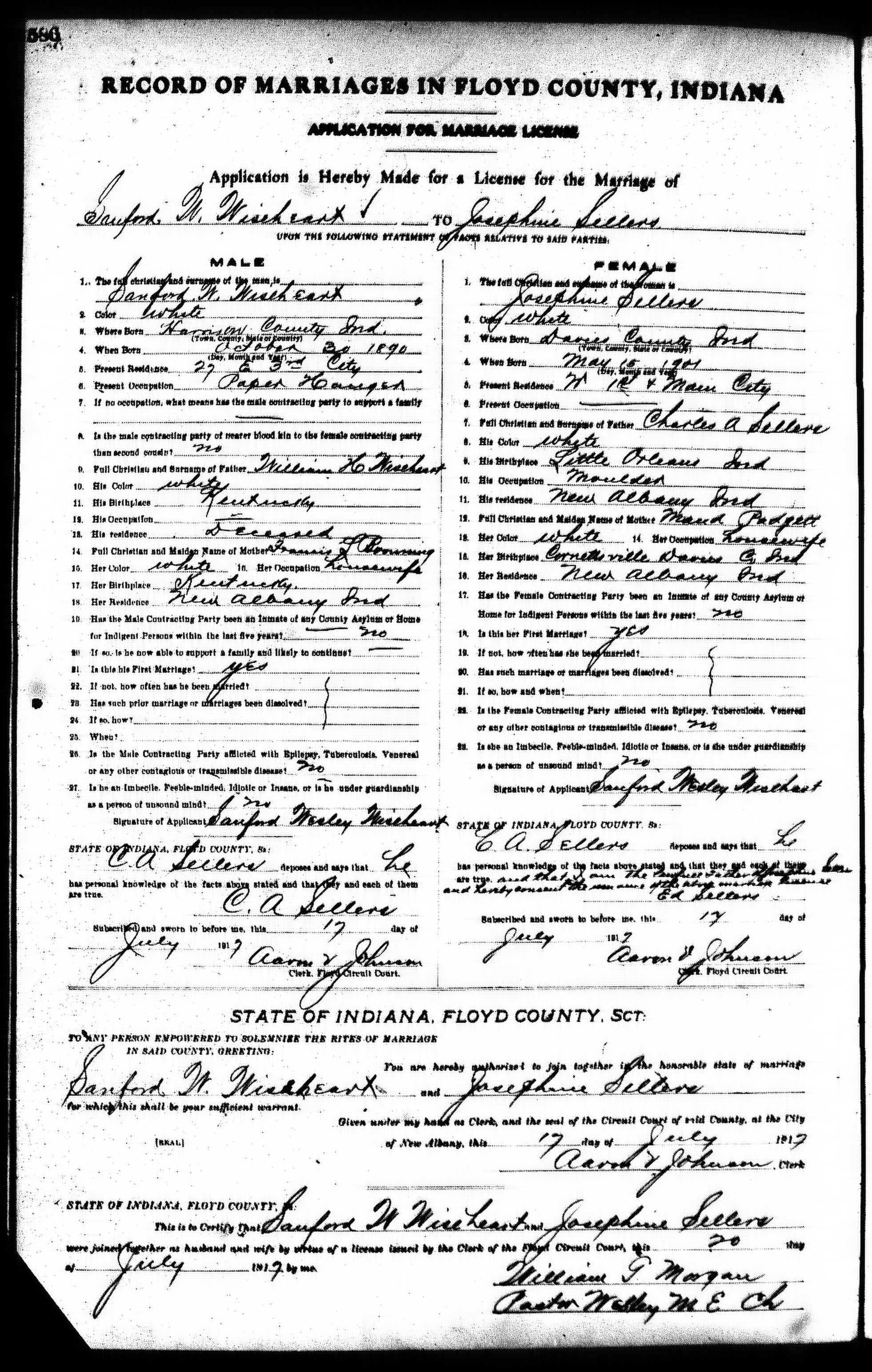
In 1917, Sandy filled out a Draft Registration Card.  His occupation was “driver for David Brubeck.”  According to the 1917 New Albany City Directory, David Brubeck was the owner of Brubeck Ice Cream Company.  About a month later, on Sandy’s marriage application with his first wife, his occupation is listed as paper hanger, that is one who hangs wallpaper.

In August of 1918, Sandy went to France and served in the occupation of Privenelle Sector, west of Moselle (Second Army Offensive).

Sanford Wesley Wiseheart (ca. 1914)

Sanford Wesley Wiseheart (ca. 1918)

While there, he was a medical transporter in Field Hospital 22.  He frequently wrote to his mother and to his friend, Mildred Springer.  One such letter contained the following:

if you could of saw what I have over here you would learn that there is no use to worry about anything we must just keep a brave heart and meet our trouble half way for we cannot change what must be.

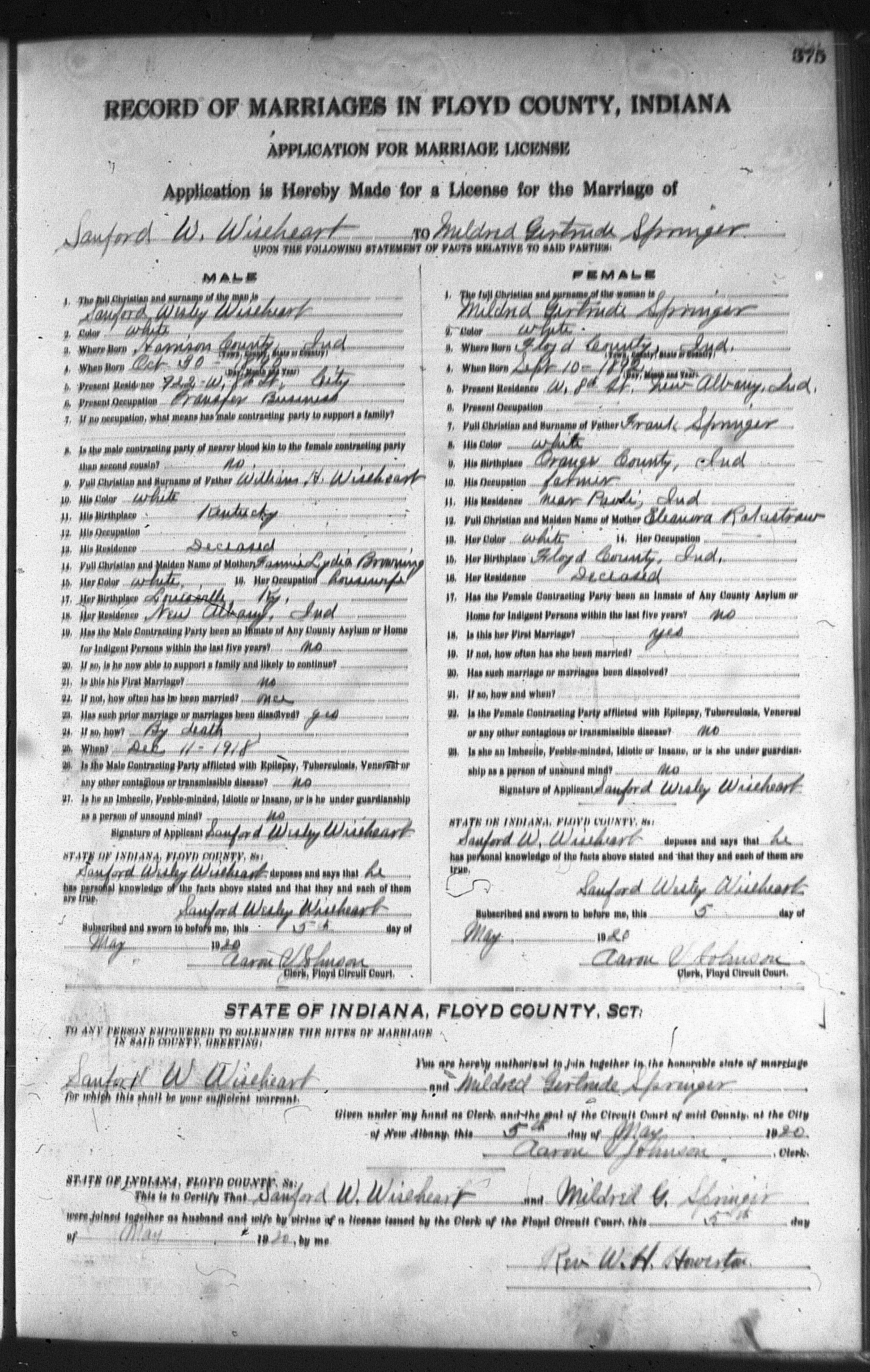
Sandy married Mildred Gertrude Springer, his second marriage, on May 5, 1920 in Floyd County, Indiana.  Here, Sandy’s occupation was “transfer business,” which is delivery service.  On the 1930 Census, he was a salesman of medicines and toiletries.

Grandpa also told me that during the 1937 flood, Sandy and one of his friends borrowed a neighbor’s rowboat and took hay around to the stranded cows.

The 1940 Census lists Sandy as being a general contractor, working on his own account, who repairs and builds homes.  In 1941, he bought a farm and the family raised crops and chickens as well.

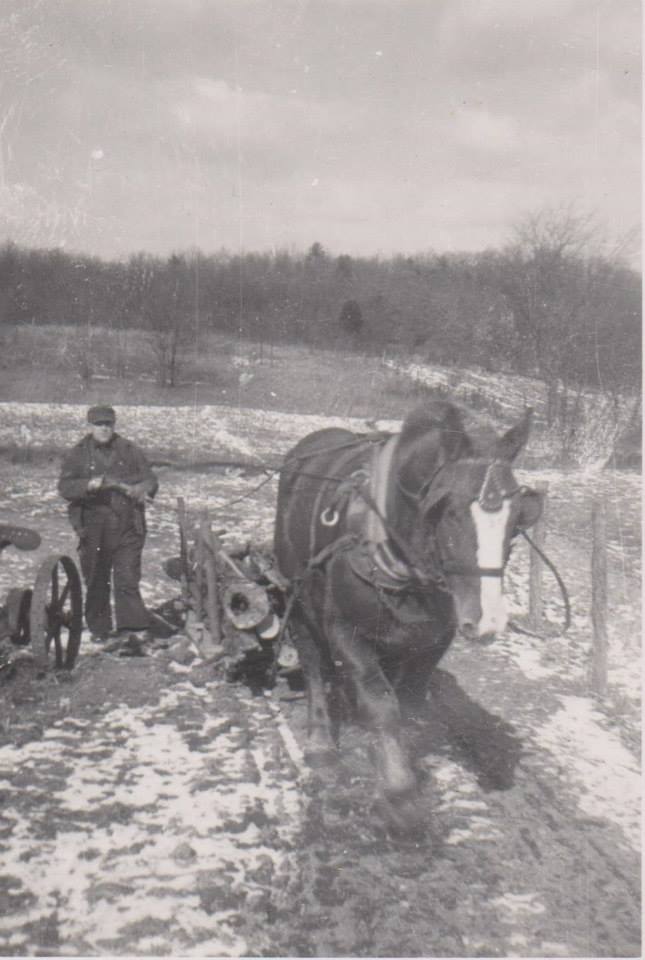
Sandy Wiseheart on the farm.

Sanford Wiseheart on the farm.

Sandy wasn’t afraid of hard work, and he did whatever job was necessary and available in order to provide for his family.

Wiseheart, Sanford - business card

Frank Springer: The Search Continues

I’ve posted a few times before about my great great grandfather, Frank Springer.  He disappeared from public records in 1893 and didn’t resurface until 1920.  Family letters (which I will post as soon as I have them scanned and in chronological order) place him in Oklahoma, Missouri, and Indiana during these years.

The mystery still remains as to what happened to him after 1920.  He does not appear on the 1930 or 1940 Census.  My grandpa remembered having met him in about 1931, so I’m operating under the assumption that he died after 1931.  A recently found letter reveals that Mildred Wiseheart, his daughter, did not know where he was or whether he was dead or alive in 1944.

Letter, Mildred Springer to Arthur Dillard, 25 Jun 1944, p.1

Letter, Mildred Springer to Arthur Dillard, 25 Jun 1944, p.1

Now my questions are:  When did he die?  Where did he die?  What happened to him between 1920 and the time of his death?  These are questions to which I may never have an answer, but that won’t deter me from searching.

James Roscoe Wiseheart: One Little Shoe

James Roscoe Wiseheart was born to parents Sanford Wesley and Mildred Gertrude (Springer) Wiseheart on November 13, 1930.  He had two older sisters and two older brothers, one of whom was my grandfather.  The family lived in Clark County, Indiana at the time.  Jimmy didn’t live long and I know very little about him.  Grandpa said that Jimmy was given his middle name, Roscoe, after his father’s good friend, Roscoe Treece.  Jimmy died at the age of two from convulsions due to a fever that was brought on by lobar pneumonia.¹  He was the first of two Wiseheart children to die young.  The other was Mary Katherine, who was born after Jimmy died.

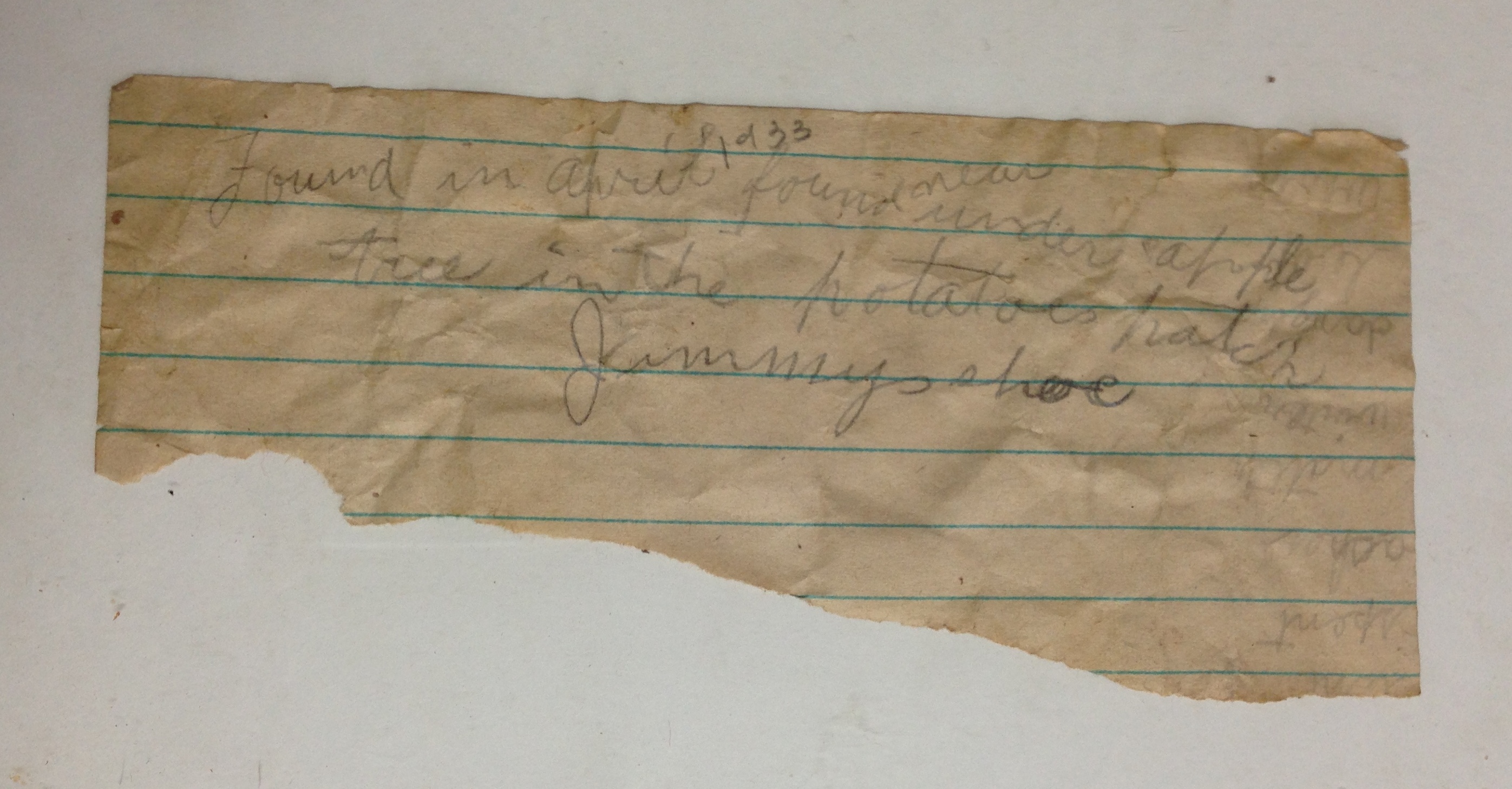
Recently, as my dad, my uncle and I were going trough the Rakestraw trunk, we came across a photograph of Jimmy in his coffin (which I will not post) and one little shoe that had been found in the potato patch just four months after his death.  How heartbreaking it must’ve been to find the shoe, and how precious.

The note that had been tucked into the shoe.

The note that had been tucked into the shoe.

Jimmy's shoe.

Jimmy’s shoe.

2015-02-22 12.46.49


1.  Clark County, Indiana Deaths, Roll 20, Book 2, p.11, Jeffersonville Township Public Library.