Leason Gilliland: The Elusive Leason (52 Ancestors #30)

The Elusive Leason.  It sounds like a magician’s stage name or something.  Perhaps he should have been a magician.  When I think of ancestors who have been a challenge to research, several names come to mind, but none have been more challenging than Leason Gilliland.  I mentioned him once before.  He is the ancestor that my grandpa had said worked on a steamboat and was away from home all the time.  I have little idea where he came from and no idea where he ended up.  He just disappeared.

In the beginning, all I had was a name on a pedigree chart.  My grandparents had done some research, but I had no idea what it was or where it was.  Honestly, I was a teenager at the time and really didn’t care very much.  I just wanted the names.  As I got older and worked with my grandparents more, I began to understand the importance of documents and researching things for oneself.  The first piece of documentation that I found for Leason was the 1840 Census.  Being a pre-1850 census, it didn’t yield very much information.  What it did yield was Leason Gilliland (age 20-30), presumably a wife (age 20-30), and presumably two sons (both under 5).  He was employed in agriculture and living in Hardin County, Kentucky.1

Agriculture to steamboating seems like a big leap to me, but I can’t totally discount it.  The story was told to my grandpa by Leason’s daughter, Mary Elizabeth.  It seems to me that if anyone knew what became of Leason, his wife or children would.  And it would go a long way to explaining why he just disappeared.  I discussed this with a co-worker and she suggested that perhaps steamboating was more lucrative than farming at this particular time and place.

I looked for Leason and his family members on the 1850 Census.  I found that Zerelda Gilliland (31) and her children, Daniel (12), William (10), Ezra (8), and Mary (1), were living with Asa and Maria Loundsbury in New Albany, Indiana.2  I could not find Leason.  I looked at the clues I had from this record.  If Zerelda was 31 in 1850, she would have been 21 in 1840.  If Daniel was 12 and William was 10 in 1850, they both would have been under 5 in 1840.  The other children would not have been born yet.  This all fit.  Also, Zerelda and all of the children except for Mary were born in Kentucky.2  I was left with two questions here.  How did the Gillilands know Asa Loundsbury?  Did Leason die before 1850?

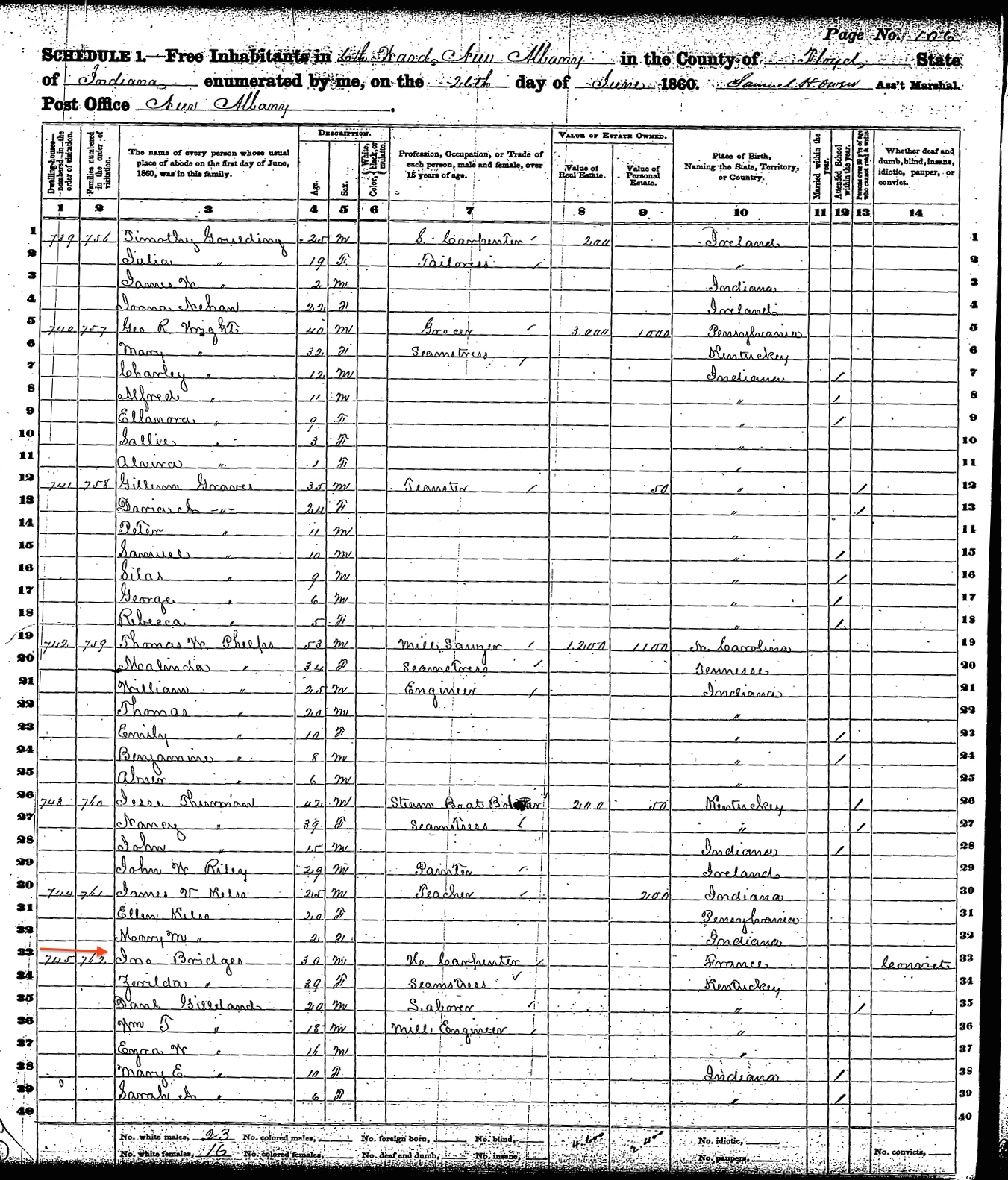
I researched Asa Loundsbury a little but could not find any obvious connection, so I moved on.  I knew from other research that Serilda Gilliland married John Bridges in 1857.3  I looked for Leason in the 1860 Census anyway, just in case they got divorced.  No luck there.  John Bridges’ household included Zerilda Bridges (39), Daniel Gilliland (20), William Gilliland (18), Ezra Gilliland (16), Mary Gilliland (10), and Sarah Gilliland (6).4  This was a surprise.  If Sarah Gilliland was born circa 1854, then Leason did not die before the 1850 Census.  Why wasn’t he listed?  Maybe he did hop a steamboat.  He must have died before 1857 though, for Serilda to have remarried.

With all of this census research, I still didn’t have any real proof that Leason was the husband of Serilda or the father of her children.  All of this was based on what Mary Elizabeth Gilliland told my grandpa.  While I was doing some more research on Ezra Gilliland, I managed to find his death record.  His parents were listed as Leason Gilliland and Cerelda Lone.5  I re-checked Mary Elizabeth’s death record, but her parents names were unknown by the informant.  I have been unsuccessful in locating death records for any of the other children.

With nowhere else to go moving forward, I decided to move backward.  I really had no way of knowing who Leason’s father might be since I don’t know when or where he died to begin to look for death records, obituaries, church records, or the like.  I took a wild leap on my break last week and searched for all Gillilands in Hardin County, Kentucky on the 1820 Census when Leason, theoretically, would have still been living at home.

The only Gilliland in Hardin County in 1820 was James Gilliland (age 26-44), presumably a wife (age 26-44), what appears to be a mother or mother-in-law (age 45 and over), and children: one male 16-18 and two males under 10, and one female 10-15 and two females under 10.6  In 1820, Leason would have been under 10.  Not proof, but a good lead.

I pursued this lead and looked for James Gilliland on the 1850 Census to see who else might be listed in his household.  For some reason, James was enumerated twice in 1850, once in August and once in October, both in Hardin County.  I guess they moved between these months.  They are enumerated first as the 228th family visited and then as the 549th family visited.  The problem I have here is that some of the ages are vastly different in the span of just two months.  What I do gather from these records is that James’ wife was Mary and a son, Thomas, was living with him or next door.7,8  Averaging the two enumerations, Thomas would have been born circa 1819, which means he would have been under 10 on the 1820 Census.

I knew we had some Kentucky books at work, so I checked the shelf and found two marriage record books for Hardin County, Kentucky in the early 1800s.  I looked for James Gilliland and Thomas Gilliland.  I found that James married Polly Morrison on October 4, 1808 and Thomas married Elizabeth LeMaster on June 30, 1838.9,10  James Gilliland gave consent for Thomas to be married, which would put Thomas under 18 in 1838.10  If he had been born in 1820, he could have been under 10 on the 1820 Census, 17 and almost 18 at the time of his marriage, and 30 years old on the 1850 Census.

I went home and told my dad about the new lead and what I had discovered.  He called me back in the room a little bit later because he had done some searching with the new information and stumbled across Steven Butler’s website, which includes an interesting little history on the James Gilliland family.

According to this, James’ daughters were Letitia (1810) and Sarah (1811), which would put them in the under 10 category in 1820.11  This didn’t match what I found on the 1830 and 1840 Census for James Gilliland and family, so I set to work with a pile of census pages and copies from the Hardin County marriage books and filled in a Family Group Census Grid for James Gilliland.  Luckily for me, most of James’ children were under age at the time of their marriage, which gave me a good idea of approximate birth dates to compare with the census records.  After checking records, doing some math, re-checking records, and re-checking my math, I finally came up with what I believe is an accurate account of the Gilliland family movements.

James Gilliland Census Grid

What is really exciting to me is that Leason fits the unnamed son’s criteria!  I can find no other evidence of possible parents for Leason and I can find no other evidence of a different son for James and Polly.  It’s still not definitive proof, but it’s better than the thread I had in the beginning.  I may never find any more on Leason Gilliland or his possible connection to the James Gilliland family, but I look forward to trying!


Sources

1.  Ancestry.com. 1840 United States Federal Census [database on-line]. Provo, UT, USA: Ancestry.com Operations, Inc., 2010.   Year: 1840; Census Place: Hardin, Kentucky; Roll: 113; Page: 30; Image: 65; Family History Library Film:0007827.

2.  Ancestry.com. 1850 United States Federal Census [database on-line]. Provo, UT, USA: Ancestry.com Operations, Inc., 2009. Images reproduced by FamilySearch.  Year: 1850; Census Place: New Albany, Floyd, Indiana; Roll: M432_145; Page: 301A; Image: 14.

3.  Floyd County Clerk. Microfilm. Floyd County, Indiana Marriages Volume 4 (1857): p.485.  Accessed 09 Jan. 2015, Stuart Barth Wrege Indiana History Room.

4.  Ancestry.com. 1860 United States Federal Census [database on-line]. Provo, UT, USA: Ancestry.com Operations, Inc., 2009. Images reproduced by FamilySearch.  Year: 1860; Census Place: New Albany Ward 6, Floyd, Indiana; Roll: M653_257; Page: 422; Image: 426; Family History Library Film: 803257.

5.  Floyd County Health Department. Microfilm. Floyd County, Indiana Deaths CH-33 (1920): p. 54, record 300.  Accessed 11 Feb. 2015, Stuart Barth Wrege Indiana History Room.

6.  Ancestry.com. 1820 United States Federal Census [database on-line]. Provo, UT, USA: Ancestry.com Operations, Inc., 2010. Images reproduced by FamilySearch.  Year: 1820; Census Place: Philadelphia, Hardin, Kentucky; NARA Roll: M33_23; Page: 8; Image: 15.

7.  “United States Census, 1850,” database with images, FamilySearch (https://familysearch.org/ark:/61903/1:1:M657-T64 : accessed 17 December 2014), James Gillilan, Hardin county, Hardin, Kentucky, United States; citing family 228, NARA microfilm publication M432 (Washington, D.C.: National Archives and Records Administration, n.d.).

8.  “United States Census, 1850,” database with images, FamilySearch (https://familysearch.org/ark:/61903/1:1:M65W-7XK : accessed 17 December 2014), James Gillelund, Hardin county, Hardin, Kentucky, United States; citing family 549, NARA microfilm publication M432 (Washington, D.C.: National Archives and Records Administration, n.d.).

9.  Jones, Mary Josephine., comp. Hardin County, Kentucky Marriages 1793 to 1829. Vine Grove, KY: Ancestral Trails Historical Society, 1996. Print. p. 12.

10.  Jones, Mary Josephine., comp. Hardin County, Kentucky Marriages 1830 to 1850. Vine Grove, KY: Ancestral Trails Historical Society, 1996. Print. p. 24.

11.  Butler, Steven. “Biographies: James Gilliland.” Steven Butler’s Family History Website. N.p., 11 Feb. 2011. Web. 18 July 2015.
Serilda Long: A Long Life (52 Ancestors #16)

Serilda Long is another ancestor that I have had a hard time tracking.  She has appeared as Serilda, Sirelda, Serelda, Serrelda, Serralda, Zerelda, Zerilda, and Cerelda.  She has been Long, Gilliland (sometimes Gilleland, Gilland or Gillen), and Bridges.  I really should re-evaluate how I spell it.  I’ve just been spelling it Serilda because that’s how it appeared on the first record on which I saw it written.  It appears most often as Zerelda or Serelda.  But I digress.

Serilda Long was born on January 15, 1820, in Kentucky, to parents Daniel and Ruth (Lewis) Long.1,3,5,7,8,9,10  She married Leason Gilliland sometime before 1840.11  The story I heard growing up was that Leason worked on a steamboat and was away a lot, but the 1840 Census says that he was employed in agriculture.2  I suppose it is possible that he switched professions, as many of my ancestors have done, but that seems like a big change to me.

Serilda and Leason had Daniel circa 1838, William T. circa 1840, Ezra W. in 1841, and Mary Elizabeth on January 22, 1849.1,3,5,7,8,11,12  In 1850, Serilda and the children were living with Asa and Maria J. Loundsbury or Longsberry.3  Leason wasn’t there, which caused me to suspect that he had died.  However, Sarah A. Gilliland was born in 1853.5,7,8  Either Leason was still alive and happened to be away from home, prompting Serilda to move in with a friend or neighbor, or Sarah was illegitimate.

Leason was most likely dead by 1857 (I haven’t found evidence of a divorce), as Serilda married John T.M. Bridges on October 15 of that year.4  Shortly after their marriage, John Bridges was tried for and convicted of murder and was sentenced to life in Indiana State Prison in Jeffersonville, Indiana in 1859.  (See Coroner’s Inquest, Trial Day 1, Trial Day 2, Trial Day 3, Trial Day 4, and The Verdict).  By 1860, Serilda had taken a job as a seamstress to provide for her family.5  At some point during John’s confinement, they must have realized that the “preacher of the Gospel” who had married them was not actually ordained and the marriage, therefore, not legal.  (See Marriage Mystery and Two Marriages).  John was released from prison for good behavior on February 2, 1871 (See John Bridges), and Serilda married him again the very next day.6

John died in 1899, and Serilda went to live with her daughter, Sarah, and her children.  Her son, Ezra, lived with them as well.8  Serilda lived with Sarah until her death on September 13, 1907.1,9,10  Serilda lived a long life, but I wonder if she would have lived longer without all of the stress that she must surely have felt.

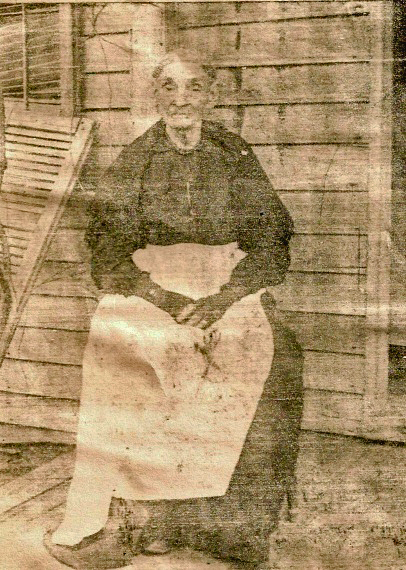
Serilda Bridges, circa 1900.

Serilda (Long) Gilliland Bridges, circa 1900.


Sources

1.  Transcription of the Rakestraw Family Bible.

2.  1840 U.S. Census, Hardin, Kentucky, p. 30, Ancestry.com.

3.  1850 U.S. Census, New Albany, Floyd, Indiana, p. 105, HeritageQuestOnline.com.

4.  Floyd County, Indiana Marriages, Volume 4, p. 485, Stuart Barth Wrege Indiana History Room.

5.  1860 U.S. Census, 6th Ward, New Albany, Floyd, Indiana, p. 106, FamilySearch.org.

6.  Floyd County, Indiana Marriages, Volume 6, p. 644, Stuart Barth Wrege Indiana History Room.

7.  1880 U.S. Census, New Albany, Floyd, Indiana, p. 2B, HeritageQuestOnline.com.

8.  1900 U.S. Census, 5th Ward, New Albany, Floyd, Indiana, p. 16B, FamilySearch.org.

9.  Floyd County, Indiana Deaths, Book CH-20, p. 32, Stuart Barth Wrege Indiana History Room.

10.  Obituary, New Albany Evening Tribune, Friday, 13 Sept 1907, p. 4, column 2, Stuart Barth Wrege Indiana History Room.

11.  Floyd County, Indiana Deaths, Book CH-33, p. 54, Stuart Barth Wrege Indiana History Room.

12.  Floyd County, Indiana Deaths, Book CH-37, p. 67, Stuart Barth Wrege Indiana History Room.

John Bridges: Maniacal, Mischievous, or Misunderstood?

On a rare few occasions, my grandpa told me about John Bridges, my fourth great grandmother’s second husband.  He never spoke in specifics.  He said that his great grandmother, John’s step-daughter, did not like him.  According to family legend, John was a drunk and a layabout who never worked.  He went to prison and was eventually put in the asylum because he was insane.  I never cared to look into it until I happened upon his two marriages to Serilda Gilliland.

I know nothing of John’s life before he married Serilda.  John Bridges is a fairly common name.  In fact, there was another John Bridges living in the same town at the same time.  In addition, multiple birth places are given for him and I have next to no information about his parents.

In previous posts, I revealed that John Bridges married Serilda Gilliland in 1857, and then again in 1871 because the first marriage wasn’t valid.  I also posted at length about the trial for the murder of Charles Baker and the subsequent sentence of life in the state prison in Jeffersonville.  I still had no answers as to how John could go to prison, in Clark County, for life in 1859 and then somehow be in Floyd County in 1871 to marry Serilda again.  So I kept looking.

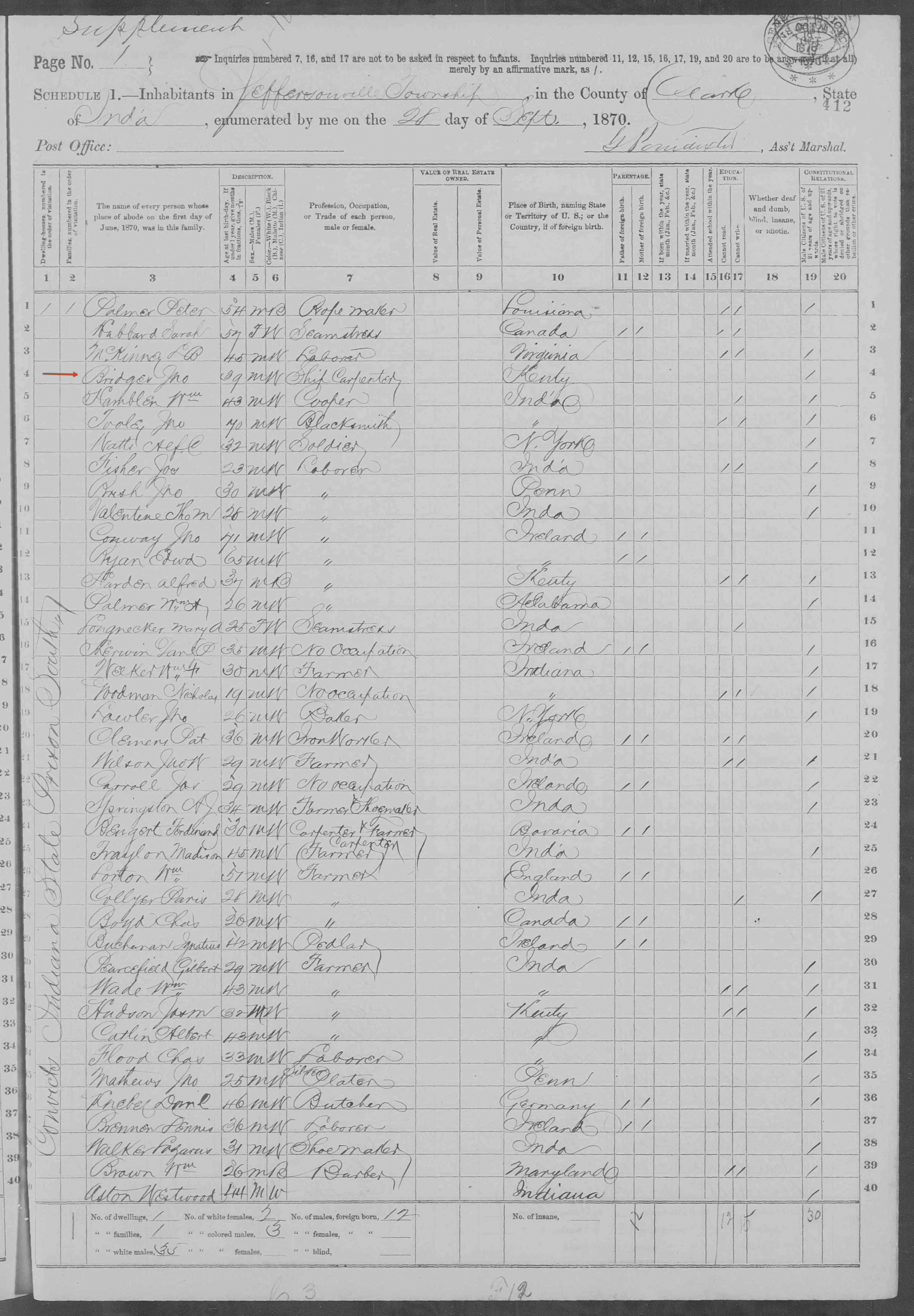
I found him on the 1860 Census listed with the family, but in the 14th column, he is marked “convict.”  It also gives his birthplace as France.  It is important to note that he is listed as a ship carpenter, which means he did, at one point at least, have a job.  In the 1870 Census, John is listed among other convicts in the Indiana State Prison South supplement.  Here, his birthplace is Kentucky and he is still listed as a ship’s carpenter.  Then, in 1871, John is released from prison.

New Albany Daily Ledger, Friday, 3 February 1871, p.2, column 1, Stuart Barth Wrege Indiana History Room

New Albany Daily Ledger, Friday, 3 February 1871, p.2, column 1, Stuart Barth Wrege Indiana History Room

The case of the prosecution seemed shaky.  It relied heavily on the testimonies of people who were known to lie and people who simply overheard something, what is known in court as “hearsay.”  The paper had stated that there would be a move for a new trial.  I suppose that a pardon isn’t hard to believe.  This explains how John was able to get married in Floyd County on the very day that this article was published.  The fact that John was pardoned made me wonder what else in the family legend may have been skewed.  And the search continued.

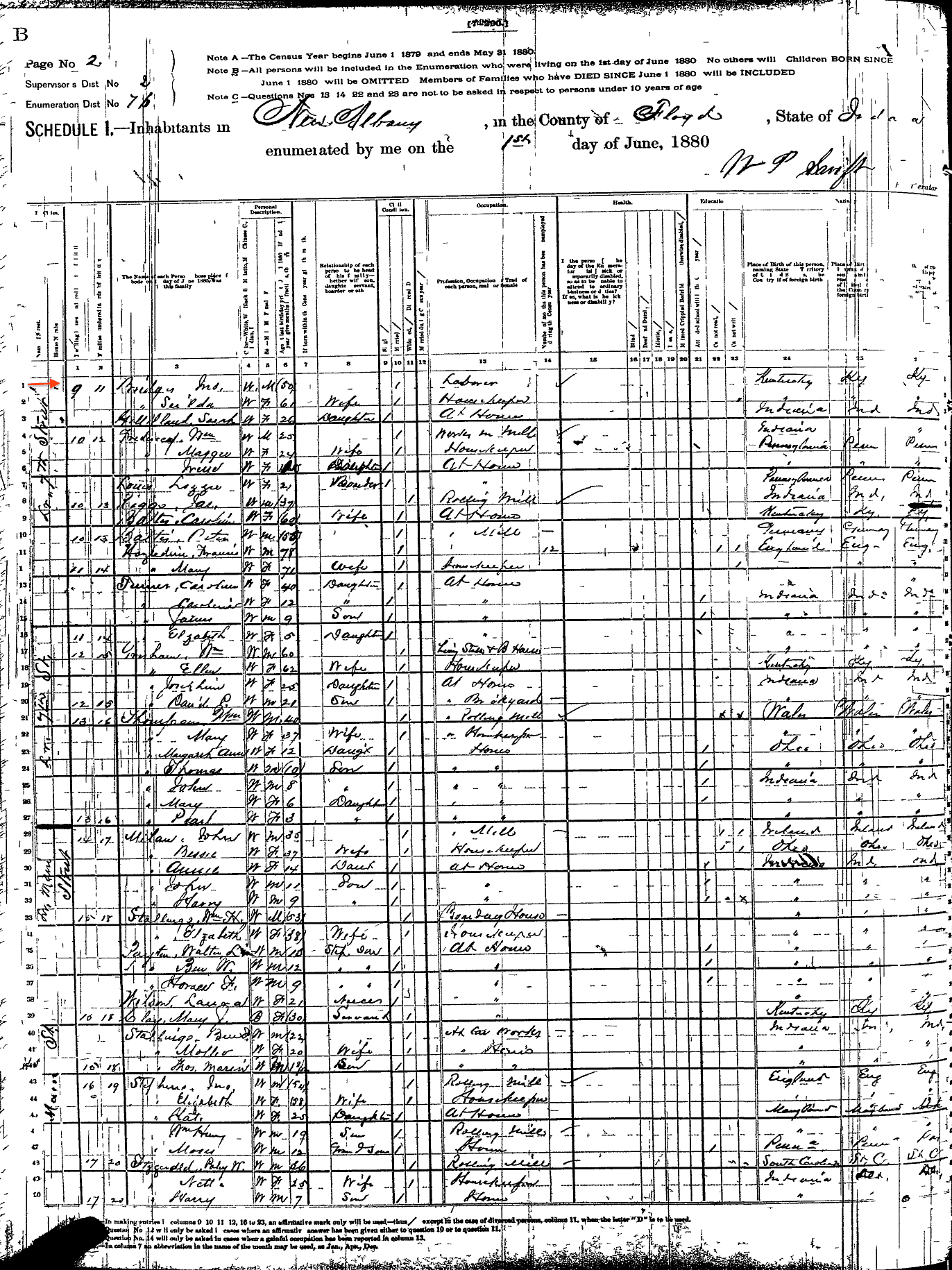
In the 1880 Census, he was living with his wife and youngest step-daughter.  He is a laborer.  His birthplace is Kentucky, as is the birthplace of both his parents.  He managed to stay out of trouble for about ten years after his release, or at least anything that the newspaper would have found out about.  Until…

New Albany Ledger, Thursday, 20 July 1882, p.4, column 2, Stuart Barth Wrege Indiana History Room

New Albany Ledger, Thursday, 20 July 1882, p.4, column 2, Stuart Barth Wrege Indiana History Room

Somehow, he got out of it with only a fine.  The next item in the timeline for John Bridges is his entry into the Floyd County Asylum (aka. Floyd County Poor Farm) and subsequent death.  He entered the asylum on March 13, 1899 and his condition was “sickly,” not insane or feeble-minded.  He died on May 2, 1899.  His obituary confirms his condition.

New Albany Daily Ledger,  2 May 1899, p.4, column 2, Stuart Barth Wrege Indiana History Room

New Albany Daily Ledger, 2 May 1899, p.4, column 2, Stuart Barth Wrege Indiana History Room

I always have to take newspaper articles with a grain of salt.  In fact, never believe what you read in the paper unless you have another document to confirm it.  This one says that John was in the asylum for two years, when asylum records state it was two months.  It does confirm that he was in poor health.  It also suggests that he was able to work until recently.  His death record provides no new information, other than another possible birthplace.

Floyd County, Indiana Deaths, CH-18, p. 7 (transcription)

Floyd County, Indiana Deaths, CH-18, p. 7 (transcription)

Addressing the issues…

Was John Bridges a drunk?  It’s hard to say.  The only mention of alcohol was in the murder trial.  He was at a bar at about four o’clock in the afternoon and “seemed to be in liquor.”  Was this a regular occurrence or was it to do with the upcoming confrontation with Baker?  We’ll probably never know.

Was he a layabout who never worked?  Not from what I can tell.  He is listed on two census as a ship’s carpenter and as a laborer on a third.  His step-son said that he was a watchman on the river.  His obituary said that he had been “unable to work in recent years.”

Did he go to prison?  Yes.  He was sentenced to life in prison for the murder of Charles Baker.  He was pardoned after he had served twelve years.

Was he sent to the asylum for insanity?  No.  The asylum records indicate that he was “sickly.”  His obituary confirms that he had come out of prison in “broken health.”  There is no indication that he was insane.  That’s not to say he wasn’t, but there are no official records indicating insanity and that is not the reason he ended up in the asylum.  It is strange that he has three different birthplaces.  This could indicate insanity, or maybe he enjoyed tall tales.

I still have very few hard facts about John Bridges, but I feel as though I have a fairly complete story for him (minus his early life).  I also find that I don’t dislike him as much as I did before.  When I stop to think about it, it’s amazing the strong feelings I have for and about people I’ve never met simply because I am related to them.  I know it has to be the same for others, to some degree.  I see it when people talk about how proud they are of their Revolutionary War or Civil War ancestors, or how scared they are that they might find skeletons in the family closet.  To the latter, I say, keep researching, because what you think you know may not be what really happened.  John Bridges is a case in point.

Two Marriages & A Murder

Three days ago, I posted about Serilda Gilliland marrying John Bridges twice and that John went to prison for murder.  I was able to unravel a little bit more today.  First, I looked up the Daniel G. Stewart who was a minister from 1835 to 1837 again, and he was actually Daniel S. Stewart and is not the same D.G. Stewart who married them.  I looked in a different city directory today (1848) and David G. Stewart was listed as a homeopathic doctor.  Having the correct first name, I looked him up in the newspaper index and found a listing for an obituary.  According to his obituary in the New Albany Daily Ledger Standard (9 Apr 1878, p.4, c.2-3), David G. Stewart was a doctor who moved to New Albany in 1832.  He joined the First Christian Church and regularly preached when the the pastor was absent.  He was not ordained.  Therefore, Serilda and John’s first marriage was not valid.  Now I know the mechanics of why they were married twice, but I’m still left wondering how he got out of prison for it.

Now, on to the murder trial…

The State of Indiana v. John Bridges:  Coroner’s Inquest

New Albany Daily Tribune, 17 Jan 1859, p.3, c.1, Stuart Barth Wrege Indiana History Room

New Albany Daily Tribune, 17 Jan 1859, p.3, c.1, Stuart Barth Wrege Indiana History Room

A Marriage Mystery

Last night, while doing research for a collection that I’m processing at work, I saw my great great great great grandmother’s name on a marriage record index page… twice… to the same man… fourteen years apart.  I quickly made a note to look them up later.  I knew that she had been married once to Leason Gillilland, from whom I am descended, and who died young.  I knew that she married John Bridges after Leason died.  Today, on my lunch break, I did look up the records.  The first one was John T.M. Bridges and Sirelda Gilland on October 15, 1857.  The second was John T.M. Bridges and Serrelda Gilliland on February 3, 1871.

Floyd County, Indiana Marriages, Vol. 4, p.485

Floyd County, Indiana Marriages, Vol. 4, p.485, Stuart Barth Wrege Indiana History Room

Floyd County, Indiana Marriages, Vol. 6, p.644

Floyd County, Indiana Marriages, Vol. 6, p.644, Stuart Barth Wrege Indiana History Room

This is weird.  I consulted a co-worker who has been doing genealogy far longer than I have and has taught me most of what I know about researching.  She agreed that it is weird.  At first we thought that maybe the first marriage was invalid.  The name of the minister is smudged out and we thought that possibly he wasn’t really a minister.  A cleaner copy of that marriage record is available on FamilySearch.org and the minister’s name can be read.  He is D. G. Stewart.  Daniel G. Stewart is listed in the back of the index as being a minister from 1835-1837.  In the 1857 New Albany city directory, he’s listed as a homeopathic physician.  While I was looking up the minister, my co-worker searched the newspaper index for me.  She found that John Bridges wasn’t such a great guy.

My grandfather had always told me that John was a drunk and that he was constantly in trouble.  He had heard stories about John from his great grandmother, Serilda’s daughter, who had helped raise him.  Today, I discovered that John murdered a man, was convicted, and went to the Indiana State Prison in Jeffersonville, Indiana.  I didn’t have a lot of time on my lunch, so I only read the brief descriptions of the over a dozen articles on the trial and his other run-ins with the law.  I’ll copy those as soon as I can.  The result of the trial is that he was convicted in 1859.  The 1860 Census lists him with the family, but in the last column, where it asks for a person’s condition, it says “convict.”  In the 1870 Census, he’s listed among other convicts as being in Indiana State Prison.  Yet, somehow, he married or re-married Serilda in 1871.  Maybe the marriage was annulled or they got a divorce when he went to jail?  Maybe the first marriage really wasn’t legal?  I’m not sure.  What I really want to know is did they get married in the jail, or was he released from prison after only twelve years when he was sentenced for murder?  I’m hoping the articles about the trial will shed some light on that.