Phillip Irey: What’s in a Will (52 Ancestors #18)

I haven’t done much research on my Irey line.  Syntha Irey is the only one I’ve thoroughly researched.  This week’s 52 Ancestors in 52 Weeks theme of “Where There’s a Will” prompted me to research Syntha’s father, Phillip Irey.  I have a copy of his will from a probate record and I’ve never done anything with it other than to use it as one source for Syntha’s marriage to Charles Rakestraw.  I began to follow the other clues in the will and was surprised at how much information I found in just a few hours.

The first thing I noted was that Phillip named children and grandchildren in his will, but not his wife.  I surmise from this that she must have died prior to the writing of the will, which was on August 22, 1841.  In the 1840 Census, Phillip was between the ages of 80 and 90.  There was a tick mark in the corresponding column on the female side, which was presumably his wife.  The 1840 Census enumeration began on June 1st, so it seems that Phillip’s wife died sometime between June 1, 1840 and August 22, 1841.

The next thing I noticed was a legal description for land in “Fort Wain,” Indiana.  I’ve been working with deeds and abstracts a lot lately at work, so that just jumped right out at me.  I did find a deed for Phillip Irey who purchased land matching that description in Fort Wayne, Indiana on August 20, 1838.
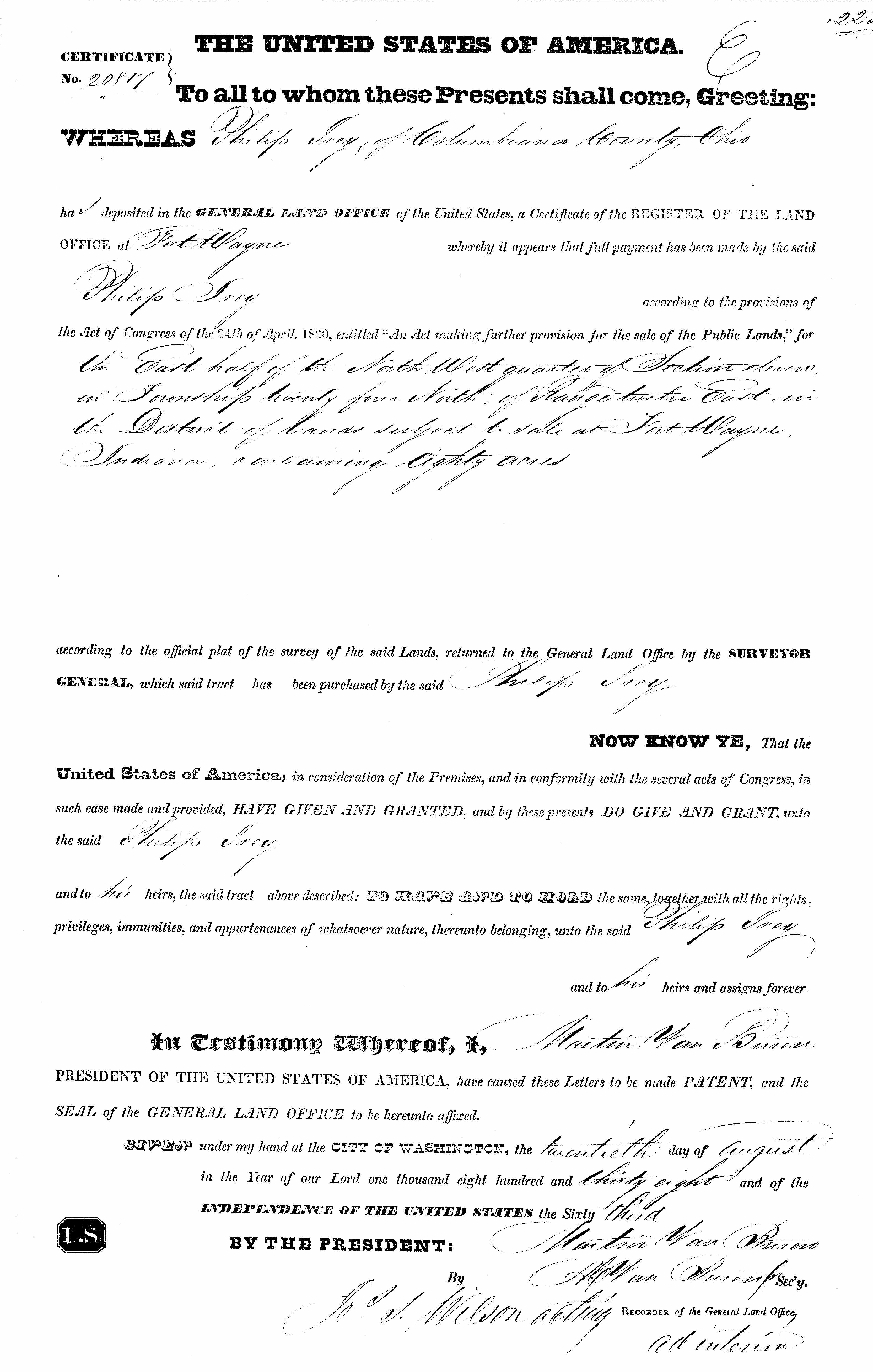
U.S. General Land Office Records, 1796-1907, deed for land in Fort Wayne, Allen, Indiana, Ancestry.com

U.S. General Land Office Records, 1796-1907, deed for land in Fort Wayne, Allen, Indiana, Ancestry.com

I also found a deed for land that he had purchased in Bucyrus, Ohio on April 5, 1836.

U.S. General Land Office Records, 1796-1907, deed for land in Bucyrus, Crawford, Ohio, Ancestry.com

U.S. General Land Office Records, 1796-1907, deed for land in Bucyrus, Crawford, Ohio, Ancestry.com

Next, I decided to run through the names of the children.  All of his daughters were married by the time he wrote his will, so this gave me a bit more to go on, knowing their married names.  I managed to find marriage records for all of his children (John, Isaac, Dawson, Sarah, Susannah, Jane, Eli, and Syntha) on FamilySearch.org.

Since Phillip bequeaths a portion of his estate to the children of Susannah and Jane, I am fairly certain that they had both died before August 22, 1841.  It also appears from the language of the will that Dawson was not expected to live long.

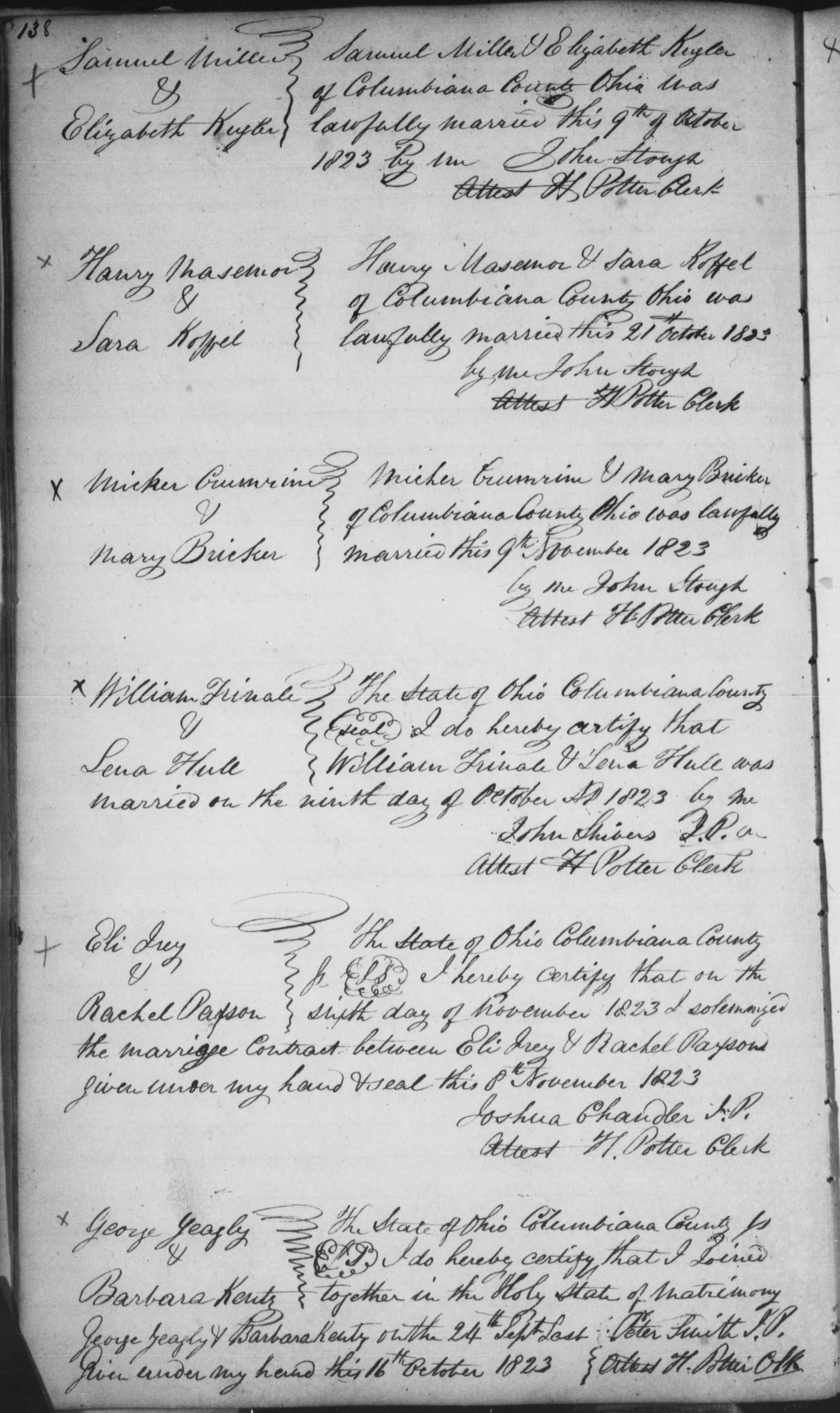
The Quaker records pertaining to Jane and Eli were probably the most significant find of the night.  Jane Irey married Joseph Paxson, and Eli Irey married Joseph’s sister, Rachel.  Presumably, the Paxsons were Quakers, since they are the ones listed in the book and Jane and Eli show up merely as spouses.  The Meeting records give lots of good information.
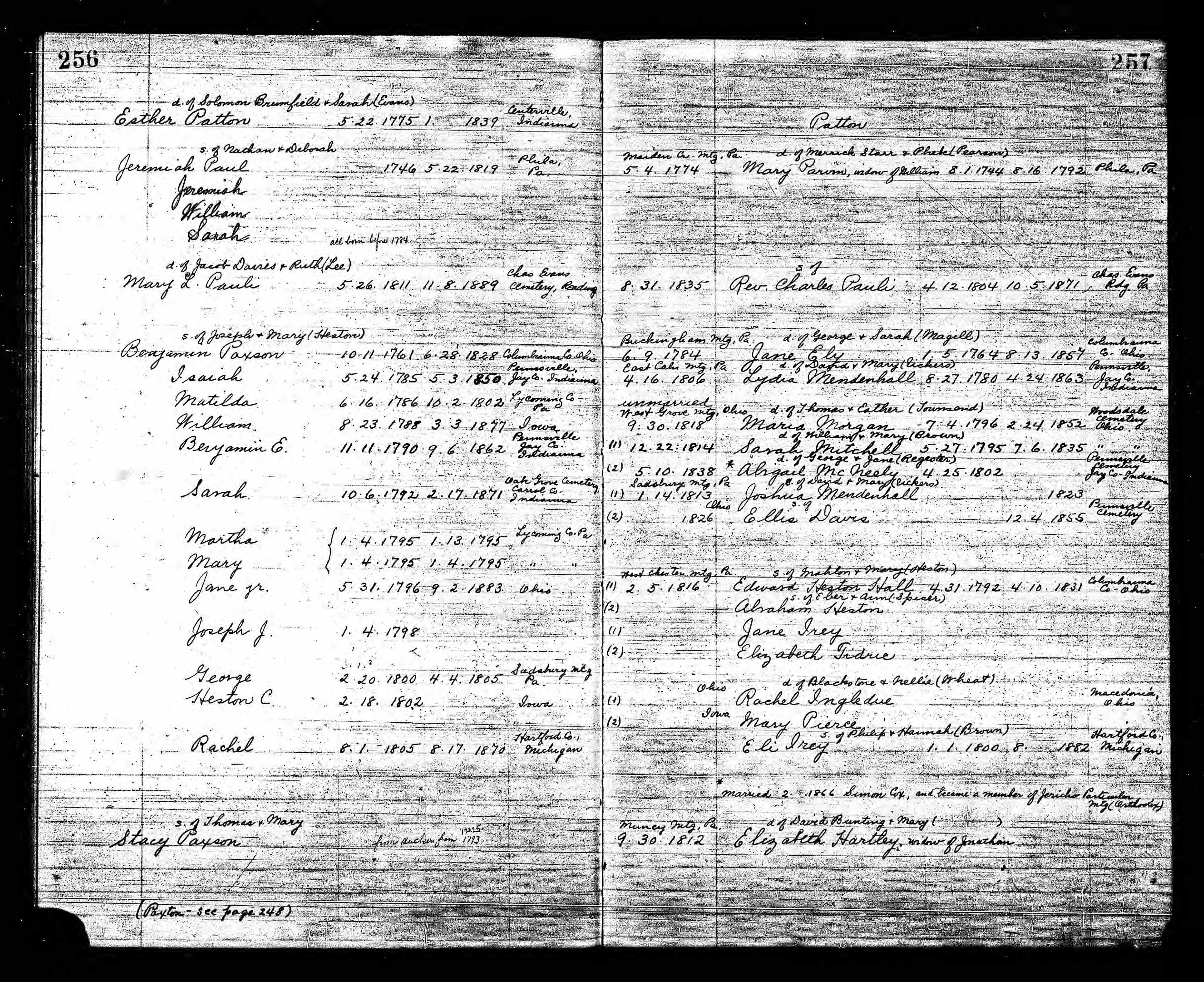
U.S. Quaker Meeting Records, 1681-1935, Exeter Monthly Meeting, Berks, Pennsylvania, p. 256, Ancestry.com

U.S. Quaker Meeting Records, 1681-1935, Exeter Monthly Meeting, Berks, Pennsylvania, p. 256, Ancestry.com

U.S. Quaker Meeting Records, 1681-1935, Wrightstown Monthly Meeting, Bucks, Pennsylvania, p. 108, Ancestry.com

U.S. Quaker Meeting Records, 1681-1935, Wrightstown Monthly Meeting, Bucks, Pennsylvania, p. 108, Ancestry.com

The headers for the columns should read as follows:  Name, Date of Birth, Date of Death, Place of Burial, Marriage, Spouse’s Name, Date of Birth, Date of Death, Place of Burial.  In addition, they wrote in the names of parents where they could.

From this, I know that Phillip’s wife was Hannah Brown.  Eli Irey was born January 1, 1800 and died in August of 1882 and is buried in Hartford County, Michigan.  Not much can be learned about Jane Irey, other than she was the first wife of Joseph Paxson.  This also gives a lot of information on Joseph Paxson, his siblings, his parents, and even the names of his grandparents.  A fantastic find!

Louise Reisenberg: A Leap of Faith (52 Ancestors #17)

I am fortunate to have a family full of storytellers with long memories. What this means for me, though, is that my genealogical research primarily entails proving or disproving these stories. One story, on which I am currently working, is about my great great grandmother, Louise Reisenberg (or Risenburg).

Louise (Reisenberg) Schroeder, circa 1900.

Louise (Reisenberg) Schroeder, circa 1905.

Louise’s story, if I remember right, is as follows. One day, a sixteen year old Louise was working in the field on her family’s farm, she heard God tell her to leave her home and her family and go to America. She went back to the house and told her parents what God had told her to do. Her parents believed that she should do as God commanded and sold a cow to buy her passage to America. Louise didn’t speak a word of English, so she found a German family on the boat who were heading to Toledo, Ohio and she went with them. In Toledo, she got a job to support herself and married Frederick Schroeder.

Proving the story has been difficult, but I do believe that it is true based on what I have found so far.

Louise Reisenberg was born in Germany in November of 1860.1,5,6,8,10,11  She came to America in 1882, and arrived in Baltimore, Maryland on the Hermann on April 19th of that year, at the age of 21.1,5,6,8  From Maryland, she went on to Ohio, where she met Frederick Schroeder.  Fred and Louise married on May 8, 1882 in Lucas County, Ohio.2  Louise was a carpet weaver.5  Fred and Louise had six children:  Emma W., born circa 1883; Elizabeth A., born January 1885; Henry F., born circa 1887; Bertha Amelia, born March 30, 1890; John F., born October 1892; and George Herman, born September 21, 1896.3,4,5,6,7,8,9,10,11,12

Fred died sometime between 1896 and 1900.3,4,5  By 1900, Louise had been naturalized and could speak English.5  By 1930, she was living with her daughter, Bertha, and her son-in-law, Lloyd Bersticker.  She lived with them until she died in 1955.10,11

Most of the story couldn’t be directly proven with facts, but I feel that the facts support it.  A sixteen year old Louise could have heard God, and her parents could have sold the cow.  It may have taken some few years between the initial voice of God and setting off for America.  It also would have taken about a month for the actual voyage.  It seems likely to me that a non-English speaking young lady would have found a family to travel with that spoke her language.  I also have to wonder if maybe this family had connections to the Schroeders in Toledo.  Louise arrived in Maryland on April 19th and married Fred on May 8th, so maybe the family arranged it or suggested it.  Louise certainly did have a job as a carpet weaver.

Louise Reisenberg Schroeder is one of my ancestors about whom I am dying to know more.  She’s always been a bit of a mystery and I’m glad to have uncovered what I have so far.


Sources

1.  Baltimore, Maryland Passenger Lists Index, 1820-1897, FamilySearch.org.

2.  Lucas County, Ohio Marriages, 1789-1997, Vol. 3, p.379, FamilySearch.org.

3.  Ottawa County, Ohio Births, 1841-2003, Vol. 1, p.324, no. 94, FamilySearch.org.

4.  Ottawa County, Ohio Births 1891-1908, Vol. 2, p.245, no. 382, FamilySearch.org.

5.  1900 U.S. Federal Census, Benton, Ottawa, Ohio, p.12B, Ancestry.com.

6.  1910 U.S. Federal Census, Toledo, Lucas, Ohio, p.9A, Ancestry.com.

7.  Genesee County, Michigan Marriages, 1868-1925, Vol. 2, p.335, FamilySearch.org.

8.  1920 U.S. Federal Census, Toledo, Lucas, Ohio, p.4A, Ancestry.com.

9.  Lucas County, Ohio Marriages 1920, Vol. 39, p.483, FamilySearch.org.

10.  1930 U.S. Federal Census, Toledo, Lucas, Ohio, p.12B, Ancestry.com.

11.  1940 U.S. Federal Census, Toledo, Lucas, Ohio, p.7B, Ancestry.com.

12.  The Blade Correspondent (Toledo), 5 October 1964, Obituary, Emma Damschroeder, found a copy in my grandparents’ box not cited.

Syntha Irey: The Synthesis of a Name (52 Ancestors #15)

The Rakestraws have always been a difficult bunch to try to track down, the women in particular.  Like her great granddaughter, Syntha (Irey) Rakestraw lived a short and mostly undocumented life.  Also like her great granddaughter, her name is different on every record.

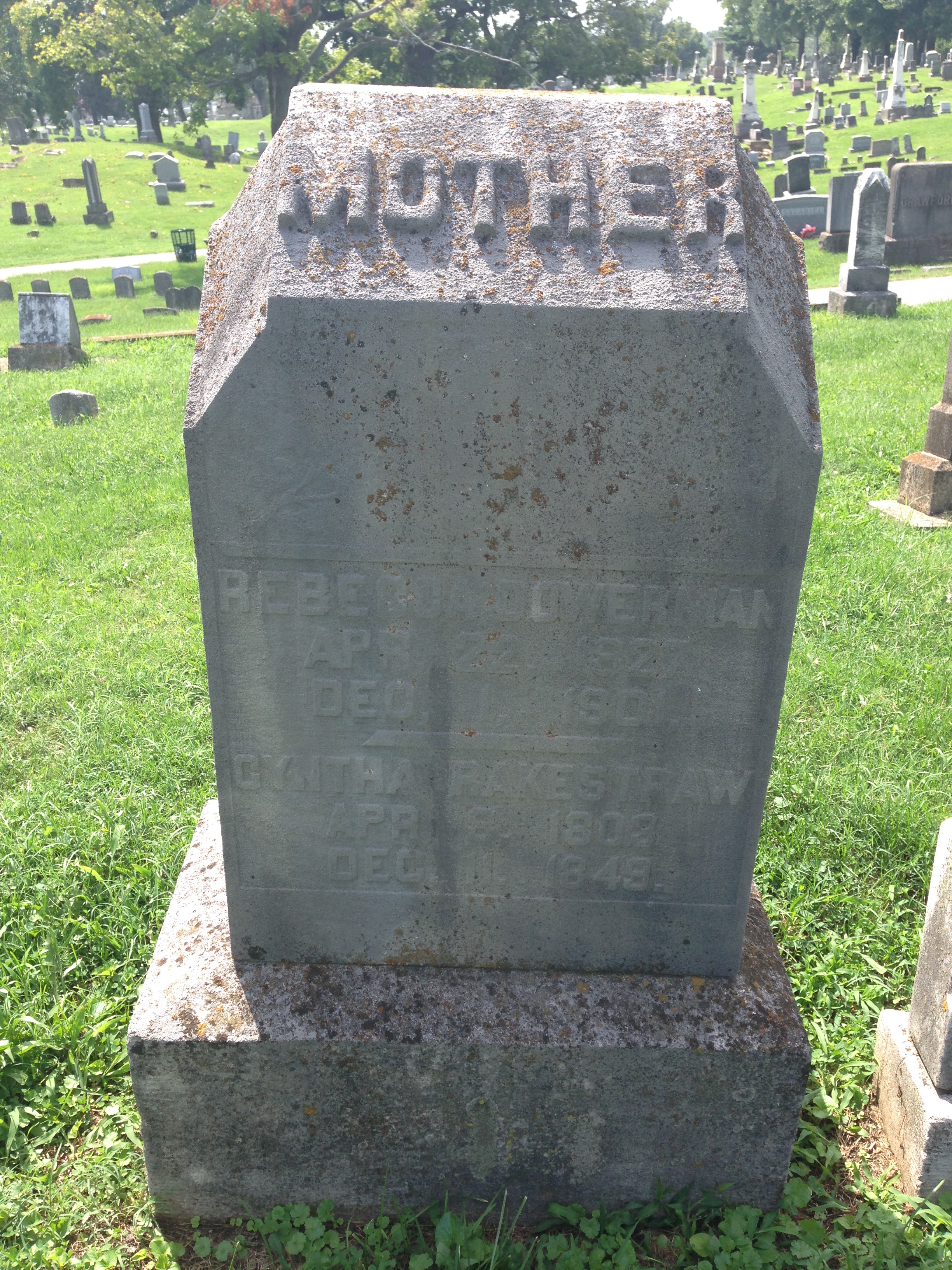
Syntha was born on April 8, 1803.  Her father was Phillip (or Philip) Irey of Butler Township in Columbiana County, Ohio.  She married Charles Rakestraw on December 6, 1821.  The couple and some of their children moved to New Albany, Indiana sometime between 1832 and 1840.  I’m still not sure how many children they had, but I have been able to prove eight and have leads on two more.  Syntha died of consumption on December 11, 1849, and was buried at Fairview Cemetery on the 17th.  I don’t know whether or not she originally had a tombstone, but she currently shares a stone with her daughter, Rebecca Dowerman, who died in 1901.

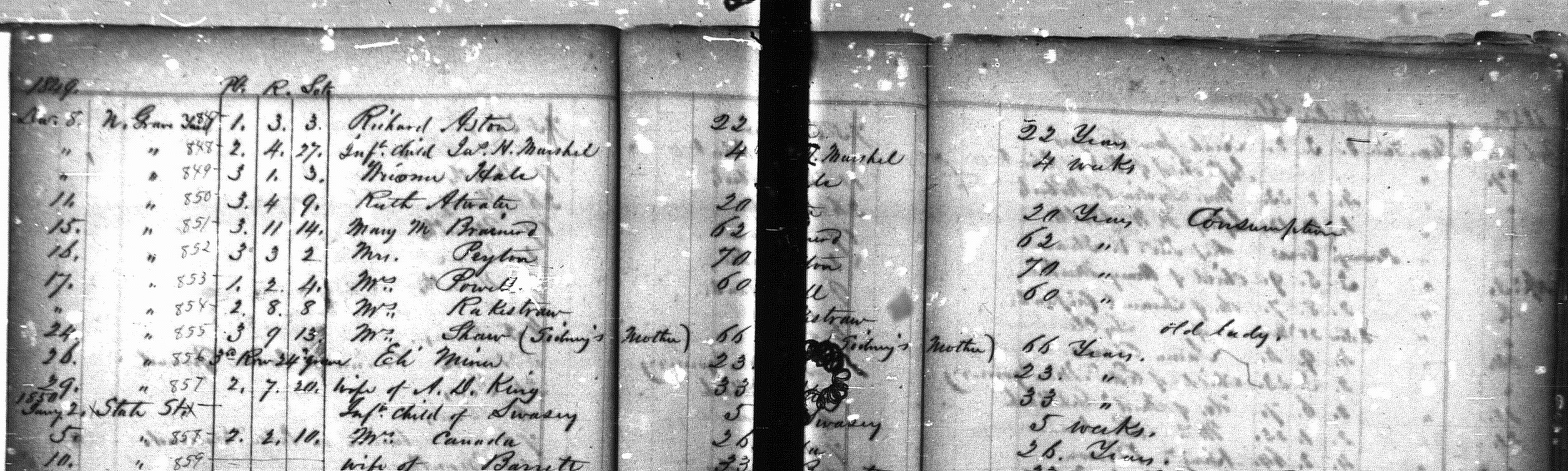
The first piece of documentation that I ever found for Syntha was the 1850 Mortality Schedule, on which her name is spelled “Sintha.”  I had only “known” that she was married to my Charles Rakestraw because of a pedigree chart that my grandma had given me years ago.

1850 Mortality Schedule, Ancestry.com

1850 Mortality Schedule, Ancestry.com

With a piece of evidence in hand, Sintha is how I spelled it until someone saw it on my Ancestry tree and sent me a very nasty message about how I was spelling Syntha incorrectly and that I should have more respect for my ancestors than to spell their names incorrectly.  Luckily, this didn’t turn me off to genealogy, but it did turn me off to having a publicly viewable tree on Ancestry.

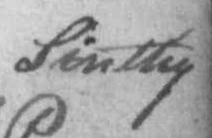
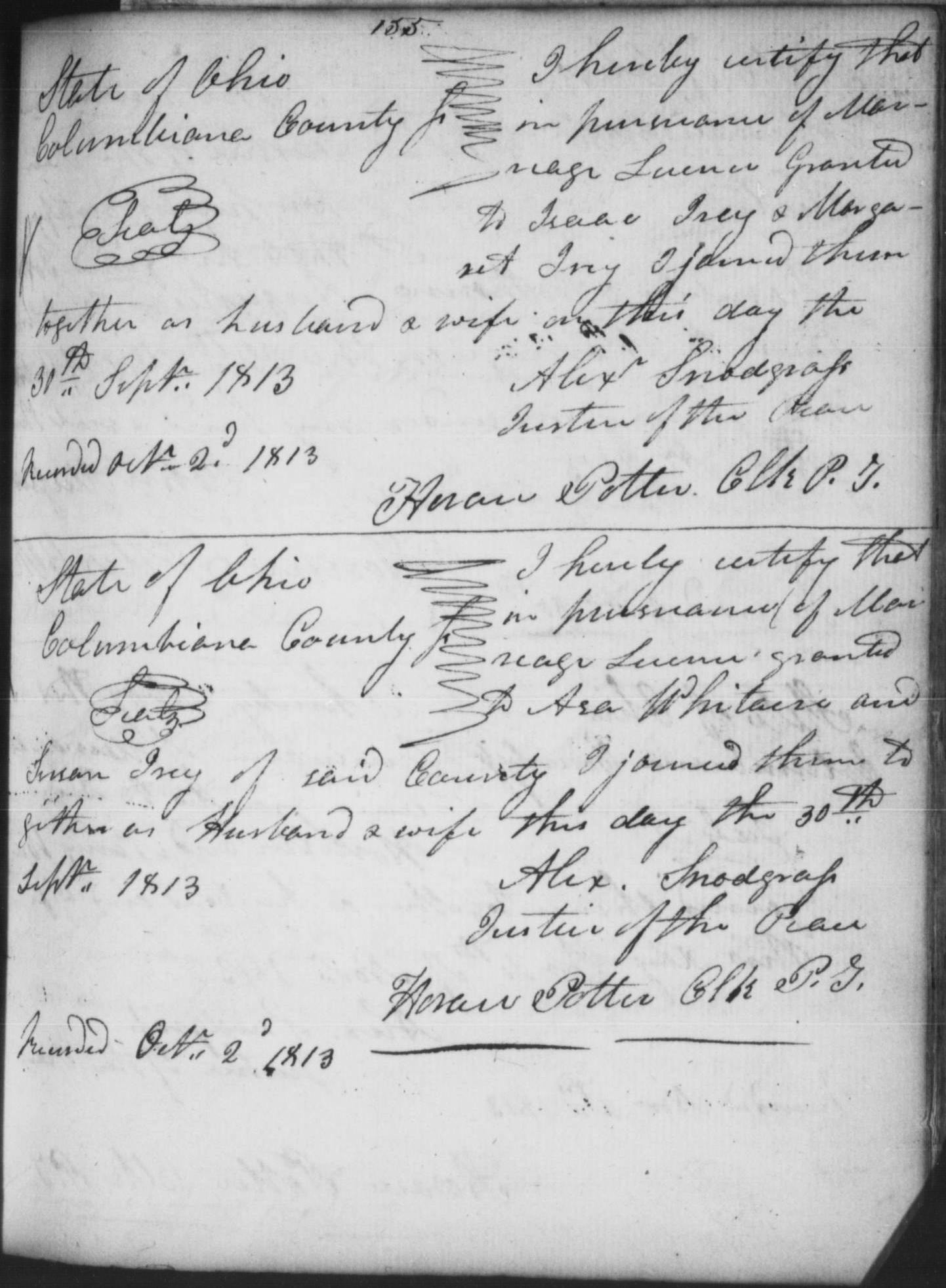
The next record I came across was the marriage record for Charles Rakestraw and Sinthy Irey.  Now, my grandpa always used to pronounce Missouri as miz-ur-ah and Sunday as sun-dee, so I can see how Sintha might have become Sinthy.  I still couldn’t figure out where Syntha had come from, though.

Columbiana County, Ohio Marriages, Vol. 2, p. 103, FamilySearch.org

Columbiana County, Ohio Marriages, Vol. 2, p. 103, FamilySearch.org

The next piece of the puzzle came when I borrowed the Rakestraw box of paperwork from my grandpa so that I could scan it all into my computer.  Among the papers was a copy of Phillip Irey’s will, which appears to have been part of a probate record.  For some reason, whoever copied it was only concerned with the will.  In the will, Phillip names his daughter, Syntha Rakestraw.

At last, I knew where Syntha had come from!  One day, while working, I came across a roll of microfilm labeled Fairview Cemetery Records, 1841-1864.  I thought this strange because the Southern Indiana Genealogical Society had indexed all of the Fairview Cemetery record books and their first index started in 1852.  So, like any history/genealogy obsessed, mystery loving librarian, I put the roll on and started to scroll through it.  I took note of some names and dates, doing a random sampling.  One of the pages that I happened to stop on was an interment record for a Mrs. Rakestraw who had been buried on December 17, 1849.  Even though this record said the cause of death was “old lady,” which actually made me picture an old lady beating her to death with a purse, and Syntha had died of consumption, I was sure this had to be her.  I included her name and interment date on my sample list.

Fairview Cemetery Records, 1841-1864, microfilm, Stuart Barth Wrege Indiana History Room

Fairview Cemetery Records, 1841-1864, microfilm, Stuart Barth Wrege Indiana History Room

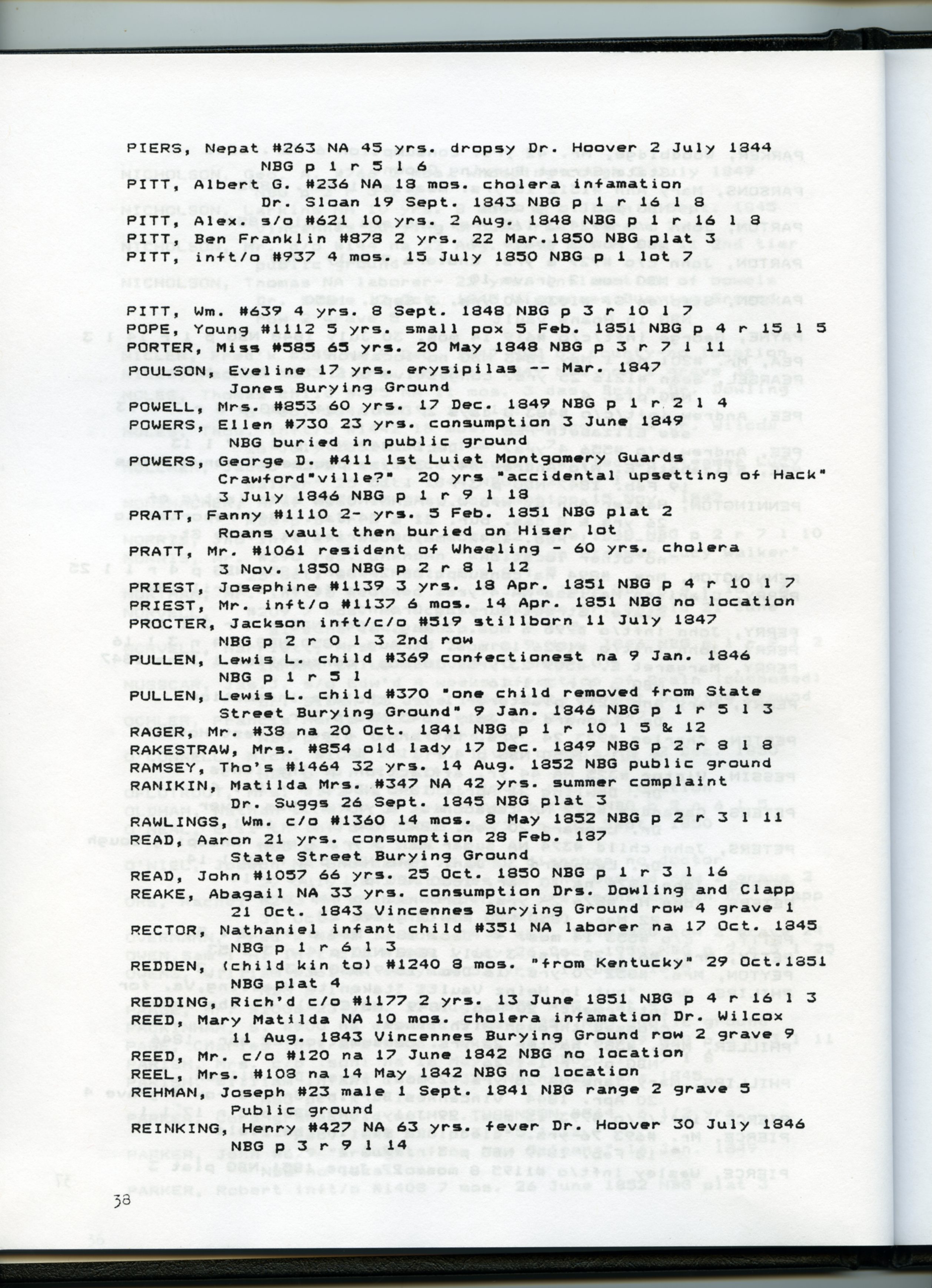
I began to go through the books on the cemetery index shelf to see if anything matched my sampling.  I finally found matching names in Persons Buried in the Ground by the City of New Albany, which was a transcription of records for burials at the State Street Burying Ground that were later moved to Fairview, and early Fairview burials.  Unfortunately, this didn’t clear up the Sintha/Syntha issue.

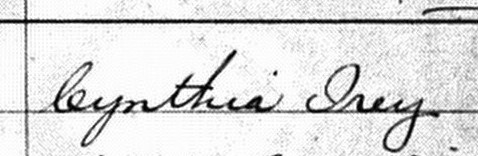
Then, last year, I decided to research my Rakestraw line to prove that they were here before December 31, 1840 to get a certificate from the Southern Indiana Genealogical Society’s First Families Program.  In so doing, I had a hard time proving that Milton was the son of Charles and Syntha.  I had to use a lot of siblings to prove connections.  One of the records I used was Rebecca Dowerman’s death record.  She was Milton’s sister, and her death record listed her parents names as Chas. Rakestraw and Cynthia Irey.  Cynthia.  Well, I guess I can see how that happened.  The informant may not have really known Rebecca’s mother’s name, or they might have said Syntha and the clerk heard it differently.  We all know how easily names can be butchered.  I still had no second source for proving how to spell her name.

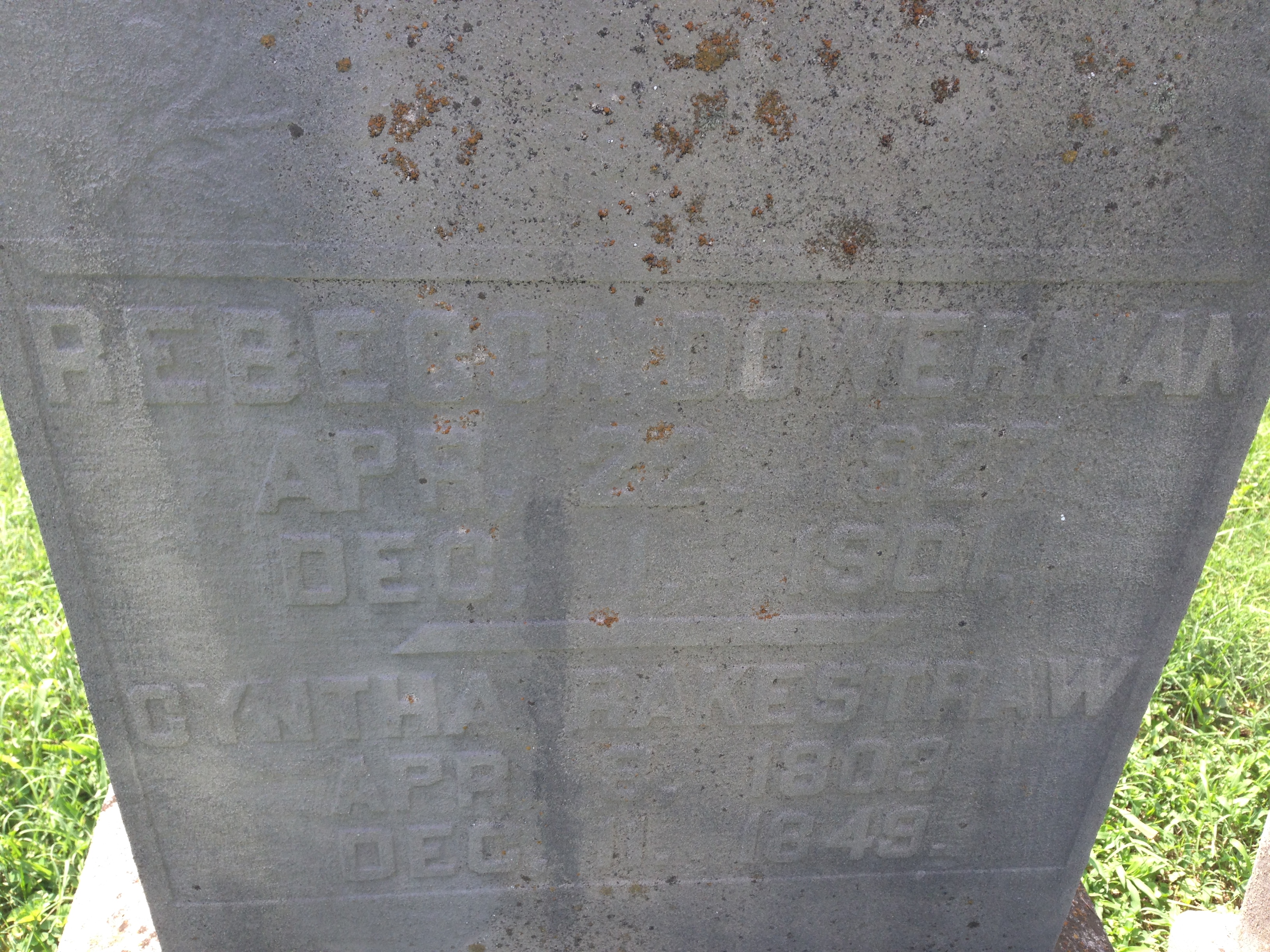
After I had completed the research for the First Families Program, I made plans to go to Fairview and try to find Syntha’s tombstone.  My dad went with me.  He said he remembered visiting a bunch of ancestor’s graves with his mom and he thought he could remember where they were.  We did find a tombstone for Rebecca Dowerman with Cyntha Rakestraw also listed on it.  So, now I also had Cyntha in the mix.

Tombstone, Rebecca Dowerman and Cyntha Rakestraw, Fairview Cemetery, photo taken by Melissa Wiseheart, 1 September 2014

Tombstone, Rebecca Dowerman and Cyntha Rakestraw, Fairview Cemetery, photo taken by Melissa Wiseheart, 1 September 2014

Tombstone, Rebecca Dowerman and Cyntha Rakestraw, Fairview Cemetery, photo taken by Melissa Wiseheart, 1 September 2014

Tombstone, Rebecca Dowerman and Cyntha Rakestraw, Fairview Cemetery, photo taken by Melissa Wiseheart, 1 September 2014

A different name for every source.  In case you are having a hard time keeping track, here are the variations:

rakestraw, sintha 1850 mortality schedule crop copy

Rakestraw, Charles - Columbiana County, Ohio Marriages, Vol. 2, p103 copy

Last Will & Testament, Philip Irey, 1841

Dowerman, Rebecca - Floyd County, Indiana Deaths, Book H-4, page 50 - part 5 copy

2014-09-01 14.48.07 copy

I finally settled on Syntha because, in the absence of corroborating sources, I broke the name into parts and synthesized it in the most logical way I could think to.  I most frequently saw it spelled with an “S” instead of a “C.”  I most frequently saw it spelled “yn” over “in.”  I most frequently saw it spelled “tha” over “thy” or “thia.”  So, S-yn-tha.  Syntha.  It coincidentally agrees with the person who had rather harshly corrected me, but that didn’t influence my decision.  I’m always on the lookout for records and would be excited to see if something finally agrees with one of these spellings.

Dolores Schroeder: A Servant’s Heart (52 Ancestors #04)

Dolores Louise Schroeder, circa 1949.

Dolores Louise Schroeder, circa 1949.

Dolores was my grandmother.  I was born the day after her 52nd birthday.  We both love daffodils and cooking, although, my love of those things is probably because of how much time I spent with her.  My cousins, siblings, and I spent every spare moment at her house.  At Christmas, I helped her bake Springerles and German Sour Cream Twists.  I still bake those every year.  I’m like her in many ways, but I aspire to be more like her.

Dolores Louise Schroeder was born on March 3, 1931 in Toledo, Ohio to parents George Herman and Louise Marie (Von Allmen) Schroeder.1,5  The Schroeders moved to Indiana when Dolores was about seven.  They lived in Lafayette in Floyd County, Indiana and joined Atkins Chapel United Methodist Church.1

Dolores graduated from Indiana Central College with a bachelor’s degree in education, and she received her master’s degree at Indiana University Southeast.  She taught at S. Ellen Jones school from 1954 to 1955.2  In 1955, she was forced to resign.  She would never tell me what happened.  The account I had from my grandpa, Sanford “Bud” Wiseheart, is as follows:

She was teachin’ over at S. Ellen Jones and Peder Espeseth was the principal over there.2,3  Well, he called her in the office one day and said, ‘Miss Schroeder, I’d like for you to resign.’  And she said, ‘Well, Mr. Espeseth, what in the world about?’  And he said, ‘You didn’t seek my counsel and that’s one of the rules in the school system.  Teachers always have to seek the principal’s counsel.’  She never could figure out what was provoking him and she went to see Willie Wilson, superintendent.  He said, ‘Miss Schroeder, unfortunately, in the school system, if you do not resign and he presses it and they fire you, then you can’t teach anywhere in the state of Indiana.  But if you do resign, you are free to go anywhere else in the state and teach.’  She said it hurt her terribly, but she went ahead and resigned to please Espeseth.  So she went back up to where she’d been goin’ to college and got on up there.

Dolores taught in Indianapolis from 1956 to 1958.4  By the summer of 1958, she had gone on some dates with Bud.  That story is also best told from his point of view:

Dolores and I had took in some things together.  We went to James Whitcomb Riley home and things like that.  Finally it came to July one night, I was goin’ home from her house.  We walked out to the car together and she said that it’s gettin’ to that time of the year when she has to let them know at Indianapolis whether she was goin’ to teach that year or not and she’d have to sign a contract.  And I said, ‘Well, I don’t know what to tell you, but,’ I said, ‘if you want to stay down here,’ I said, ‘I’ll sign a contract with you.’  And she said, ‘It sounds good to me.’  I guess that’s a crazy way of proposin’ to somebody.

Dolores Louise Schroeder and Sanford William Wiseheart were married on August 2, 1958 at Atkins Chapel United Methodist Church in Floyd Knobs, Indiana by Reverend Earl W. Reed.  5,6,7Dolores and Bud had four sons and ten grandchildren.9  She devoted her life to her family, her church, and helping others.

Dolores was the treasurer of Atkins Chapel for twenty years.  She was a Sunday school teacher and she was in charge of Vacation Bible School, a program to provide meals for those in need, and the church’s Harvest Homecoming booth.  She was also involved in the church’s quilting group, which made quilts for Home of the Innocents and St. Elizabeth’s Maternity Center; Helping Hands ministry, which paid rent and utility bills for people who couldn’t afford it; women’s missions; fundraising for charities; and other outreach, such as visiting the sick.  In 2006, Dolores received the Gold Leaf Award from Community Foundation for outstanding volunteer service.8,9

Dolores Louise Wiseheart died of leukemia on Sunday, September 10, 2006 at her home in New Albany, Indiana.9

Dolores Louise (Schroeder) Wiseheart, June 2006.  Photo taken by Keith Williams for The Courier-Journal (Louisville, KY).

Dolores Louise (Schroeder) Wiseheart, June 2006 at Atkins Chapel United Methodist Church. Photo taken by Keith Williams for The Courier-Journal (Louisville, KY).

I wonder if she really didn’t know why Mr. Espeseth wanted her to resign, or if she just didn’t want to say.  I never heard her say a bad word about anyone in her entire life.  Just a few weeks ago, I was down at my grandparents’ house with my dad and my uncles.  We were going through paperwork and came across some of her school records.  This prompted my uncle to tell us what he knew about what had happened with Grandma and Mr. Espeseth.  Dolores had been in charge of a school play and had allowed African American children to be in it (this was during integration).  Mr. Espeseth was upset that she hadn’t consulted him about it and asked her to resign.  I’ve always been proud of my grandma, but hearing this story makes me tremendously proud of her for doing the right thing.


Sources

1.  1940 U.S. Federal Census, Lafayette, Floyd County, Indiana, p.1B, FamilySearch

2.  Caron’s New Albany-Jeffersonville (Floyd-Clark Counties, Ind.) City Directory, Vol. 40, 1955, Stuart Barth Wrege Indiana History Room

3.  New Albany Tribune, 9 Oct 1963, p.1, c.6, Stuart Barth Wrege Indiana History Room

4.  Polk’s Indianapolis (Marion County, Ind.) City Directory, Vol. 47, 1957, InternetArchive

5.  Floyd County, Indiana Marriages, Vol. 55, p.244, Floyd County Clerk’s Office

6.  New Albany Tribune, Sun 24 Aug 1958, p.6, c.1, Stuart Barth Wrege Indiana History Room

7.  New Albany Ledger & Tribune, Sun 2 Aug 1998, p.B2, c.3, Stuart Barth Wrege Indiana History Room

8.  The Courier-Journal (Louisville), Sat 24 Jun 2006, p.B3, c.2

9.  New Albany Tribune, Tues 12 Sep 2006, p. A3, c.3