Sanford Wiseheart: The Strong, Silent Type (52 Ancestors #05)

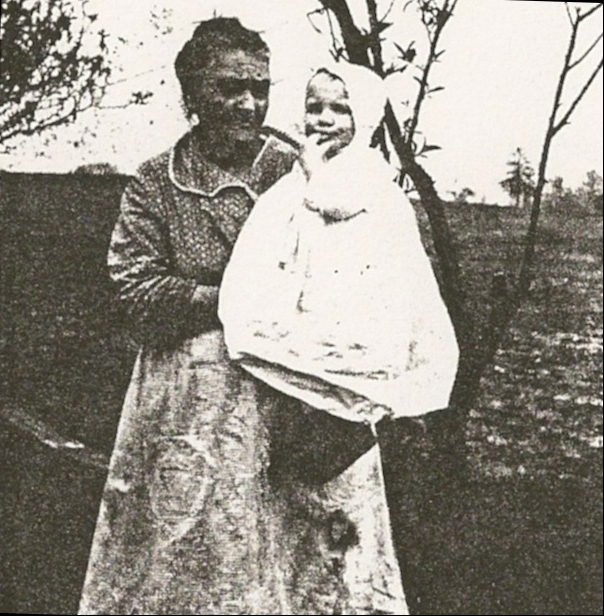
Mary Elizabeth (Gilliland) Rakestraw with her great grandson, Sanford "Bud" Wiseheart, circa 1924.

Mary Elizabeth (Gilliland) Rakestraw with her great grandson, Sanford “Bud” Wiseheart, circa 1924.

Sanford William “Bud” Wiseheart was born on May 30, 1923 in New Albany, Indiana to Sanford Wesley and Mildred Gertrude (Springer) Wiseheart.1  Bud’s great grandmother, Mary Elizabeth Rakestraw, lived with the family until her death in 1935.2,3  She was the widow of a Civil War soldier and passed down many family stories to Bud and his siblings.  In 1941, Bud’s father bought a farm just outside New Albany.  They raised crops and chickens.  Plucking the chickens was one of Bud’s jobs.  He never would eat any poultry after that.

Sanford "Bud" Wiseheart on the farm.

Sanford “Bud” Wiseheart on the farm.

Bud married Dolores Louise Schroeder on August 2, 1958 at Atkins Chapel United Methodist Church in Floyd Knobs, Indiana.4,5,6  (For their engagement story, see Dolores Schroeder).  They had four sons.6  Bud was a carpenter.  He worked for New Albany-Floyd County Consolidated School Corporation and he also did some freelance work.  He was also very active in the church.  He was an usher, bell ringer, Sunday school teacher, and maintenance man for Atkins Chapel.  He also built the church’s Harvest Homecoming booth and assisted with Vacation Bible School.  Bud died at home on October 30, 2014.7

Sanford William "Bud" Wiseheart

Sanford William “Bud” Wiseheart

My grandpa was a hard working man who didn’t seem to have much to say, but when he did say something, it was more than worth it to pay attention.  He was an excellent story teller and knew a lot about a lot of things.  Every time he told me a story, it was full of heart.  Bud was no stranger to hard times, but he weathered them all.  The following is a story, in his own words, that includes two such times:

World War II.  I must’ve been nineteen when it started.  After a while, they started draftin’ and they had a bunch of us went over to Louisville and we were sent letters that we were to be inducted into the Armed Forces.  Thirty three of us went over in that bus from New Albany to Louisville and eleven of us came back rejected.

They examined me and I had a bad ear.  And the psychologist held me up and asked me all kinds of questions.  He asked me what I got out of life.  I told him, ‘I like to help other people, my mother and my father.’  And he kept callin’ me ‘Old Man.’  Nineteen years old and he’s callin’ me ‘Old Man.’  He said, ‘Tell me, Old Man, was there ever somebody in your life you loved very deeply?’  And I said, ‘Well, I can’t think of anything right off.’  Of course, what it was, my little sister, Mary Katherine, I used to sometimes change her diapers.  I was kind of an interpreter.  Sometimes she’d say something to her mother and Ma would ask me what she said.  And so, when she was two years old, she walked right past where I was cleanin’ the stables out and into the neighbors’ yard and fell in the fish pond and drowned.  That went pretty hard with me.  I felt responsible, like I should’ve seen her.  I should’ve saved her.  I even prayed to God to bring her back and take me in her place…

But gettin’ back to it.  I took a heck of a lot of flack.  One time I was goin’ to the grocery with Pap and someone remarked, ‘There’s a young man who ought to be in the military.’  Well, now you can’t tell by lookin’ at somebody that they ought to be in the military.  I just never did have any desire to shoot and kill anybody, but I never made any effort to avoid the draft.

They sent a notice out, ‘All people that are unfit for military service are expected to get into the defense work to help the cause.’  And if we didn’t go somewhere voluntarily, they were goin’ to draft us into defense work.  So I went on up to Charlestown and got in on the construction over there.

My mother got a letter one day from Clara Edwards.  ‘My Dear Mrs. Wiseheart, Thank you for your compliments on Albert and Vernon.’  They had both been inducted into the Army, you see.  ‘Thank you for your compliments on their nerves.  Well, let me tell you something.  All you’ll ever see out of the Wiseheart boys is dirty bedsheets, the dirty yellowbacks.’  And then she signed it off.  ‘Course Frank was too young and I was 4F, I couldn’t help it.  Not that I wanted to go, but they said I was unfit for military service.  So anyway, all them years of this hostile attitude.

Sanford "Bud" Wiseheart hanging the flags for the 4th of July.

Sanford “Bud” Wiseheart hanging the flags.  July 4, 2009.  Photo taken by Sarah Wiseheart of Wiseheart Photo.


Sources

1.  Floyd County, Indiana Births, CH-14, p.113, Stuart Barth Wrege Indiana History Room

2.  1930 U.S. Federal Census, Silver Creek, Clark County, Indiana, p.14B, Ancestry

3.  1940 U.S. Federal Census, New Albany, Floyd, Indiana, p.10B, FamilySearch

4.  Floyd County, Indiana Marriages, Vol. 55, p.244, Floyd County Clerk’s Office

5.  New Albany Tribune, Sun 24 Aug 1958, p.6, c.1, Stuart Barth Wrege Indiana History Room

6.  New Albany Ledger & Tribune, Sun 2 Aug 1998, p.B2, c.3, Stuart Barth Wrege Indiana History Room

7.  New Albany Tribune, Sat 1 Nov 2014, p.A4, c.3, Stuart Barth Wrege Indiana History Room

Josephine Sellers: A Wedding, A War, and A Pandemic

Several years ago, as I was sitting with my cousins after having eaten lunch, my grandpa brought a document into the room for me to look at.  It was a Certificate of Death for a Josephine Sellers Wiseheart.  Josephine was not a family name with which I was familiar.  Grandpa said she was Pap’s (his dad) first wife.

In 1918, there was an influenza pandemic that killed an estimated 50 million people.  Josephine Sellers Wiseheart was one of these people.  She was sixteen and a half.  She and Sanford Wesley Wiseheart (Pap) had been married for almost a year and half.  For such a short marriage, it was certainly an eventful one.

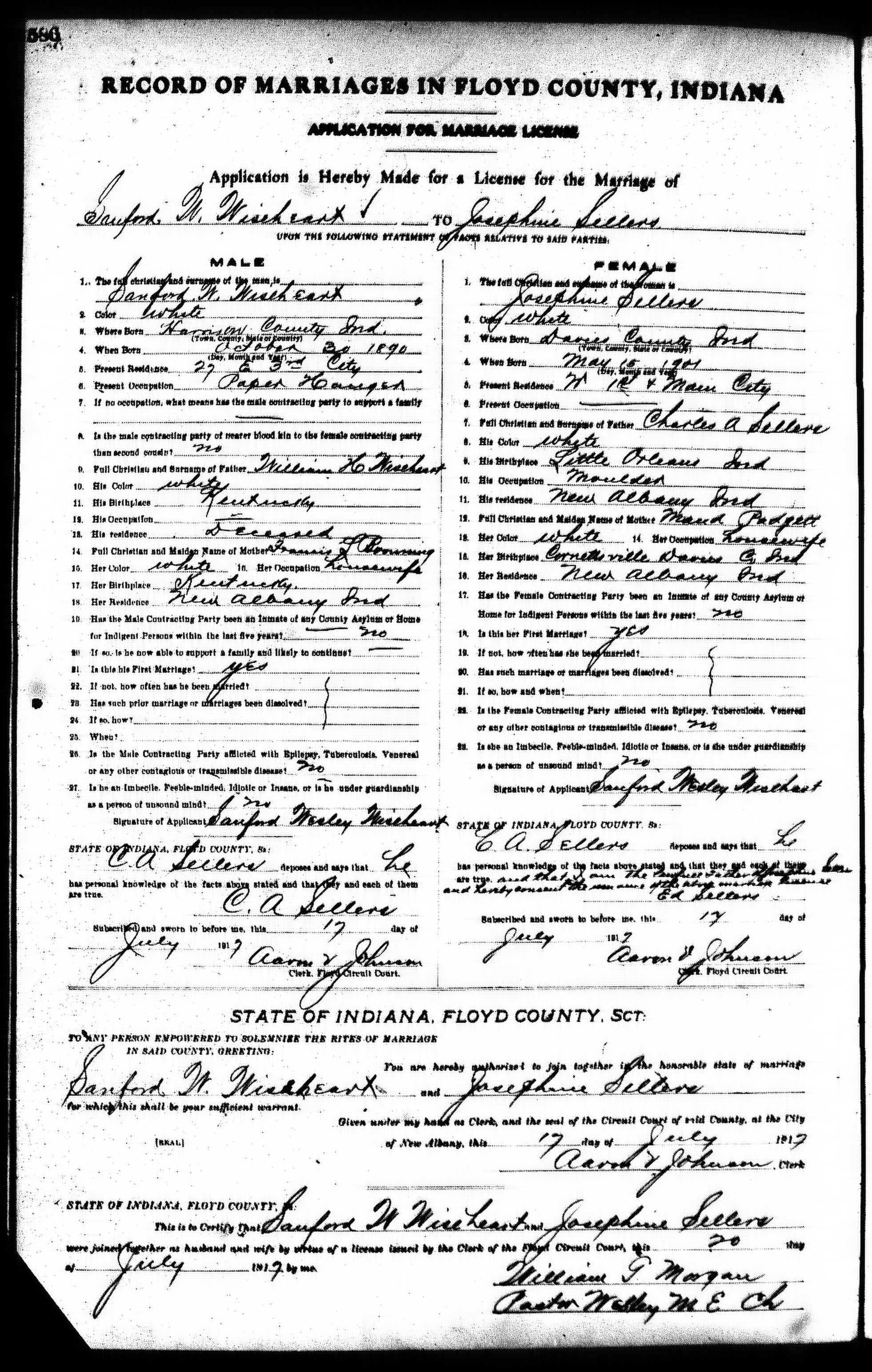
I have no idea how they met or exactly when, I just know that Josephine was living with her parents and two brothers in Vincennes, Indiana in 1910, so they couldn’t have been in New Albany for more than seven years.  In any case, Sanford and Josephine were married by the pastor of Wesley Methodist Episcopal Church on July 20, 1917.  Josephine’s birthdate was listed as May 15, 1901, which would have made her sixteen at the time of their marriage.  She was born in Daviess County, Indiana.  Her parents were Charles A. Sellers and Maud Padgett.  Charles Sellers consented to the marriage.

Just four months later, the couple separated and Josephine filed for divorce, rather her mother filed for her because she was a minor.

New Albany Daily Ledger, 10 Nov 1917, p.4, column 2, Stuart Barth Wrege Indiana History Room

New Albany Daily Ledger, Saturday, 10 Nov 1917, p.4, column 2, Stuart Barth Wrege Indiana History Room

Family legend is that Sanford, or Sandy as he was known around town, filed for divorce because he found out that Josephine had lied about her age.  I haven’t found any evidence that he ever filed for divorce.

On April 22, 1918, Sandy was inducted into the Army, having already filled out a draft registration card in June of 1917.  In August of 1918, he left for France.

In December of 1918, Josephine caught the flu.  Dr. Schoen attended her from December 2nd until her death on December 11th.  Her Death Record shows that she was married to a J. Wiseheart at the time of her death.  I’ve found no record of the divorce having gone through and I’ve found no record of Josephine ever having married again.  I believe that it was supposed to have been S. Wiseheart.

Floyd County, Indiana Deaths, Book CH-24, p.104, Stuart Barth Wrege Indiana History Room

Floyd County, Indiana Deaths, Book CH-24, p.104, Stuart Barth Wrege Indiana History Room

Her death record also states that she was born on May 24, 1902.  So, either she (and her father) lied about her age when she married or the clerk made an error.  Or, the death record is incorrect.  I’ve tried to find a birth record to verify the date to no avail.  I searched first in Daviess County, since that’s where the marriage record says she and her mother were born.  Then I searched Orange County, where her father was born, and Knox County where they lived before moving to New Albany.  I also searched the surrounding counties of Pike, Martin, Dubois, and Greene in case she had been born while they were moving from one place to another.  Lastly, I searched Floyd County, since that’s where they ended up.  No birth record.

Josephine was buried in Sandy’s plot at Fairview Cemetery on December 14, 1918 as Josephine S. Wiseheart.  Her father had her moved to the Sellers family plot in Holy Trinity Cemetery just two months later.

Fairview Cemetery, Volume VI, 1910-1919, p.127, Stuart Barth Wrege Indiana History Room

Fairview Cemetery, Volume VI, 1910-1919, p.127, Stuart Barth Wrege Indiana History Room

Her tombstone reads Josephine Sellers, 1902-1918.  I wonder if he moved her because she was posthumously granted the divorce or if he just really wanted her to be separated from Sandy even in death.  I’m keeping an eye out for any documentation that a divorce was granted, but everything I’m finding says that Sandy was a widower.

Such was the short, dramatic life of Josephine Sellers.  Even though I’m not directly related to her, I sometimes wonder about her.  What did she look like?  What was her personality?  Why did she marry at fifteen or sixteen?  What really happened to cause her to file for divorce?  When I think about her in terms of being my great grandfather’s first wife, it doesn’t seem so long ago, but looking at dates, it was nearly one hundred years ago.  These are questions to which I will probably never know the answer.

Dolores Schroeder: A Servant’s Heart (52 Ancestors #04)

Dolores Louise Schroeder, circa 1949.

Dolores Louise Schroeder, circa 1949.

Dolores was my grandmother.  I was born the day after her 52nd birthday.  We both love daffodils and cooking, although, my love of those things is probably because of how much time I spent with her.  My cousins, siblings, and I spent every spare moment at her house.  At Christmas, I helped her bake Springerles and German Sour Cream Twists.  I still bake those every year.  I’m like her in many ways, but I aspire to be more like her.

Dolores Louise Schroeder was born on March 3, 1931 in Toledo, Ohio to parents George Herman and Louise Marie (Von Allmen) Schroeder.1,5  The Schroeders moved to Indiana when Dolores was about seven.  They lived in Lafayette in Floyd County, Indiana and joined Atkins Chapel United Methodist Church.1

Dolores graduated from Indiana Central College with a bachelor’s degree in education, and she received her master’s degree at Indiana University Southeast.  She taught at S. Ellen Jones school from 1954 to 1955.2  In 1955, she was forced to resign.  She would never tell me what happened.  The account I had from my grandpa, Sanford “Bud” Wiseheart, is as follows:

She was teachin’ over at S. Ellen Jones and Peder Espeseth was the principal over there.2,3  Well, he called her in the office one day and said, ‘Miss Schroeder, I’d like for you to resign.’  And she said, ‘Well, Mr. Espeseth, what in the world about?’  And he said, ‘You didn’t seek my counsel and that’s one of the rules in the school system.  Teachers always have to seek the principal’s counsel.’  She never could figure out what was provoking him and she went to see Willie Wilson, superintendent.  He said, ‘Miss Schroeder, unfortunately, in the school system, if you do not resign and he presses it and they fire you, then you can’t teach anywhere in the state of Indiana.  But if you do resign, you are free to go anywhere else in the state and teach.’  She said it hurt her terribly, but she went ahead and resigned to please Espeseth.  So she went back up to where she’d been goin’ to college and got on up there.

Dolores taught in Indianapolis from 1956 to 1958.4  By the summer of 1958, she had gone on some dates with Bud.  That story is also best told from his point of view:

Dolores and I had took in some things together.  We went to James Whitcomb Riley home and things like that.  Finally it came to July one night, I was goin’ home from her house.  We walked out to the car together and she said that it’s gettin’ to that time of the year when she has to let them know at Indianapolis whether she was goin’ to teach that year or not and she’d have to sign a contract.  And I said, ‘Well, I don’t know what to tell you, but,’ I said, ‘if you want to stay down here,’ I said, ‘I’ll sign a contract with you.’  And she said, ‘It sounds good to me.’  I guess that’s a crazy way of proposin’ to somebody.

Dolores Louise Schroeder and Sanford William Wiseheart were married on August 2, 1958 at Atkins Chapel United Methodist Church in Floyd Knobs, Indiana by Reverend Earl W. Reed.  5,6,7Dolores and Bud had four sons and ten grandchildren.9  She devoted her life to her family, her church, and helping others.

Dolores was the treasurer of Atkins Chapel for twenty years.  She was a Sunday school teacher and she was in charge of Vacation Bible School, a program to provide meals for those in need, and the church’s Harvest Homecoming booth.  She was also involved in the church’s quilting group, which made quilts for Home of the Innocents and St. Elizabeth’s Maternity Center; Helping Hands ministry, which paid rent and utility bills for people who couldn’t afford it; women’s missions; fundraising for charities; and other outreach, such as visiting the sick.  In 2006, Dolores received the Gold Leaf Award from Community Foundation for outstanding volunteer service.8,9

Dolores Louise Wiseheart died of leukemia on Sunday, September 10, 2006 at her home in New Albany, Indiana.9

Dolores Louise (Schroeder) Wiseheart, June 2006.  Photo taken by Keith Williams for The Courier-Journal (Louisville, KY).

Dolores Louise (Schroeder) Wiseheart, June 2006 at Atkins Chapel United Methodist Church. Photo taken by Keith Williams for The Courier-Journal (Louisville, KY).

I wonder if she really didn’t know why Mr. Espeseth wanted her to resign, or if she just didn’t want to say.  I never heard her say a bad word about anyone in her entire life.  Just a few weeks ago, I was down at my grandparents’ house with my dad and my uncles.  We were going through paperwork and came across some of her school records.  This prompted my uncle to tell us what he knew about what had happened with Grandma and Mr. Espeseth.  Dolores had been in charge of a school play and had allowed African American children to be in it (this was during integration).  Mr. Espeseth was upset that she hadn’t consulted him about it and asked her to resign.  I’ve always been proud of my grandma, but hearing this story makes me tremendously proud of her for doing the right thing.


Sources

1.  1940 U.S. Federal Census, Lafayette, Floyd County, Indiana, p.1B, FamilySearch

2.  Caron’s New Albany-Jeffersonville (Floyd-Clark Counties, Ind.) City Directory, Vol. 40, 1955, Stuart Barth Wrege Indiana History Room

3.  New Albany Tribune, 9 Oct 1963, p.1, c.6, Stuart Barth Wrege Indiana History Room

4.  Polk’s Indianapolis (Marion County, Ind.) City Directory, Vol. 47, 1957, InternetArchive

5.  Floyd County, Indiana Marriages, Vol. 55, p.244, Floyd County Clerk’s Office

6.  New Albany Tribune, Sun 24 Aug 1958, p.6, c.1, Stuart Barth Wrege Indiana History Room

7.  New Albany Ledger & Tribune, Sun 2 Aug 1998, p.B2, c.3, Stuart Barth Wrege Indiana History Room

8.  The Courier-Journal (Louisville), Sat 24 Jun 2006, p.B3, c.2

9.  New Albany Tribune, Tues 12 Sep 2006, p. A3, c.3

Two Marriages & A Murder

Three days ago, I posted about Serilda Gilliland marrying John Bridges twice and that John went to prison for murder.  I was able to unravel a little bit more today.  First, I looked up the Daniel G. Stewart who was a minister from 1835 to 1837 again, and he was actually Daniel S. Stewart and is not the same D.G. Stewart who married them.  I looked in a different city directory today (1848) and David G. Stewart was listed as a homeopathic doctor.  Having the correct first name, I looked him up in the newspaper index and found a listing for an obituary.  According to his obituary in the New Albany Daily Ledger Standard (9 Apr 1878, p.4, c.2-3), David G. Stewart was a doctor who moved to New Albany in 1832.  He joined the First Christian Church and regularly preached when the the pastor was absent.  He was not ordained.  Therefore, Serilda and John’s first marriage was not valid.  Now I know the mechanics of why they were married twice, but I’m still left wondering how he got out of prison for it.

Now, on to the murder trial…

The State of Indiana v. John Bridges:  Coroner’s Inquest

New Albany Daily Tribune, 17 Jan 1859, p.3, c.1, Stuart Barth Wrege Indiana History Room

New Albany Daily Tribune, 17 Jan 1859, p.3, c.1, Stuart Barth Wrege Indiana History Room