The State of Indiana v. John Bridges: Trial, Day 2

Today, we read the testimony of witnesses Andrew Beard, John Watkin, Joseph Towner, Joseph Wattam, N. B. Wilson, Hamilton Tresenriter, H. L. Bridwell, and Thomas Hutchinson.

New Albany Daily Tribune, Thursday, 3 November 1859, p.2, column 2, Stuart Barth Wrege Indiana History Room

New Albany Daily Tribune, Thursday, 3 November 1859, p.2, column 2, Stuart Barth Wrege Indiana History Room

New Albany Daily Tribune, Thursday, 3 November 1859, p.2, column 3, Stuart Barth Wrege Indiana History Room

New Albany Daily Tribune, Thursday, 3 November 1859, p.2, column 3, Stuart Barth Wrege Indiana History Room

To be continued…

The State of Indiana v. John Bridges: Trial, Day 1

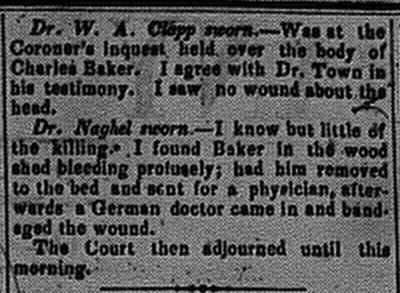
About ten months after the Coroner’s Inquest, the murder trial of John Bridges finally went to court.  It was several days of jury selection and testimony, so I’ll break it up into separate posts for ease of access.  It’s quite lengthy, but I find it all very interesting.  The following articles are the two pre-trial articles and the first day of the trial, which includes the testimony of Sarah Jane Baker (or Albaker), wife of the deceased, and Doctors Town, Clapp, and Naghel.

New Albany Daily Tribune, Monday, 31 October 1859, p.3, column 1, Stuart Barth Wrege Indiana History Room

New Albany Daily Tribune, Monday, 31 October 1859, p.3, column 1, Stuart Barth Wrege Indiana History Room

New Albany Daily Tribune, Tuesday, 1 November 1859, p.2, column 2, Stuart Barth Wrege Indiana History Room

New Albany Daily Tribune, Tuesday, 1 November 1859, p.2, column 2, Stuart Barth Wrege Indiana History Room

New Albany Daily Tribune, Wednesday, 2 November 1859, p.2, column 3, Stuart Barth Wrege Indiana History Room

New Albany Daily Tribune, Wednesday, 2 November 1859, p.2, column 3, Stuart Barth Wrege Indiana History Room

New Albany Daily Tribune, Wednesday, 2 November 1859, p.2, column 4, Stuart Barth Wrege Indiana History Room

New Albany Daily Tribune, Wednesday, 2 November 1859, p.2, column 4, Stuart Barth Wrege Indiana History Room

To be continued…

Two Marriages & A Murder

Three days ago, I posted about Serilda Gilliland marrying John Bridges twice and that John went to prison for murder.  I was able to unravel a little bit more today.  First, I looked up the Daniel G. Stewart who was a minister from 1835 to 1837 again, and he was actually Daniel S. Stewart and is not the same D.G. Stewart who married them.  I looked in a different city directory today (1848) and David G. Stewart was listed as a homeopathic doctor.  Having the correct first name, I looked him up in the newspaper index and found a listing for an obituary.  According to his obituary in the New Albany Daily Ledger Standard (9 Apr 1878, p.4, c.2-3), David G. Stewart was a doctor who moved to New Albany in 1832.  He joined the First Christian Church and regularly preached when the the pastor was absent.  He was not ordained.  Therefore, Serilda and John’s first marriage was not valid.  Now I know the mechanics of why they were married twice, but I’m still left wondering how he got out of prison for it.

Now, on to the murder trial…

The State of Indiana v. John Bridges:  Coroner’s Inquest

New Albany Daily Tribune, 17 Jan 1859, p.3, c.1, Stuart Barth Wrege Indiana History Room

New Albany Daily Tribune, 17 Jan 1859, p.3, c.1, Stuart Barth Wrege Indiana History Room

A Marriage Mystery

Last night, while doing research for a collection that I’m processing at work, I saw my great great great great grandmother’s name on a marriage record index page… twice… to the same man… fourteen years apart.  I quickly made a note to look them up later.  I knew that she had been married once to Leason Gillilland, from whom I am descended, and who died young.  I knew that she married John Bridges after Leason died.  Today, on my lunch break, I did look up the records.  The first one was John T.M. Bridges and Sirelda Gilland on October 15, 1857.  The second was John T.M. Bridges and Serrelda Gilliland on February 3, 1871.

Floyd County, Indiana Marriages, Vol. 4, p.485

Floyd County, Indiana Marriages, Vol. 4, p.485, Stuart Barth Wrege Indiana History Room

Floyd County, Indiana Marriages, Vol. 6, p.644

Floyd County, Indiana Marriages, Vol. 6, p.644, Stuart Barth Wrege Indiana History Room

This is weird.  I consulted a co-worker who has been doing genealogy far longer than I have and has taught me most of what I know about researching.  She agreed that it is weird.  At first we thought that maybe the first marriage was invalid.  The name of the minister is smudged out and we thought that possibly he wasn’t really a minister.  A cleaner copy of that marriage record is available on FamilySearch.org and the minister’s name can be read.  He is D. G. Stewart.  Daniel G. Stewart is listed in the back of the index as being a minister from 1835-1837.  In the 1857 New Albany city directory, he’s listed as a homeopathic physician.  While I was looking up the minister, my co-worker searched the newspaper index for me.  She found that John Bridges wasn’t such a great guy.

My grandfather had always told me that John was a drunk and that he was constantly in trouble.  He had heard stories about John from his great grandmother, Serilda’s daughter, who had helped raise him.  Today, I discovered that John murdered a man, was convicted, and went to the Indiana State Prison in Jeffersonville, Indiana.  I didn’t have a lot of time on my lunch, so I only read the brief descriptions of the over a dozen articles on the trial and his other run-ins with the law.  I’ll copy those as soon as I can.  The result of the trial is that he was convicted in 1859.  The 1860 Census lists him with the family, but in the last column, where it asks for a person’s condition, it says “convict.”  In the 1870 Census, he’s listed among other convicts as being in Indiana State Prison.  Yet, somehow, he married or re-married Serilda in 1871.  Maybe the marriage was annulled or they got a divorce when he went to jail?  Maybe the first marriage really wasn’t legal?  I’m not sure.  What I really want to know is did they get married in the jail, or was he released from prison after only twelve years when he was sentenced for murder?  I’m hoping the articles about the trial will shed some light on that.