The State of Indiana v. John Bridges: Trial, Day 3

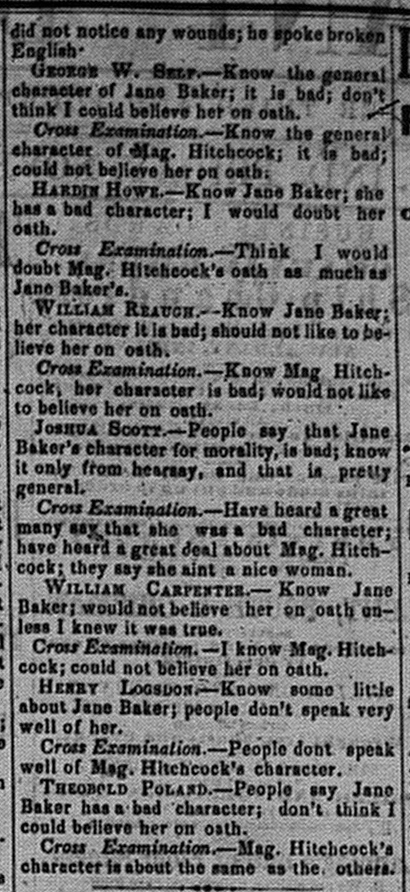
Today, we read the testimonies of Addison Morecraft, William Carey, John S. Davis, Alexander Dowling, James B. Gains, Ezra Gilliland (step-son of John Bridges), Margaret Hitchcock, William Gilliland (step-son of John Bridges), John Underhill, James Reed, Henry Meeker, E. L. Pennington, George W. Self, Hardin Howe, William Reaugh, Joshua Scott, William Carpenter, Henry Logsdon, and Theobold Poland.

New Albany Daily Tribune, Friday, 4 November 1859, p.2, column 3, Stuart Barth Wrege Indiana History Room

New Albany Daily Tribune, Friday, 4 November 1859, p.2, column 3, Stuart Barth Wrege Indiana History Room

New Albany Daily Tribune, Friday, 4 November 1859, p.2, column 4, Stuart Barth Wrege Indiana History Room

New Albany Daily Tribune, Friday, 4 November 1859, p.2, column 4, Stuart Barth Wrege Indiana History Room

To be continued…

Two Marriages & A Murder

Three days ago, I posted about Serilda Gilliland marrying John Bridges twice and that John went to prison for murder.  I was able to unravel a little bit more today.  First, I looked up the Daniel G. Stewart who was a minister from 1835 to 1837 again, and he was actually Daniel S. Stewart and is not the same D.G. Stewart who married them.  I looked in a different city directory today (1848) and David G. Stewart was listed as a homeopathic doctor.  Having the correct first name, I looked him up in the newspaper index and found a listing for an obituary.  According to his obituary in the New Albany Daily Ledger Standard (9 Apr 1878, p.4, c.2-3), David G. Stewart was a doctor who moved to New Albany in 1832.  He joined the First Christian Church and regularly preached when the the pastor was absent.  He was not ordained.  Therefore, Serilda and John’s first marriage was not valid.  Now I know the mechanics of why they were married twice, but I’m still left wondering how he got out of prison for it.

Now, on to the murder trial…

The State of Indiana v. John Bridges:  Coroner’s Inquest

New Albany Daily Tribune, 17 Jan 1859, p.3, c.1, Stuart Barth Wrege Indiana History Room

New Albany Daily Tribune, 17 Jan 1859, p.3, c.1, Stuart Barth Wrege Indiana History Room

A Marriage Mystery

Last night, while doing research for a collection that I’m processing at work, I saw my great great great great grandmother’s name on a marriage record index page… twice… to the same man… fourteen years apart.  I quickly made a note to look them up later.  I knew that she had been married once to Leason Gillilland, from whom I am descended, and who died young.  I knew that she married John Bridges after Leason died.  Today, on my lunch break, I did look up the records.  The first one was John T.M. Bridges and Sirelda Gilland on October 15, 1857.  The second was John T.M. Bridges and Serrelda Gilliland on February 3, 1871.

Floyd County, Indiana Marriages, Vol. 4, p.485

Floyd County, Indiana Marriages, Vol. 4, p.485, Stuart Barth Wrege Indiana History Room

Floyd County, Indiana Marriages, Vol. 6, p.644

Floyd County, Indiana Marriages, Vol. 6, p.644, Stuart Barth Wrege Indiana History Room

This is weird.  I consulted a co-worker who has been doing genealogy far longer than I have and has taught me most of what I know about researching.  She agreed that it is weird.  At first we thought that maybe the first marriage was invalid.  The name of the minister is smudged out and we thought that possibly he wasn’t really a minister.  A cleaner copy of that marriage record is available on FamilySearch.org and the minister’s name can be read.  He is D. G. Stewart.  Daniel G. Stewart is listed in the back of the index as being a minister from 1835-1837.  In the 1857 New Albany city directory, he’s listed as a homeopathic physician.  While I was looking up the minister, my co-worker searched the newspaper index for me.  She found that John Bridges wasn’t such a great guy.

My grandfather had always told me that John was a drunk and that he was constantly in trouble.  He had heard stories about John from his great grandmother, Serilda’s daughter, who had helped raise him.  Today, I discovered that John murdered a man, was convicted, and went to the Indiana State Prison in Jeffersonville, Indiana.  I didn’t have a lot of time on my lunch, so I only read the brief descriptions of the over a dozen articles on the trial and his other run-ins with the law.  I’ll copy those as soon as I can.  The result of the trial is that he was convicted in 1859.  The 1860 Census lists him with the family, but in the last column, where it asks for a person’s condition, it says “convict.”  In the 1870 Census, he’s listed among other convicts as being in Indiana State Prison.  Yet, somehow, he married or re-married Serilda in 1871.  Maybe the marriage was annulled or they got a divorce when he went to jail?  Maybe the first marriage really wasn’t legal?  I’m not sure.  What I really want to know is did they get married in the jail, or was he released from prison after only twelve years when he was sentenced for murder?  I’m hoping the articles about the trial will shed some light on that.

Not My Elizabeth

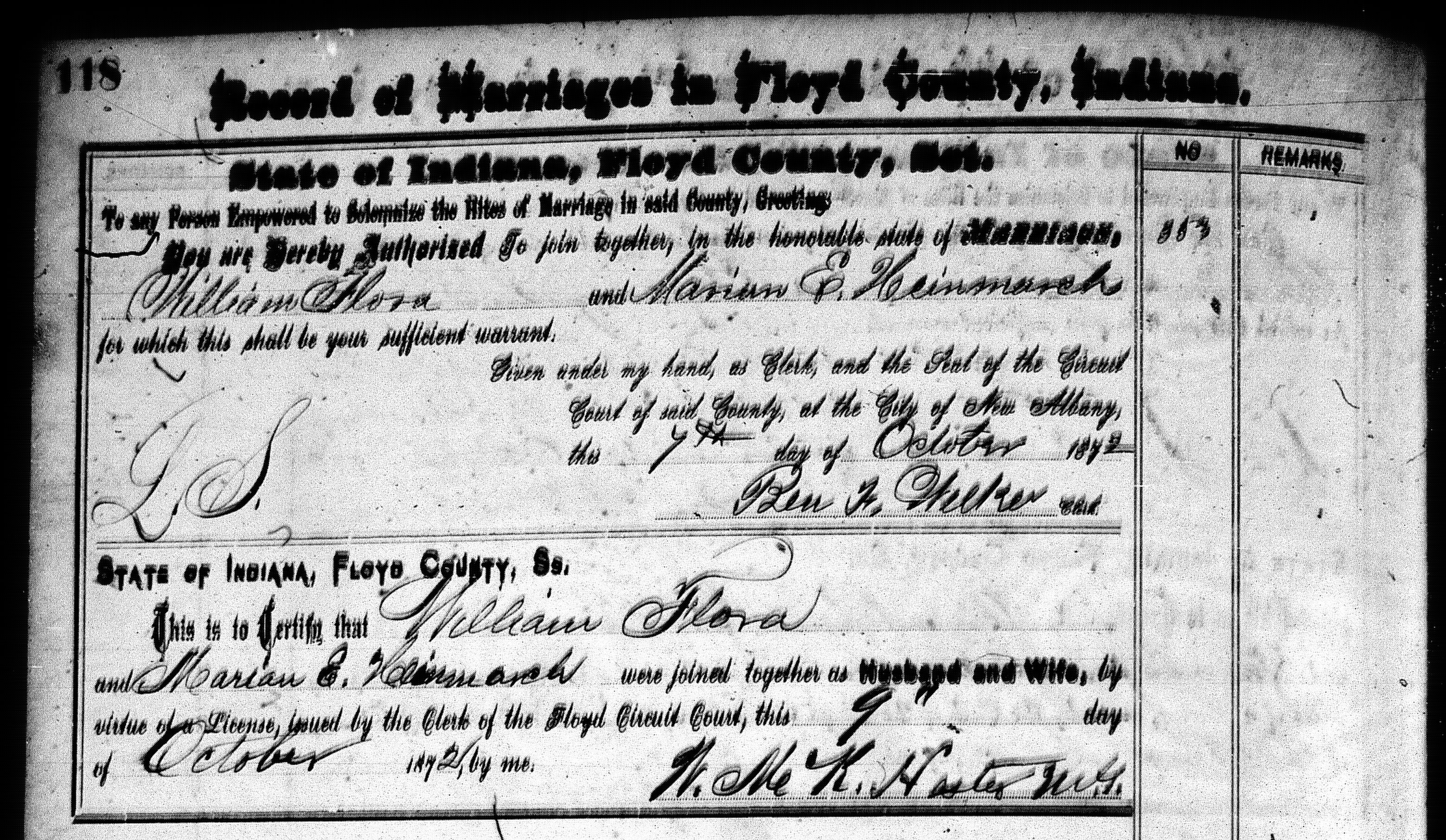
Today, while on my break at work, I followed the Marion Elizabeth Flora lead.  William Flora married Marian E. Heinmarch on October 9, 1872 in Floyd County, Indiana.

Flora, William - Floyd, Indiana Marriages, Vol. 7, p.118

Floyd County, Indiana Marriages, Vol. 7, p.118, Stuart Barth Wrege Indiana History Room

She isn’t the Elizabeth Rakestraw I’ve been searching for, so I’m guessing that her relation to the Rakestraws is through William Flora.  The search continues for Elizabeth Rakestraw, and a search for the connection between William Flora and my other Floras begins.

The Importance of Re-checking Your Old Documents

My grandparents had been working on our genealogy for pretty much their whole lives.  I didn’t really get into it until about twelve years ago, when my grandma gave me several pedigree charts for different lines of the family.  At that point in time, having just graduated from high school, I was content to just have that.  Of course, now that I’m working at the Stuart Barth Wrege Indiana History Room, I know the importance of sourcing everything.  My grandparents have several cardboard boxes full of documents, some original and some copies, from which they have gotten the genealogical information.

A couple of years ago, I sat down with my grandpa and we discussed my plans for documenting everything.  He agreed to let me borrow a box to start with to digitize everything and sort it a little.  He said the boxes had originally been separated by which line of the family the information pertained to, but as the years went by, things just got tossed into whichever box was most convenient or least full at the time.

The first box he gave me was the “Wiseheart” box, but there were some Rakestraws, Von Allmens, church history, and several other things in there as well.  I just scanned everything and labeled it as best I could, even if I didn’t know what it was or how it fit.  I then returned the box and borrowed another.  At that point in time, I was just learning how to use my scanner with my new Mac.  Everything I scanned got saved to a default location and I, for some reason, haven’t looked at it since, until today.

Here, I will digress for a bit, to give some context as to why this is significant.  In October of 2013, the Southern Indiana Genealogical Society (SIGS) held its first First Families of Floyd County program.  Basically, if you can prove that your ancestor was in Floyd County, Indiana on or before December 31, 1840, you qualify for a First Families certificate.  I wasn’t anywhere near ready for the deadline for that one, but they announced that First Families would continue the following year.  I researched the Rakestraw line of my family because I knew Charles Rakestraw was on the 1840 U.S. Federal Census, which was enumerated on June 1, 1840, thus before the requisite date.

After tracing my family pretty far back, I hit a snag.  I couldn’t find a way to link Milton Rakestraw to his father, Charles.  The 1840 Census only lists head of household with tallies for people of certain age groups in the household.  By the 1850 Census, Milton had married and moved out.  I decided to use siblings to prove his relationship.  In the 1850 Census, Milton’s younger brother, William Arlie, was living with him, while his father, Charles, and two sisters, Elizabeth and Minerva, were living with his brother-in-law and sister, Henry and Adaline Hardy.  I looked for William Arlie’s death record, to see if his parents were named.  They were not.  In the 1870 Census, Elizabeth Flora is living with William Arlie Rakestraw.  I “know” this is his sister Elizabeth, but I couldn’t find any record of Elizabeth Rakestraw having married a Flora, or anyone, for that matter, in either of the two counties where she had lived.  I needed this to close the connection circle.  All of this was enough for SIGS, but it wasn’t enough for me.  Having completed the application for the program, I set the Rakestraws aside to give myself a break and decided to focus on the Springers for a while.

This brings us back to today.  I found the default folder in which my scanner had saved everything.  One image was labeled “Flora, Marion Elizabeth – Cemetery Record,” which had meant nothing to me at the time.  I had no idea then that the Floras were in any way related to us.  Now, however, this could be a big clue as to why I couldn’t find a marriage record for Elizabeth Rakestraw to a Flora.  If her name was in fact Marion Elizabeth Rakestraw, the marriage record might have been filed under Marion Rakestraw.  The “Cemetery Record” is page 49 from Fairview Cemetery, Volume VIII, January 1, 1930-December 31, 1934, published by the Southern Indiana Genealogical Society.  The whole thing is quite lengthy, as it includes two obituaries, but the important part is:

FLORA, Marion Elizabeth; 20978; 78 yrs; res L. A. CA; d. 13 Aug 1933; bur 19 Aug 1933; ; ; P 2 R 8 Lot 21 G 5; Charles Rakestraw and Henry Hardy trans. to Susan Flora; Chr. Myocarditis; Frank W. Webb; Elmer H. Dieckman; 20978–Former Local Woman Dies in Los Angeles–Mrs. Marion E. Flora, 78, widow of William Flora, a former New Albany resident…

I know from this that Marion Elizabeth Flora is from New Albany, Floyd County, Indiana, that her husband was William Flora, that she is approximately the same age as my Elizabeth Rakestraw, and that she is in some way related to Charles Rakestraw, Henry Hardy, and Susan (Rakestraw) Flora.  Now I need to go back through the marriage records for Floyd County to see if a William Flora married either a Marion or an Elizabeth Rakestraw.

This is a prime example of why it is important to re-check your old documents periodically.  Something that doesn’t seem to fit now might turn out to be the missing puzzle piece you’ve been beating your head against the wall for months to find.