An Example of Best Practice Genealogy from My Great Great Grandfather

Some time around one hundred years ago, Daniel Wiseheart asked his father, William Henry (my great great grandfather), if he could borrow the family Bible.  William lent it to him.  A letter from Daniel states that the family Bible was destroyed in the 1917 tornado (or cyclone) that struck New Albany, Indiana.  As I read this letter, I was dismayed.  Until that point, I held out hope that one of Uncle Dan’s descendants might still have the Bible.

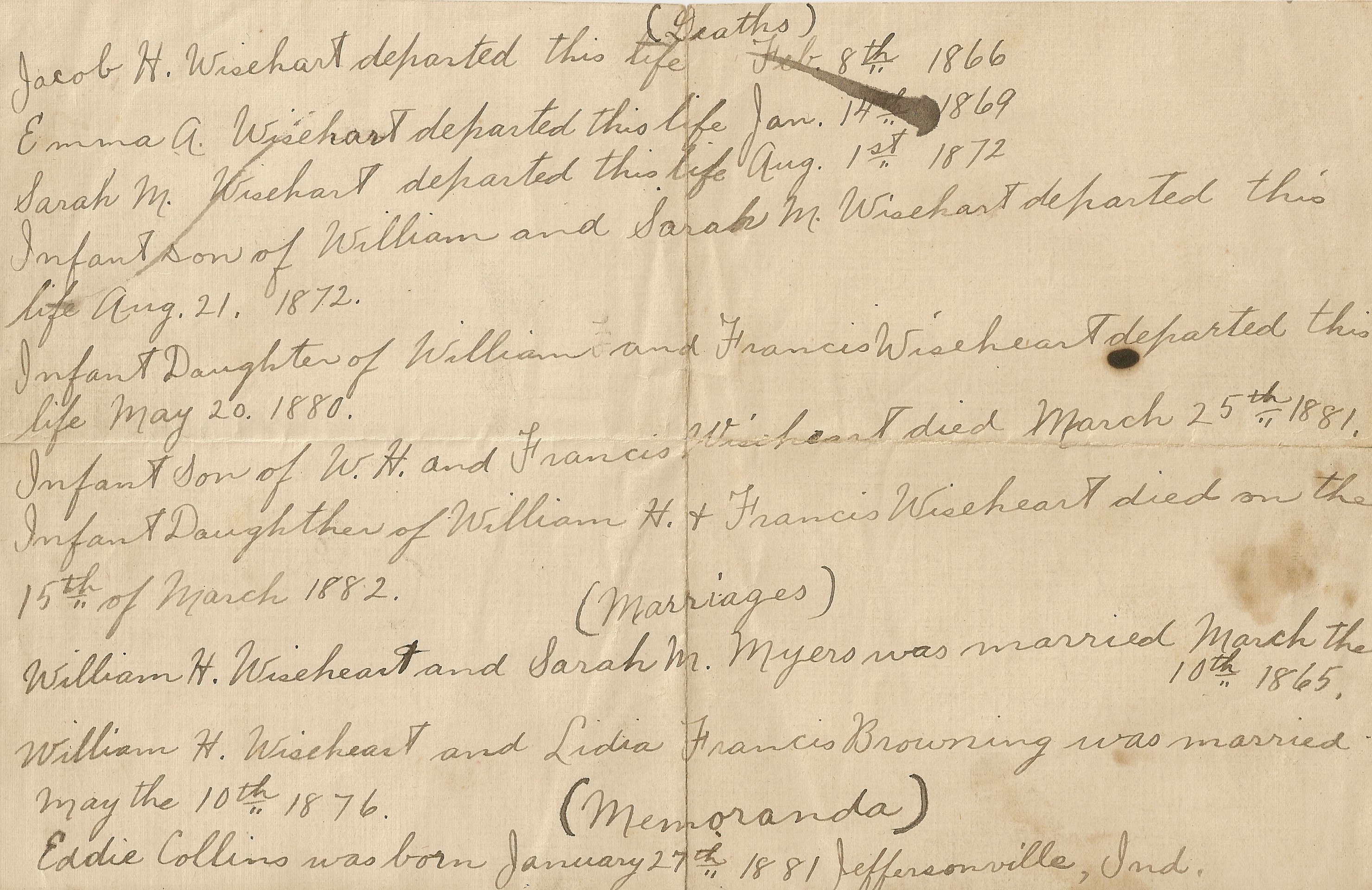
A couple of days ago, as my uncle and I went through the Rakestraw trunk looking for letters relating to Frank Springer, we found that William H. Wiseheart had copied down all of the information from the family Bible onto a piece of paper.  Words cannot express the joy I felt with that discovery!

I’m also grateful that my great great grandpa had the foresight to copy the information.  I can take a lesson from him.  Make sure to copy everything before you loan it, or make copies for the person who wants to do the borrowing.

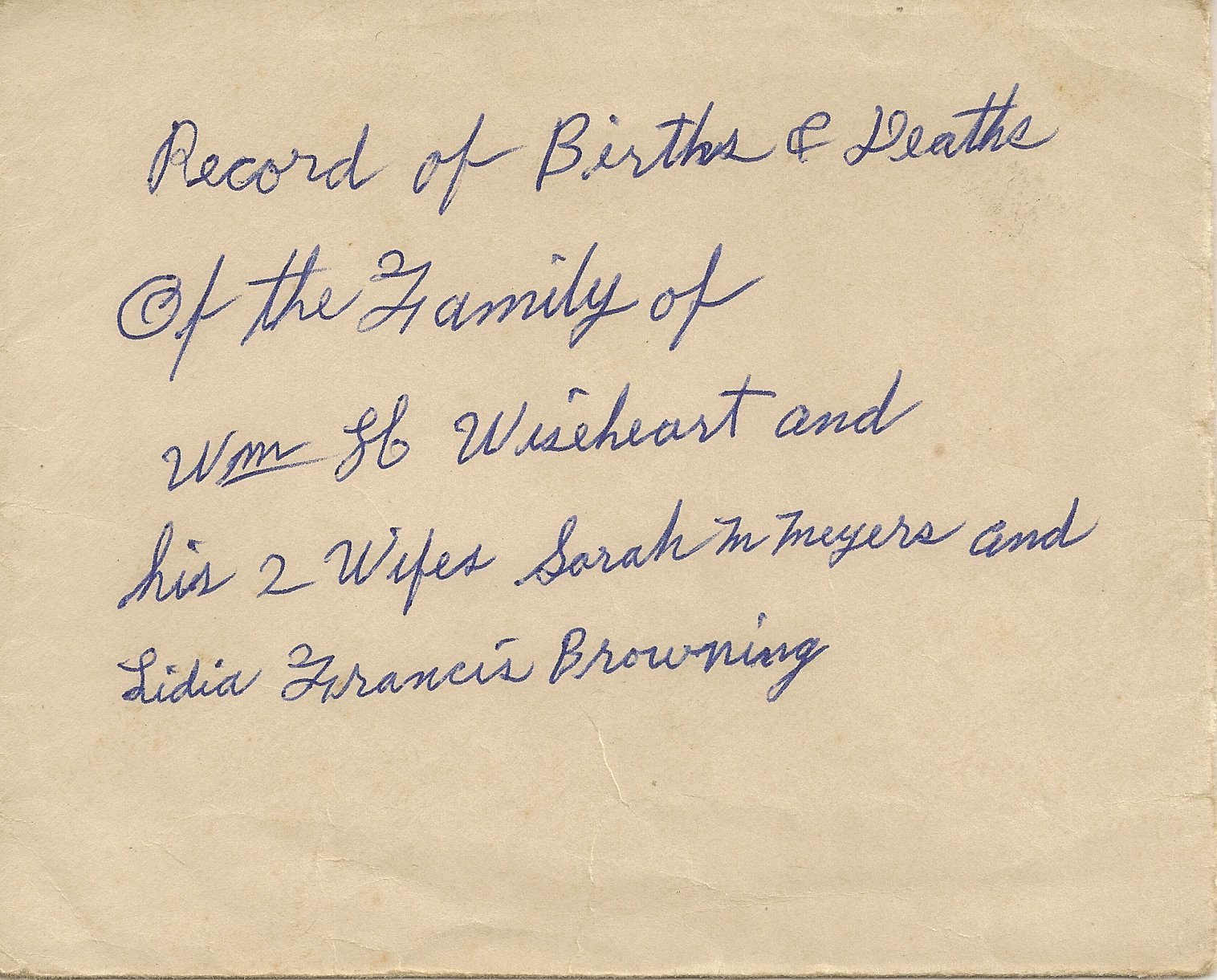
The following images are the envelope the paper was in, and the front and back of the page.  I don’t know whose writing is the blue ink, but the information is accurate based on my research thus far.

Envelope containing transcription of William H. Wiseheart Family Bible.

Envelope containing transcription of William H. Wiseheart Family Bible.

Transcription of the William H. Wiseheart Family Bible by William H. Wiseheart.  Births.

Transcription of the William H. Wiseheart Family Bible by William H. Wiseheart. Births.

Transcription of the William H. Wiseheart Family Bible by William H. Wiseheart.  Deaths, Marriages, and Memoranda.

Transcription of the William H. Wiseheart Family Bible by William H. Wiseheart. Deaths, Marriages, and Memoranda.

Sanford Wiseheart: The Strong, Silent Type (52 Ancestors #05)

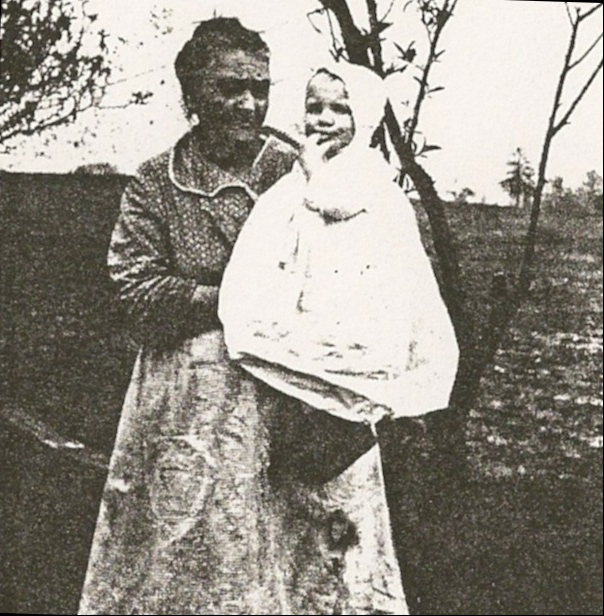
Mary Elizabeth (Gilliland) Rakestraw with her great grandson, Sanford "Bud" Wiseheart, circa 1924.

Mary Elizabeth (Gilliland) Rakestraw with her great grandson, Sanford “Bud” Wiseheart, circa 1924.

Sanford William “Bud” Wiseheart was born on May 30, 1923 in New Albany, Indiana to Sanford Wesley and Mildred Gertrude (Springer) Wiseheart.1  Bud’s great grandmother, Mary Elizabeth Rakestraw, lived with the family until her death in 1935.2,3  She was the widow of a Civil War soldier and passed down many family stories to Bud and his siblings.  In 1941, Bud’s father bought a farm just outside New Albany.  They raised crops and chickens.  Plucking the chickens was one of Bud’s jobs.  He never would eat any poultry after that.
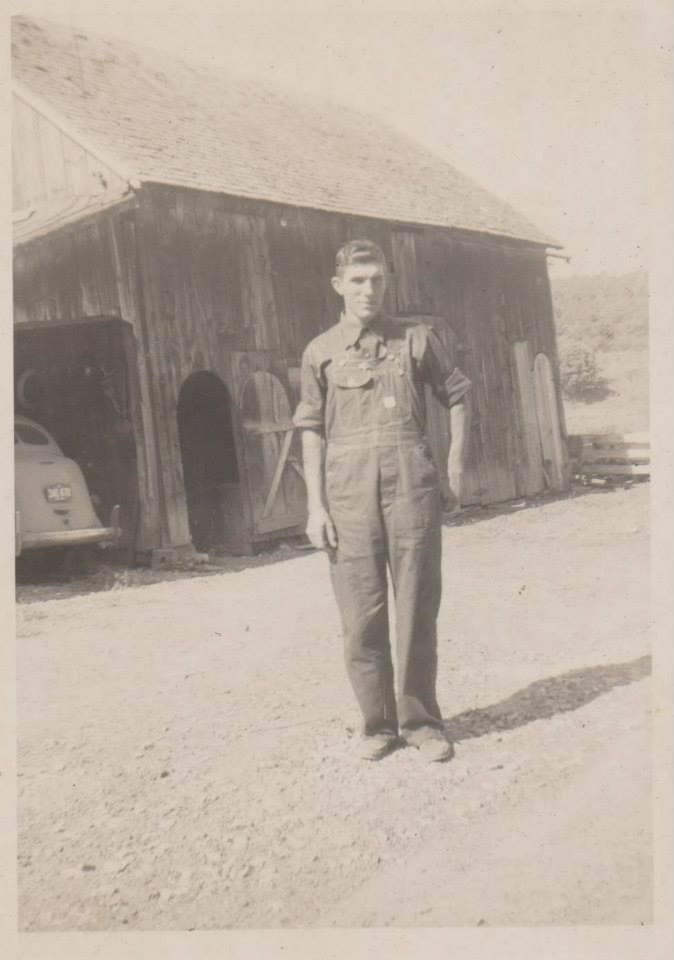
Sanford "Bud" Wiseheart on the farm.

Sanford “Bud” Wiseheart on the farm.

Bud married Dolores Louise Schroeder on August 2, 1958 at Atkins Chapel United Methodist Church in Floyd Knobs, Indiana.4,5,6  (For their engagement story, see Dolores Schroeder).  They had four sons.6  Bud was a carpenter.  He worked for New Albany-Floyd County Consolidated School Corporation and he also did some freelance work.  He was also very active in the church.  He was an usher, bell ringer, Sunday school teacher, and maintenance man for Atkins Chapel.  He also built the church’s Harvest Homecoming booth and assisted with Vacation Bible School.  Bud died at home on October 30, 2014.7

Sanford William "Bud" Wiseheart

Sanford William “Bud” Wiseheart

My grandpa was a hard working man who didn’t seem to have much to say, but when he did say something, it was more than worth it to pay attention.  He was an excellent story teller and knew a lot about a lot of things.  Every time he told me a story, it was full of heart.  Bud was no stranger to hard times, but he weathered them all.  The following is a story, in his own words, that includes two such times:

World War II.  I must’ve been nineteen when it started.  After a while, they started draftin’ and they had a bunch of us went over to Louisville and we were sent letters that we were to be inducted into the Armed Forces.  Thirty three of us went over in that bus from New Albany to Louisville and eleven of us came back rejected.

They examined me and I had a bad ear.  And the psychologist held me up and asked me all kinds of questions.  He asked me what I got out of life.  I told him, ‘I like to help other people, my mother and my father.’  And he kept callin’ me ‘Old Man.’  Nineteen years old and he’s callin’ me ‘Old Man.’  He said, ‘Tell me, Old Man, was there ever somebody in your life you loved very deeply?’  And I said, ‘Well, I can’t think of anything right off.’  Of course, what it was, my little sister, Mary Katherine, I used to sometimes change her diapers.  I was kind of an interpreter.  Sometimes she’d say something to her mother and Ma would ask me what she said.  And so, when she was two years old, she walked right past where I was cleanin’ the stables out and into the neighbors’ yard and fell in the fish pond and drowned.  That went pretty hard with me.  I felt responsible, like I should’ve seen her.  I should’ve saved her.  I even prayed to God to bring her back and take me in her place…

But gettin’ back to it.  I took a heck of a lot of flack.  One time I was goin’ to the grocery with Pap and someone remarked, ‘There’s a young man who ought to be in the military.’  Well, now you can’t tell by lookin’ at somebody that they ought to be in the military.  I just never did have any desire to shoot and kill anybody, but I never made any effort to avoid the draft.

They sent a notice out, ‘All people that are unfit for military service are expected to get into the defense work to help the cause.’  And if we didn’t go somewhere voluntarily, they were goin’ to draft us into defense work.  So I went on up to Charlestown and got in on the construction over there.

My mother got a letter one day from Clara Edwards.  ‘My Dear Mrs. Wiseheart, Thank you for your compliments on Albert and Vernon.’  They had both been inducted into the Army, you see.  ‘Thank you for your compliments on their nerves.  Well, let me tell you something.  All you’ll ever see out of the Wiseheart boys is dirty bedsheets, the dirty yellowbacks.’  And then she signed it off.  ‘Course Frank was too young and I was 4F, I couldn’t help it.  Not that I wanted to go, but they said I was unfit for military service.  So anyway, all them years of this hostile attitude.
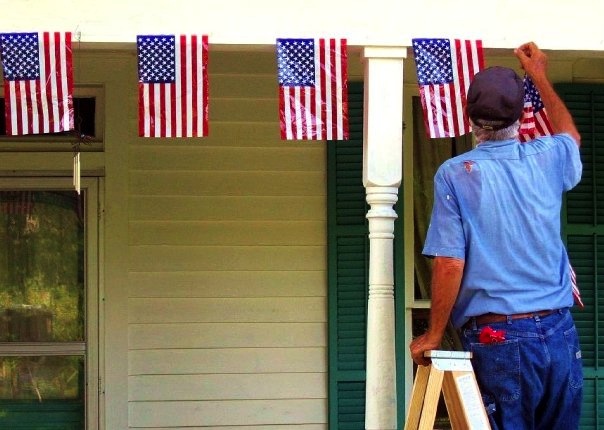
Sanford "Bud" Wiseheart hanging the flags for the 4th of July.

Sanford “Bud” Wiseheart hanging the flags.  July 4, 2009.  Photo taken by Sarah Wiseheart of Wiseheart Photo.


Sources

1.  Floyd County, Indiana Births, CH-14, p.113, Stuart Barth Wrege Indiana History Room

2.  1930 U.S. Federal Census, Silver Creek, Clark County, Indiana, p.14B, Ancestry

3.  1940 U.S. Federal Census, New Albany, Floyd, Indiana, p.10B, FamilySearch

4.  Floyd County, Indiana Marriages, Vol. 55, p.244, Floyd County Clerk’s Office

5.  New Albany Tribune, Sun 24 Aug 1958, p.6, c.1, Stuart Barth Wrege Indiana History Room

6.  New Albany Ledger & Tribune, Sun 2 Aug 1998, p.B2, c.3, Stuart Barth Wrege Indiana History Room

7.  New Albany Tribune, Sat 1 Nov 2014, p.A4, c.3, Stuart Barth Wrege Indiana History Room
More Clues for Frank Springer

As my uncle was going through things at the house yesterday, he came across a ledger belonging to Mildred Springer.  It mostly contains dates and amounts received.  I’m not sure what they are exactly, but I think they could be child support payments from her father, Frank Springer.

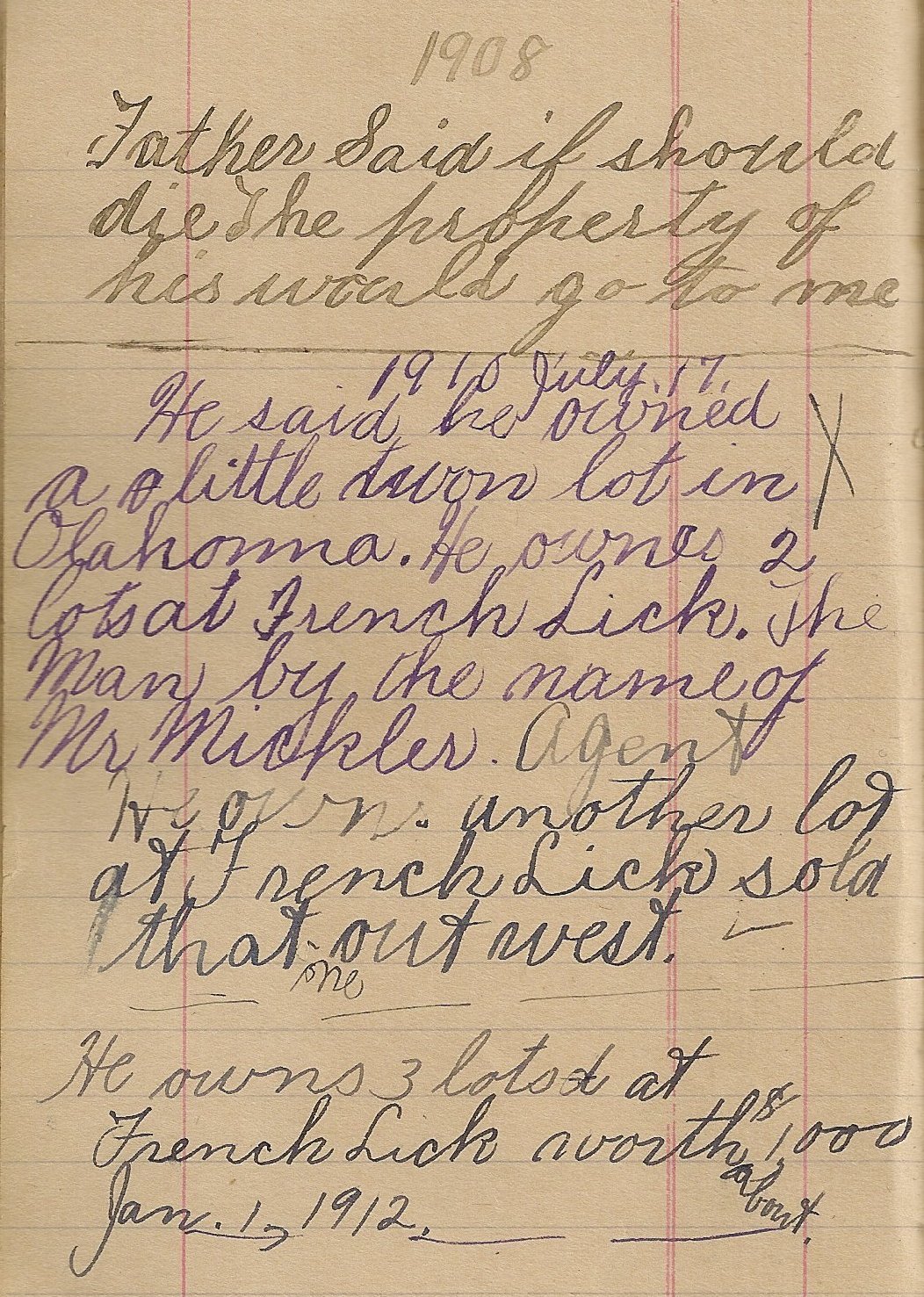
Frank left his home in Paoli, Indiana in 1893 for the World’s Fair in Chicago and I have lost track of him from then until 1920 when he appears in Paoli again.  On one page of this ledger, Mildred wrote about her father’s land holdings.

A page from Mildred Springer's ledger, 1908-1917.

A page from Mildred Springer’s ledger, 1908-1917.

In 1910, Mildred writes that Frank has a lot in Oklahoma and two lots in French Lick.  A newspaper article regarding land in Oklahoma was tucked between this page and the next.

Newspaper article from Mildred Springer's ledger, 1908-1917.

Newspaper article from Mildred Springer’s ledger, 1908-1917.

On the ledger page from the previous image, Mildred also writes that by 1912, Frank had sold his lot out west and purchased a third lot in French Lick.  There is also one page of the ledger that lists two payments coming from Madison, Illinois in 1913.

My theory is that he left Chicago after the World’s Fair and travelled West.  He settled in Oklahoma circa 1904 for a time, but was on the move again before the 1910 Census. I’ve searched for Frank Springer in the 1900 and 1910 Census for Indiana, Kentucky, Tennessee, Illinois, Iowa, Missouri, Kansas, Oklahoma, and Arkansas with no luck.  With some fairly strong evidence to suggest he was in at least two of those states, a transient lifestyle seems a logical explanation as to why I can’t find him.

Here’s my theory with a visual…

Frank Springer's journey

1.  Living in Paoli, Indiana (1892).

2.  Goes to World’s Fair, Chicago, Illinois (1893).

3.  Possible trip to Iowa.  (Part of family legend is that he spent some time in Iowa).

4.  Back to Paoli to check in with family.

5.  Purchases land in French Lick, Indiana (circa 1900).

6.  Claims land near Woodward, Oklahoma (1904).

7.  Possible trip to California.  (Part of family legend is that he spent some time in California).

8.  Sells land in Oklahoma (circa 1912).

9.  Buys another lot in French Lick (circa 1912).

10.  Goes to Madison, Illinois (1913).

11.  It is possible that the California trip fit in here instead of after Oklahoma.

12.  Back in Paoli (1920).

This is the guide I’ll be working with to try to locate Deed and City Directory records for Frank.  It’s confusing, and kind of a long shot, but it’s definitely more than what I had to go on before.  As my co-worker said just a few days ago, most genealogists don’t do it because it’s easy, they do it for the thrill of following the clues and solving the mystery.

Josephine Sellers: A Wedding, A War, and A Pandemic

Several years ago, as I was sitting with my cousins after having eaten lunch, my grandpa brought a document into the room for me to look at.  It was a Certificate of Death for a Josephine Sellers Wiseheart.  Josephine was not a family name with which I was familiar.  Grandpa said she was Pap’s (his dad) first wife.

In 1918, there was an influenza pandemic that killed an estimated 50 million people.  Josephine Sellers Wiseheart was one of these people.  She was sixteen and a half.  She and Sanford Wesley Wiseheart (Pap) had been married for almost a year and half.  For such a short marriage, it was certainly an eventful one.

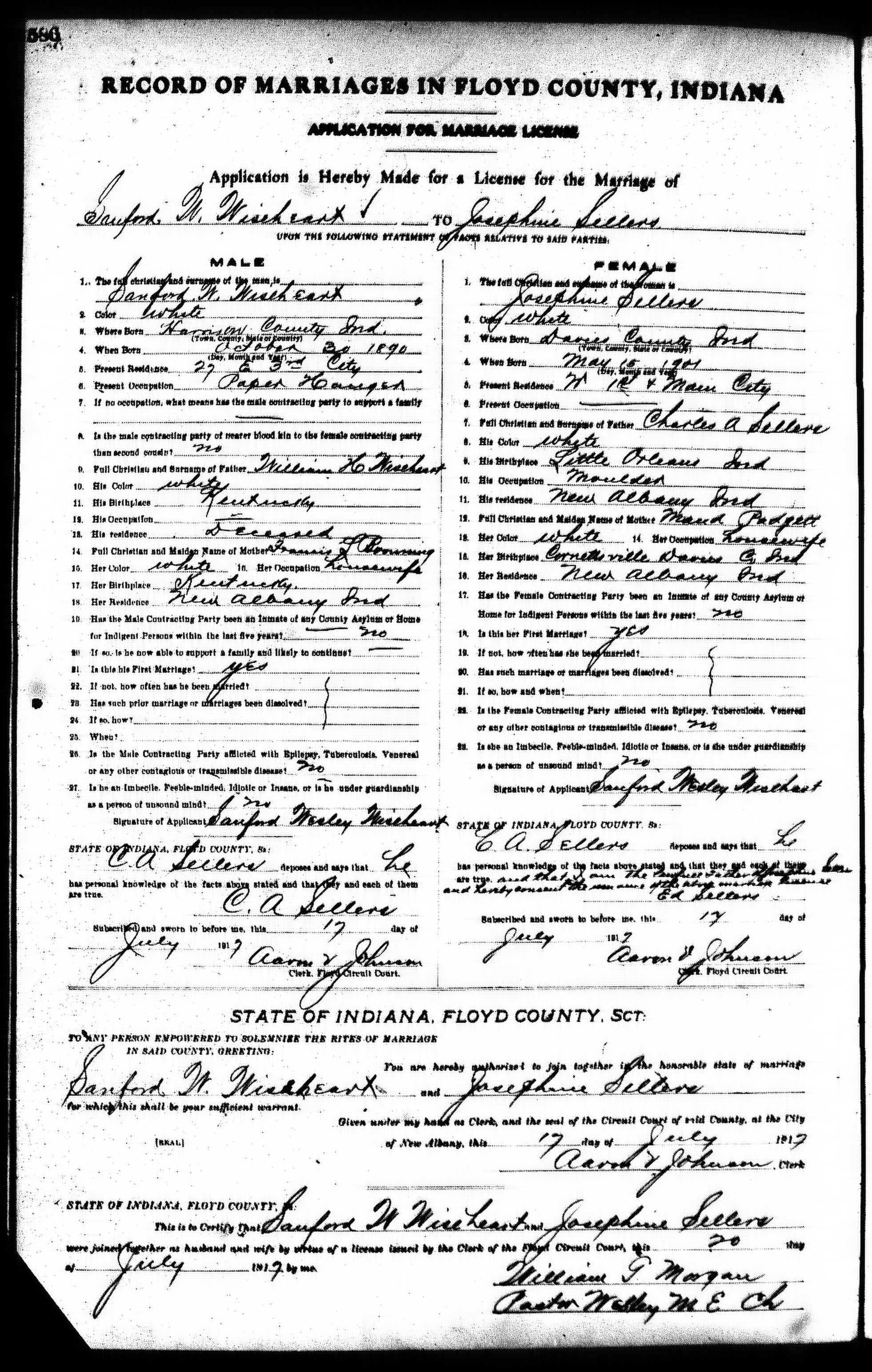
I have no idea how they met or exactly when, I just know that Josephine was living with her parents and two brothers in Vincennes, Indiana in 1910, so they couldn’t have been in New Albany for more than seven years.  In any case, Sanford and Josephine were married by the pastor of Wesley Methodist Episcopal Church on July 20, 1917.  Josephine’s birthdate was listed as May 15, 1901, which would have made her sixteen at the time of their marriage.  She was born in Daviess County, Indiana.  Her parents were Charles A. Sellers and Maud Padgett.  Charles Sellers consented to the marriage.

Just four months later, the couple separated and Josephine filed for divorce, rather her mother filed for her because she was a minor.

New Albany Daily Ledger, 10 Nov 1917, p.4, column 2, Stuart Barth Wrege Indiana History Room

New Albany Daily Ledger, Saturday, 10 Nov 1917, p.4, column 2, Stuart Barth Wrege Indiana History Room
Family legend is that Sanford, or Sandy as he was known around town, filed for divorce because he found out that Josephine had lied about her age.  I haven’t found any evidence that he ever filed for divorce.

On April 22, 1918, Sandy was inducted into the Army, having already filled out a draft registration card in June of 1917.  In August of 1918, he left for France.

In December of 1918, Josephine caught the flu.  Dr. Schoen attended her from December 2nd until her death on December 11th.  Her Death Record shows that she was married to a J. Wiseheart at the time of her death.  I’ve found no record of the divorce having gone through and I’ve found no record of Josephine ever having married again.  I believe that it was supposed to have been S. Wiseheart.

Floyd County, Indiana Deaths, Book CH-24, p.104, Stuart Barth Wrege Indiana History Room
Floyd County, Indiana Deaths, Book CH-24, p.104, Stuart Barth Wrege Indiana History Room

Her death record also states that she was born on May 24, 1902.  So, either she (and her father) lied about her age when she married or the clerk made an error.  Or, the death record is incorrect.  I’ve tried to find a birth record to verify the date to no avail.  I searched first in Daviess County, since that’s where the marriage record says she and her mother were born.  Then I searched Orange County, where her father was born, and Knox County where they lived before moving to New Albany.  I also searched the surrounding counties of Pike, Martin, Dubois, and Greene in case she had been born while they were moving from one place to another.  Lastly, I searched Floyd County, since that’s where they ended up.  No birth record.

Josephine was buried in Sandy’s plot at Fairview Cemetery on December 14, 1918 as Josephine S. Wiseheart.  Her father had her moved to the Sellers family plot in Holy Trinity Cemetery just two months later.

Fairview Cemetery, Volume VI, 1910-1919, p.127, Stuart Barth Wrege Indiana History Room

Fairview Cemetery, Volume VI, 1910-1919, p.127, Stuart Barth Wrege Indiana History Room

Her tombstone reads Josephine Sellers, 1902-1918.  I wonder if he moved her because she was posthumously granted the divorce or if he just really wanted her to be separated from Sandy even in death.  I’m keeping an eye out for any documentation that a divorce was granted, but everything I’m finding says that Sandy was a widower.

Such was the short, dramatic life of Josephine Sellers.  Even though I’m not directly related to her, I sometimes wonder about her.  What did she look like?  What was her personality?  Why did she marry at fifteen or sixteen?  What really happened to cause her to file for divorce?  When I think about her in terms of being my great grandfather’s first wife, it doesn’t seem so long ago, but looking at dates, it was nearly one hundred years ago.  These are questions to which I will probably never know the answer.

20 Rules for Genealogy

I often talk about my research with my co-workers.  I find myself saying things like, “I know ____ happened.”  When my co-worker asks how I know, my response is often “because my grandpa told me.”  Of course, I know, and frequently say, that nothing is “known” until it’s been proven.  I’m just sometimes so involved in what I’m doing that it’s hard for me to take a step back and look at it objectively, which is why I often talk to my co-workers about my research.  They act as a mirror.  They tell me the things I know but fail to recognize.  Currently, I have several different people that I’m researching and I really just need a reminder of what I need to do.  So, I set out to write down my rules.  Some of these I’ve picked up from peers and mentors and others I’ve learned the hard way.

  1. Genealogy without proof is mythology. Every fact needs supporting evidence.
  1. You have to be a detective. Pay attention to the details, think outside the box, and put yourself in your ancestor’s shoes. Be willing to beat your head against the brick wall until you make it through.
  1. Work from the known to the unknown. Start with yourself and move backward. Maybe you are descended from royalty, but it takes multiple times longer to trace it down from that royal ancestor to you.
  1. Be open. Accept that some of the things you “know” may be only partially true or may not be true at all. Family stories can be like playing telephone for decades. Also keep in mind that everyone has skeletons in their family closet. You can’t be afraid of what you might find. We are not responsible for the actions of our ancestors.
  1. Use pencil until it’s proven. Not only will you save paper (and trees), but this will also help you see what you still need to research.
  1. Use primary sources whenever possible. Secondary sources can be a helpful guide, but primary sources are generally more reliable.
  1. Cite your sources! It’s frustrating to you when you need to re-copy something and you can’t remember where you found it. It’s frustrating to others when they can’t verify something that you’ve written.
  1. Track your work. Knowing what sources were not helpful is just as important as citing the ones that were. Accidentally revisiting the same unhelpful source is a headache and a waste of your valuable time.
  1. One source is not proof. A minimum of two sources is preferable. Even vital records can be wrong. However, one source is better than no source.
  1. Check all possible spellings, sound-alikes, and look-alikes. Also look for nicknames, initials, and the use of a middle name instead of the first. “To ere is human.” Clerks, enumerators and transcribers are no exception.
  1. Always spell the month and use all four digits for the year. 3/2/12 could be March 2, 1912 or February 3, 1812. Using 2 Mar 1912 or March 2, 1912 is clearer. If you aren’t sure what the original record means, make a note of exactly how it appeared on the record.
  1. Research your collaterals. Your ancestor’s sibling may be the key to breaking through your brick wall. This is especially true if everyone in your family was named Charles, William, and Elizabeth, but there was one sister named America.
  1. Check and re-check all your sources. What doesn’t seem important now may prove to be important later. This is especially true if you’ve inherited copies from another family member and can’t quite connect some of the names to what you have researched.
  1. Back-up your work. Save it on your computer, an external hard drive, a flash drive, an online database, and the cloud. Make photocopies or printouts of everything. You can never have too many. Making a schedule for this will help. Maybe you save to your computer and print a copy immediately, back up to a flash drive and/or an online database once a week, and back up to an external hard drive once a month.
  1. Don’t be afraid to ask for help. Everyone needs help sometimes, even the experts. Sometimes you can be so focused on something, that the avenues you normally would consider have escaped your notice. Two heads are better than one.
  1. Ask questions of your elders. Having lived the longest, these family members will be the ones with the most information for you. Of course, you want to get information wherever you can, so don’t ignore the rest of the family. Often times, hearing family stories from more than one point of view can give you clues for your research. Record your family’s stories. The longer you wait, the harder it will be and it may be a useful tool for future generations.
  1. Share your discoveries. Publish a book, write a blog, or donate copies to your local genealogical society, historical society, or library. This allows access to others, ensures that future generations will be able to find it, and acts as another form of back-up, should anything happen to your files.
  1. Do not publish or post information about living people without their permission. Some people may wish to avoid being found for whatever reason. Many people simply like to keep things private and we should respect that.
  1. Some brick walls are permanent. Many records have been destroyed due to war or natural disasters, and some due to human accident. Some events were never recorded.
  1. You will probably never be finished. “New” sources are being discovered and digitized everyday. There is always something new to learn.