More Clues for Frank Springer

As my uncle was going through things at the house yesterday, he came across a ledger belonging to Mildred Springer.  It mostly contains dates and amounts received.  I’m not sure what they are exactly, but I think they could be child support payments from her father, Frank Springer.

Frank left his home in Paoli, Indiana in 1893 for the World’s Fair in Chicago and I have lost track of him from then until 1920 when he appears in Paoli again.  On one page of this ledger, Mildred wrote about her father’s land holdings.
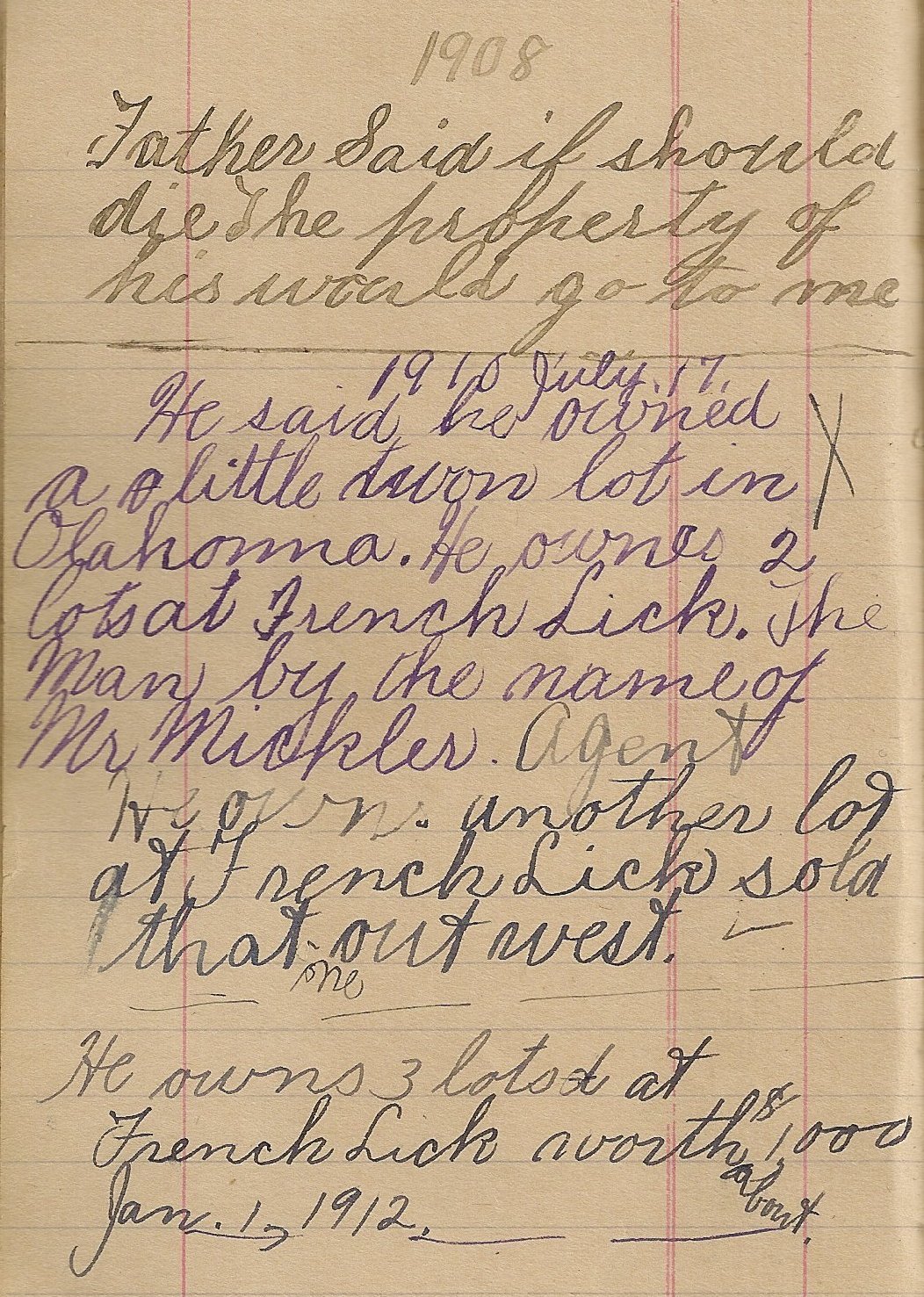
A page from Mildred Springer's ledger, 1908-1917.

A page from Mildred Springer’s ledger, 1908-1917.

In 1910, Mildred writes that Frank has a lot in Oklahoma and two lots in French Lick.  A newspaper article regarding land in Oklahoma was tucked between this page and the next.

Newspaper article from Mildred Springer's ledger, 1908-1917.

Newspaper article from Mildred Springer’s ledger, 1908-1917.

On the ledger page from the previous image, Mildred also writes that by 1912, Frank had sold his lot out west and purchased a third lot in French Lick.  There is also one page of the ledger that lists two payments coming from Madison, Illinois in 1913.

My theory is that he left Chicago after the World’s Fair and travelled West.  He settled in Oklahoma circa 1904 for a time, but was on the move again before the 1910 Census. I’ve searched for Frank Springer in the 1900 and 1910 Census for Indiana, Kentucky, Tennessee, Illinois, Iowa, Missouri, Kansas, Oklahoma, and Arkansas with no luck.  With some fairly strong evidence to suggest he was in at least two of those states, a transient lifestyle seems a logical explanation as to why I can’t find him.

Here’s my theory with a visual…

Frank Springer's journey

1.  Living in Paoli, Indiana (1892).

2.  Goes to World’s Fair, Chicago, Illinois (1893).

3.  Possible trip to Iowa.  (Part of family legend is that he spent some time in Iowa).

4.  Back to Paoli to check in with family.

5.  Purchases land in French Lick, Indiana (circa 1900).

6.  Claims land near Woodward, Oklahoma (1904).

7.  Possible trip to California.  (Part of family legend is that he spent some time in California).

8.  Sells land in Oklahoma (circa 1912).

9.  Buys another lot in French Lick (circa 1912).

10.  Goes to Madison, Illinois (1913).

11.  It is possible that the California trip fit in here instead of after Oklahoma.

12.  Back in Paoli (1920).

This is the guide I’ll be working with to try to locate Deed and City Directory records for Frank.  It’s confusing, and kind of a long shot, but it’s definitely more than what I had to go on before.  As my co-worker said just a few days ago, most genealogists don’t do it because it’s easy, they do it for the thrill of following the clues and solving the mystery.

20 Rules for Genealogy

I often talk about my research with my co-workers.  I find myself saying things like, “I know ____ happened.”  When my co-worker asks how I know, my response is often “because my grandpa told me.”  Of course, I know, and frequently say, that nothing is “known” until it’s been proven.  I’m just sometimes so involved in what I’m doing that it’s hard for me to take a step back and look at it objectively, which is why I often talk to my co-workers about my research.  They act as a mirror.  They tell me the things I know but fail to recognize.  Currently, I have several different people that I’m researching and I really just need a reminder of what I need to do.  So, I set out to write down my rules.  Some of these I’ve picked up from peers and mentors and others I’ve learned the hard way.

  1. Genealogy without proof is mythology. Every fact needs supporting evidence.
  1. You have to be a detective. Pay attention to the details, think outside the box, and put yourself in your ancestor’s shoes. Be willing to beat your head against the brick wall until you make it through.
  1. Work from the known to the unknown. Start with yourself and move backward. Maybe you are descended from royalty, but it takes multiple times longer to trace it down from that royal ancestor to you.
  1. Be open. Accept that some of the things you “know” may be only partially true or may not be true at all. Family stories can be like playing telephone for decades. Also keep in mind that everyone has skeletons in their family closet. You can’t be afraid of what you might find. We are not responsible for the actions of our ancestors.
  1. Use pencil until it’s proven. Not only will you save paper (and trees), but this will also help you see what you still need to research.
  1. Use primary sources whenever possible. Secondary sources can be a helpful guide, but primary sources are generally more reliable.
  1. Cite your sources! It’s frustrating to you when you need to re-copy something and you can’t remember where you found it. It’s frustrating to others when they can’t verify something that you’ve written.
  1. Track your work. Knowing what sources were not helpful is just as important as citing the ones that were. Accidentally revisiting the same unhelpful source is a headache and a waste of your valuable time.
  1. One source is not proof. A minimum of two sources is preferable. Even vital records can be wrong. However, one source is better than no source.
  1. Check all possible spellings, sound-alikes, and look-alikes. Also look for nicknames, initials, and the use of a middle name instead of the first. “To ere is human.” Clerks, enumerators and transcribers are no exception.
  1. Always spell the month and use all four digits for the year. 3/2/12 could be March 2, 1912 or February 3, 1812. Using 2 Mar 1912 or March 2, 1912 is clearer. If you aren’t sure what the original record means, make a note of exactly how it appeared on the record.
  1. Research your collaterals. Your ancestor’s sibling may be the key to breaking through your brick wall. This is especially true if everyone in your family was named Charles, William, and Elizabeth, but there was one sister named America.
  1. Check and re-check all your sources. What doesn’t seem important now may prove to be important later. This is especially true if you’ve inherited copies from another family member and can’t quite connect some of the names to what you have researched.
  1. Back-up your work. Save it on your computer, an external hard drive, a flash drive, an online database, and the cloud. Make photocopies or printouts of everything. You can never have too many. Making a schedule for this will help. Maybe you save to your computer and print a copy immediately, back up to a flash drive and/or an online database once a week, and back up to an external hard drive once a month.
  1. Don’t be afraid to ask for help. Everyone needs help sometimes, even the experts. Sometimes you can be so focused on something, that the avenues you normally would consider have escaped your notice. Two heads are better than one.
  1. Ask questions of your elders. Having lived the longest, these family members will be the ones with the most information for you. Of course, you want to get information wherever you can, so don’t ignore the rest of the family. Often times, hearing family stories from more than one point of view can give you clues for your research. Record your family’s stories. The longer you wait, the harder it will be and it may be a useful tool for future generations.
  1. Share your discoveries. Publish a book, write a blog, or donate copies to your local genealogical society, historical society, or library. This allows access to others, ensures that future generations will be able to find it, and acts as another form of back-up, should anything happen to your files.
  1. Do not publish or post information about living people without their permission. Some people may wish to avoid being found for whatever reason. Many people simply like to keep things private and we should respect that.
  1. Some brick walls are permanent. Many records have been destroyed due to war or natural disasters, and some due to human accident. Some events were never recorded.
  1. You will probably never be finished. “New” sources are being discovered and digitized everyday. There is always something new to learn.

Two Marriages & A Murder

Three days ago, I posted about Serilda Gilliland marrying John Bridges twice and that John went to prison for murder.  I was able to unravel a little bit more today.  First, I looked up the Daniel G. Stewart who was a minister from 1835 to 1837 again, and he was actually Daniel S. Stewart and is not the same D.G. Stewart who married them.  I looked in a different city directory today (1848) and David G. Stewart was listed as a homeopathic doctor.  Having the correct first name, I looked him up in the newspaper index and found a listing for an obituary.  According to his obituary in the New Albany Daily Ledger Standard (9 Apr 1878, p.4, c.2-3), David G. Stewart was a doctor who moved to New Albany in 1832.  He joined the First Christian Church and regularly preached when the the pastor was absent.  He was not ordained.  Therefore, Serilda and John’s first marriage was not valid.  Now I know the mechanics of why they were married twice, but I’m still left wondering how he got out of prison for it.

Now, on to the murder trial…

The State of Indiana v. John Bridges:  Coroner’s Inquest

New Albany Daily Tribune, 17 Jan 1859, p.3, c.1, Stuart Barth Wrege Indiana History Room

New Albany Daily Tribune, 17 Jan 1859, p.3, c.1, Stuart Barth Wrege Indiana History Room

Genealogy Bullet Journaling

I was in the lounge at work the other day and a couple of my co-workers were talking about bullet journals.  I’d never heard about a bullet journal before.  My co-workers gave me a description, and I looked it up when I got home.  Basically, it’s a style of journaling wherein a person writes everything with bullets or checkboxes to save the time and energy it would take to go into detail about one’s day.  I could never journal like that.  However, I thought it could be slightly adapted to work for genealogy, so I gave it a try.

The first page of my bullet journal.  I left two pages open for this person, but some people only have one page.

The first page of my bullet journal. I left two pages open for this person, but some people only have one page.

I write my ancestor’s name as the page title.  If I have something I have to look up, I draw a box and write it down.  When I look for it, I mark the box with an X if I didn’t find it and a check if I did find it.  If I didn’t find it, I also write a quick note about why I couldn’t find it.  Doing so will prevent me from looking for it again in the future and wasting time.  If I find something that I didn’t think to look for while I’m doing my research, I add a bullet and write it down.  This indicates to me that it is a note and not something on which I need to take action.  Since a lot of my research is done on my breaks, this is very helpful for me.  I can look up one or two items and save the rest for later.  It also keeps me from getting distracted from my goals and researching a different person just so that I don’t forget to later.

In the genealogy class that I teach, one of the basic genealogy “do’s” is to make a list of what you want to research so that you can accomplish the goal and not get distracted, because, let’s face it, it’s easy to see multiple family names in an index or see suggestions on Ancestry.com and never get around to what we set out to research.  For me, I’ve always brought in a checklist and a blank sheet of paper or a notebook to make notes of the things I find that I need to look up later.  This journal combines both in a way that is easy for me to handle.  I don’t mean to sound like an advertisement here.  I just found this to be really useful and I thought I’d pass on what I’ve learned.

The Importance of Re-checking Your Old Documents

My grandparents had been working on our genealogy for pretty much their whole lives.  I didn’t really get into it until about twelve years ago, when my grandma gave me several pedigree charts for different lines of the family.  At that point in time, having just graduated from high school, I was content to just have that.  Of course, now that I’m working at the Stuart Barth Wrege Indiana History Room, I know the importance of sourcing everything.  My grandparents have several cardboard boxes full of documents, some original and some copies, from which they have gotten the genealogical information.

A couple of years ago, I sat down with my grandpa and we discussed my plans for documenting everything.  He agreed to let me borrow a box to start with to digitize everything and sort it a little.  He said the boxes had originally been separated by which line of the family the information pertained to, but as the years went by, things just got tossed into whichever box was most convenient or least full at the time.

The first box he gave me was the “Wiseheart” box, but there were some Rakestraws, Von Allmens, church history, and several other things in there as well.  I just scanned everything and labeled it as best I could, even if I didn’t know what it was or how it fit.  I then returned the box and borrowed another.  At that point in time, I was just learning how to use my scanner with my new Mac.  Everything I scanned got saved to a default location and I, for some reason, haven’t looked at it since, until today.

Here, I will digress for a bit, to give some context as to why this is significant.  In October of 2013, the Southern Indiana Genealogical Society (SIGS) held its first First Families of Floyd County program.  Basically, if you can prove that your ancestor was in Floyd County, Indiana on or before December 31, 1840, you qualify for a First Families certificate.  I wasn’t anywhere near ready for the deadline for that one, but they announced that First Families would continue the following year.  I researched the Rakestraw line of my family because I knew Charles Rakestraw was on the 1840 U.S. Federal Census, which was enumerated on June 1, 1840, thus before the requisite date.

After tracing my family pretty far back, I hit a snag.  I couldn’t find a way to link Milton Rakestraw to his father, Charles.  The 1840 Census only lists head of household with tallies for people of certain age groups in the household.  By the 1850 Census, Milton had married and moved out.  I decided to use siblings to prove his relationship.  In the 1850 Census, Milton’s younger brother, William Arlie, was living with him, while his father, Charles, and two sisters, Elizabeth and Minerva, were living with his brother-in-law and sister, Henry and Adaline Hardy.  I looked for William Arlie’s death record, to see if his parents were named.  They were not.  In the 1870 Census, Elizabeth Flora is living with William Arlie Rakestraw.  I “know” this is his sister Elizabeth, but I couldn’t find any record of Elizabeth Rakestraw having married a Flora, or anyone, for that matter, in either of the two counties where she had lived.  I needed this to close the connection circle.  All of this was enough for SIGS, but it wasn’t enough for me.  Having completed the application for the program, I set the Rakestraws aside to give myself a break and decided to focus on the Springers for a while.

This brings us back to today.  I found the default folder in which my scanner had saved everything.  One image was labeled “Flora, Marion Elizabeth – Cemetery Record,” which had meant nothing to me at the time.  I had no idea then that the Floras were in any way related to us.  Now, however, this could be a big clue as to why I couldn’t find a marriage record for Elizabeth Rakestraw to a Flora.  If her name was in fact Marion Elizabeth Rakestraw, the marriage record might have been filed under Marion Rakestraw.  The “Cemetery Record” is page 49 from Fairview Cemetery, Volume VIII, January 1, 1930-December 31, 1934, published by the Southern Indiana Genealogical Society.  The whole thing is quite lengthy, as it includes two obituaries, but the important part is:

FLORA, Marion Elizabeth; 20978; 78 yrs; res L. A. CA; d. 13 Aug 1933; bur 19 Aug 1933; ; ; P 2 R 8 Lot 21 G 5; Charles Rakestraw and Henry Hardy trans. to Susan Flora; Chr. Myocarditis; Frank W. Webb; Elmer H. Dieckman; 20978–Former Local Woman Dies in Los Angeles–Mrs. Marion E. Flora, 78, widow of William Flora, a former New Albany resident…

I know from this that Marion Elizabeth Flora is from New Albany, Floyd County, Indiana, that her husband was William Flora, that she is approximately the same age as my Elizabeth Rakestraw, and that she is in some way related to Charles Rakestraw, Henry Hardy, and Susan (Rakestraw) Flora.  Now I need to go back through the marriage records for Floyd County to see if a William Flora married either a Marion or an Elizabeth Rakestraw.

This is a prime example of why it is important to re-check your old documents periodically.  Something that doesn’t seem to fit now might turn out to be the missing puzzle piece you’ve been beating your head against the wall for months to find.