Francis Rakestraw: The Effects of War (52 Ancestors #21)

George William

George William “Willie” Rakestraw, Charles M. “Charlie” Rakestraw, and Francis Marion Rakestraw, circa 1900. Three generations.

Francis Marion Rakestraw was born on December 22, 1847 in New Albany, Indiana to parents Milton and Mary Susan (Henderson) Rakestraw.1,2,3,4  He was the oldest of three children, all boys.4  When Francis was seven years old, his father died.5  Mary Susan married James Hand two years later.6,7

Francis enlisted in the army on December 28, 1863 in New Albany.  He had just turned sixteen, but he told the recruiter that he was eighteen.  He gave his occupation as fisherman.  Francis entered as a Private and was assigned to Company B of the Thirteenth Cavalry, 131st Regiment of the Indiana Infantry.8,9,10,11

The Thirteenth Cavalry was the last cavalry organized in Indiana.  Recruiting for the companies began in September of 1863 and ended in April of 1864.  Colonel Gilbert Marquis Lafayette Johnson was the commanding officer.  On April 30, 1864, the Cavalry left Indianapolis and boarded a train for Nashville, Tennessee.  They trained in Nashville for a month and then departed, again by train, for Huntsville, Alabama to garrison the post there.  They were engaged in several skirmishes while trying to keep the supply lines clear.8,10  In Nashville, Francis was thrown from his saddle mule, which caused a back injury.  In Huntsville, he contracted malarial fever.12,13

On October 1, 1864, the Thirteenth Cavalry held the post against the command of the rebel General Buford.  On October 16th, six of the companies went to Louisville, Kentucky for fresh horses.  Company B remained at the post.  The companies that had gone to Louisville did not come back to Huntsville, but were rerouted to fight in Nashville.  Company B and the remaining five companies were sent to Nashville as well.  The Thirteenth Cavalry fought in the Battle of Nashville, alongside several other regiments, against Hood’s troops and defeated them on December 16, 1864.  After the battle, all of the companies were reunited and assigned to the Second Brigade, Seventh Division of the Cavalry Corps of the Military Division of Mississippi under Colonel Johnson.8,10

On February 11, 1865, the Thirteenth Cavalry boarded transports bound for New Orleans, but were rerouted to fight at Mobile Bay.  Mobile fell in April of 1865.  The Cavalry then participated in a number of raids in the area, until they were assigned to garrison at Macon.8,10

Francis mustered out with the rest of the regiment at Vicksburg, Mississippi on November 18, 1865.  His discharge paper says that he was eighteen at this time, which is accurate.8,9,10,11

Francis Rakestraw's Civil War belt buckle.

Francis Rakestraw’s Civil War belt buckle.

Francis Rakestraw's Civil War sword.

Francis Rakestraw’s Civil War sword.

Having some disability after his accident, Francis took a job with J. Bragdon & Co., proprietors of New Albany Rolling Mills.14

On October 22, 1867, Francis married Mary Elizabeth (Gilliland) Brown.1,3,15  They had two children, Zerilda Eleanora “Ella,” born in 1868, and George William “Willie,” born in 1873.3,16,17

After Willie’s birth, Francis began working as a driver for Israel P. Park’s coal yard.18  In 1882, he began working for Ohio Falls Iron Works, as a laborer.19  In 1886, he took a job as a driver at E. W. Fawcett’s coal and ice company.20  Francis became a driver at John Newhouse & Bro. coal company in 1892.21

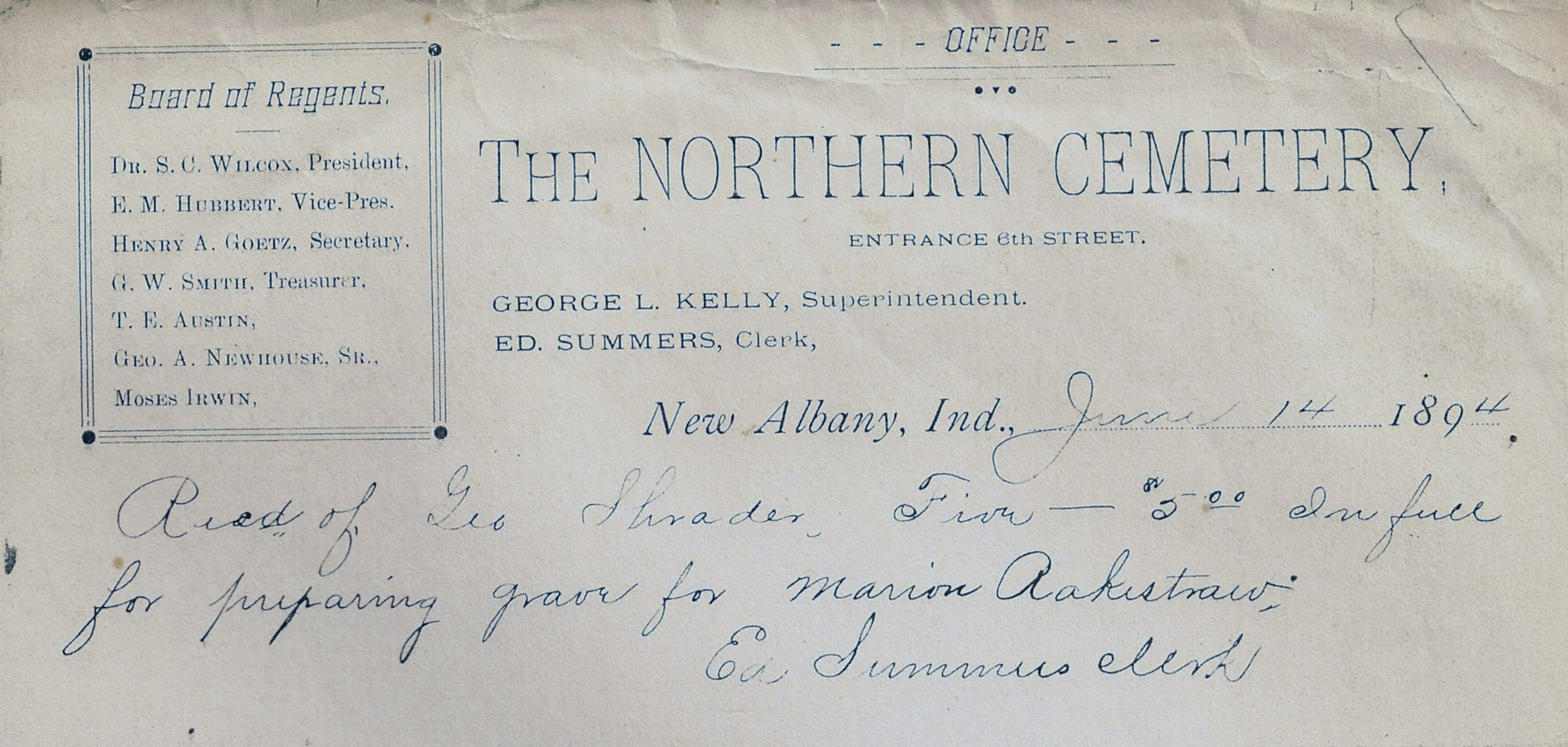
Francis’ daughter died in June of 1894 of consumption.22  George Shrader was the undertaker, and it was at about this time that Francis began working as a driver for Shrader, who also owned a livery.23,24  He worked for the Shraders until November of 1910, when he contracted Pulmonary Tuberculosis.1,25,26

Francis Marion Rakestraw died on January 27, 1911 and was buried at Soldier’s National Cemetery in New Albany, Indiana.1,2,3,11

Francis Rakestraw's G.A.R. Information Committee ribbon.

Francis Rakestraw’s G.A.R. Information Committee ribbon.

Francis Rakestraw's G.A.R. 3rd Annual Convention (1896) ribbon.

Francis Rakestraw’s G.A.R. 3rd Annual Convention (1896) ribbon.

Francis Rakestraw's G.A.R. In Memoriam ribbon.

Francis Rakestraw’s G.A.R. In Memoriam ribbon.

Tombstone,  #3054, New Albany National Cemetery, New Albany, Indiana.  Photo taken 25 May 2015 by Melissa Wiseheart.

Tombstone, #3054, New Albany National Cemetery, New Albany, Indiana. Photo taken 25 May 2015 by Melissa Wiseheart.


Sources

1.  Floyd County, Indiana Death Records, Book CH-22, p. 17, Stuart Barth Wrege Indiana History Room.

2.  Obituary, New Albany Evening Tribune, Friday, 27 January 1911, p. 4, column 2, Stuart Barth Wrege Indiana History Room.

3.  Transcription of the Rakestraw Family Bible.

4. 1850 U.S. Federal Census, Jeffersonville, Clark, Indiana, pp. 313-314, Ancestry.com.

5. Clipp, Mary Cuzzort, et al. Fairview Cemetery, Volume 1, New Albany, Floyd County, Indiana. New Albany, IN: Southern Indiana Genealogical Society, 1991. 62. Print.

6. Floyd County, Indiana Marriages, Volume 4, p. 340, Stuart Barth Wrege Indiana History Room.

7. 1860 U.S. Federal Census, New Albany, Floyd, Indiana, p. 134, Ancestry.com.

8. Terrell, W.H.H. Report of the Adjutant General of the State of Indiana. Volume 3. Indianapolis: Samuel M Douglass, 1866. 290-296. Print.

9. Terrell, W.H.H. Report of the Adjutant General of the State of Indiana. Volume 7. Indianapolis: Samuel M Douglass, 1866. 306-308. Print.

10. Powell, John W. History of the Thirteenth Indiana Cavalry Regiment, 1863-1865. Utical, KY: McDowell Publishing, 1987. Print.

11. Discharge papers, Francis Marion Rakestraw, 18 November 1865.

12. Notice, New Albany Evening Tribune, 7 January 1888.

13. Letter, U.S. Department of the Interior, Bureau of Pensions to Francis Marion Rakestraw, 14 September 1904.

14. Sholes, A.E., compiler. Sholes’ Directory of the City of New Albany, 1873-1874. New Albany, IN: John R. Nunemacher, 1873. 134. Print.

15. Floyd County, Indiana Marriages, Volume 6, p. 369, Stuart Barth Wrege Indiana History Room.

16. 1870 U.S. Federal Census, New Albany, Floyd County, Indiana, p. 15, Ancestry.com.

17. 1880 U.S. Federal Census, New Albany, Floyd County, Indiana, p. 4D, Ancestry.com.

18. Caron, C.K. Caron’s Directory of the City of New Albany for 1877-78. New Albany, IN: C.K. Caron, 1877. 166. Print.

19. Caron, C.K. Caron’s Directory of the City of New Albany for 1882-83. New Albany, IN: C.K. Caron, 1882. 218. Print.

20. Caron, C.K. Caron’s Directory of the City of New Albany and Jeffersonville for 1886-87. New Albany, IN: C.K. Caron, 1886. 237. Print.

21. Caron, C.K. Caron’s Directory of the City of New Albany and Jeffersonville for 1892-93. New Albany, IN: C.K. Caron, 1892. 310. Print.

22. Clipp, Mary Cuzzort, et al. Fairview Cemetery, Volume 4, New Albany, Floyd County, Indiana. New Albany, IN: Southern Indiana Genealogical Society, 1991. 71. Print.

23. Shrader receipt written to Francis Rakestraw for burial preparations, 14 June 1894.

24. Caron, C.K. Caron’s Directory of the City of New Albany and Jeffersonville for 1895-96. New Albany, IN: C.K. Caron, 1895. 381. Print.

25. Caron, C.K. Caron’s Directory of the City of New Albany and Jeffersonville for 1909-10. New Albany, IN: C.K. Caron, 1909. 308. Print.

26. Letter, George William Rakestraw to Francis Marion Rakestraw, 15 December 1910.

Friedrich Von Allmen: A Swiss Dairy Farmer in America (52 Ancestors #19)

I wrote a little about Friedrich when I wrote about his wife, Susannah Stähli, but there is more to his story.  Friedrich Von Allmen was born on May 9, 1832, in Switzerland, to parents Peter and Margaretha (Häsler) Von Almen.  Von Allmen is sometimes spelled Von Almen.  I’ve typically seen it with two “l”s in reference to Friedrich and one “l” in reference to his father.

The Von Allmen family had a dairy in Wilderswil, Switzerland.  In 1883, Friedrich moved his family to America to join his uncle Ulrich Von Almen, who had been here since 1833.  Friedrich and his family came over on the S.S. Canada and landed in New York.

Friedrich purchased land in Floyd County, Indiana in 1884.  It was located at the bottom of the knobs just outside of New Albany.  Friedrich went into the dairy business, as did his sons.

1898 Floyd County, Indiana Plat Map (annotated), courtesy of Shirley Wolfe, Von Allmen Family File, Stuart Barth Wrege Indiana History Room

1898 Floyd County, Indiana Plat Map (annotated), courtesy of Shirley Wolf, Von Allmen Family File, Stuart Barth Wrege Indiana History Room

He also swore an oath of allegiance in 1884.

Oath of Allegiance, courtesy of Shirley Wolfe, Von Allmen Family File, Stuart Barth Wrege Indiana History Room

Oath of Allegiance, courtesy of Shirley Wolf, Von Allmen Family File, Stuart Barth Wrege Indiana History Room

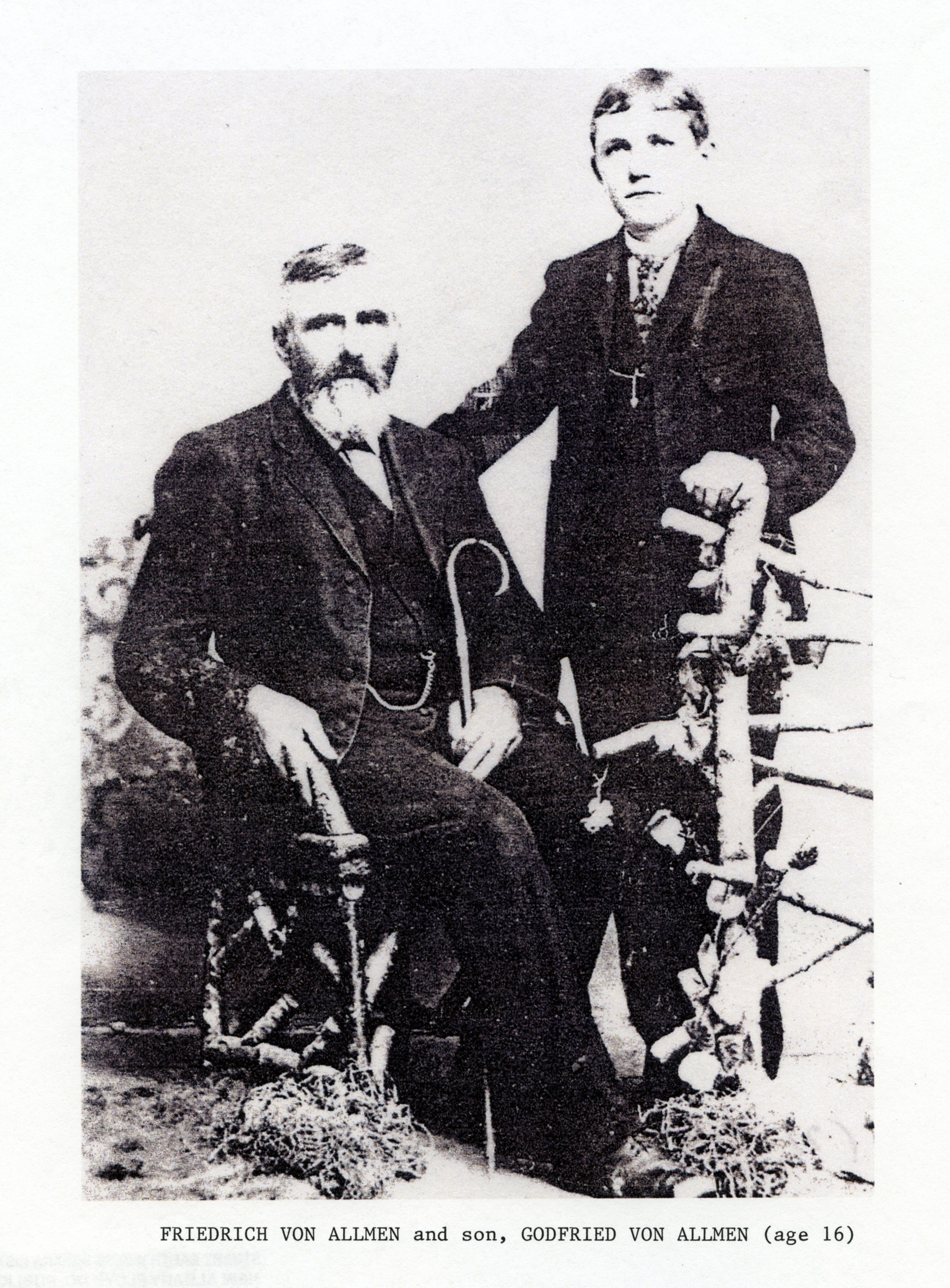
Friedrich and Gottfried Von Allmen, circa 1908, courtesy of Shirley Wolf, Von Allmen Family File, Stuart Barth Wrege Indiana History Room

Friedrich and Gottfried Von Allmen, circa 1898, courtesy of Shirley Wolf, Von Allmen Family File, Stuart Barth Wrege Indiana History Room

Friedrich’s wife, Susanna, died in 1898.  He remarried a few years later.

Marriage Announcement, courtesy of Shirley Wolfe, Von Allmen Family File, Stuart Barth Wrege Indiana History Room

Marriage Announcement, courtesy of Shirley Wolf, Von Allmen Family File, Stuart Barth Wrege Indiana History Room

Friedrich died on March 11, 1908 at his home.  He left a will, wherein he names his son, Peter, as executor.  Friedrich was buried next to his first wife, Susannah, at Atkins Cemetery.

Floyd County, Indiana Death Record for Friedrich Von Allmen, Indiana State Board of Health

Floyd County, Indiana Death Record for Friedrich Von Allmen, Indiana State Board of Health

Obituaries, courtesy of Shirley Wolfe, Von Allmen Family File, Stuart Barth Wrege Indiana History Room

Obituaries, courtesy of Shirley Wolf, Von Allmen Family File, Stuart Barth Wrege Indiana History Room

Kraft Funeral Home Record, courtesy of Shirley Wolfe, Von Allmen Family File, Stuart Barth Wrege Indiana History Room

Kraft Funeral Home Record, courtesy of Shirley Wolf, Von Allmen Family File, Stuart Barth Wrege Indiana History Room

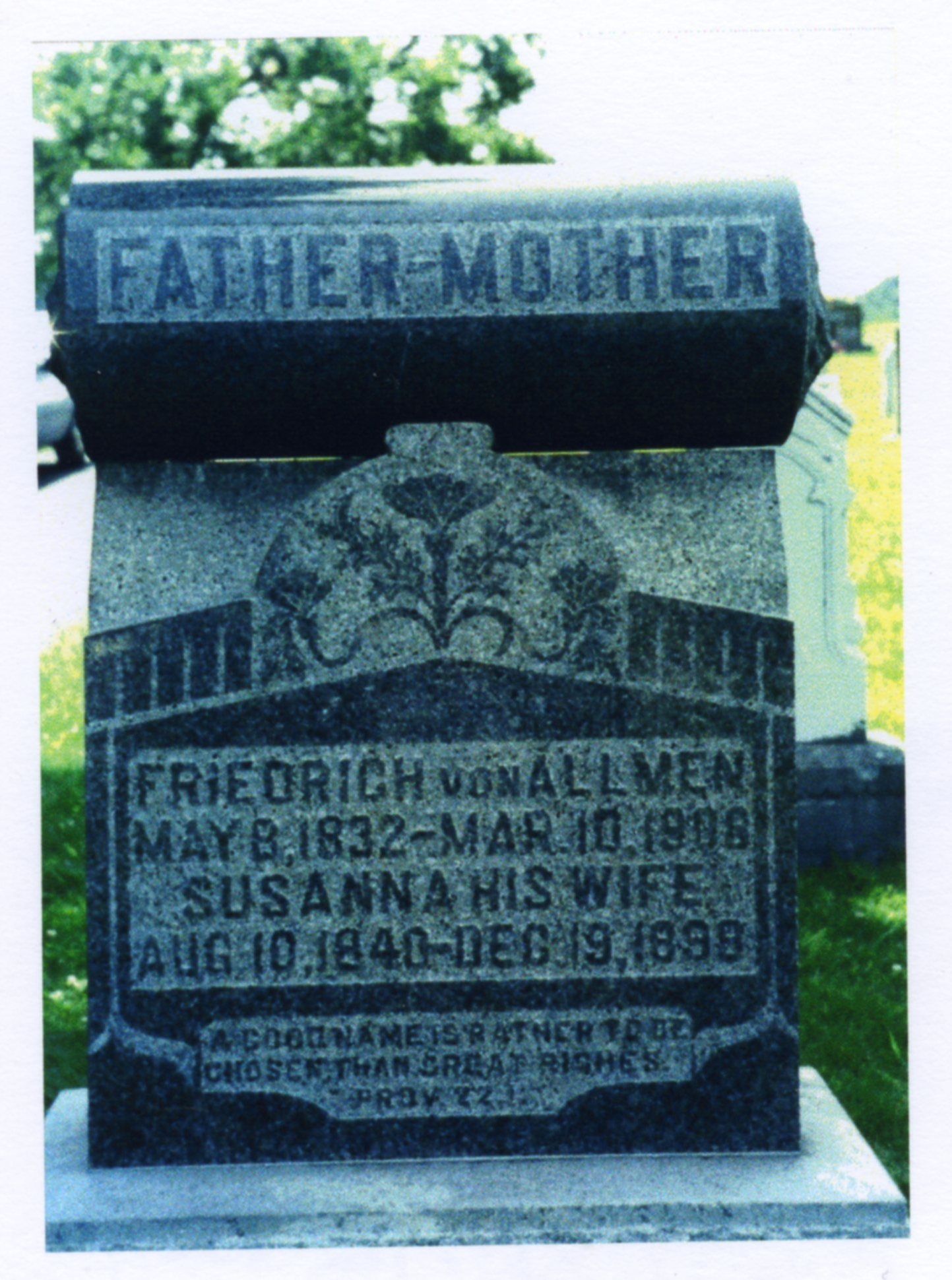
Tombstone of Friedrich and Susanna Von Allmen at Atkins Cemetery, courtesy of Shirley Wolf, Von Allmen Family File, Stuart Barth Wrege Indiana History Room

Tombstone of Friedrich and Susanna Von Allmen at Atkins Cemetery, courtesy of Shirley Wolf, Von Allmen Family File, Stuart Barth Wrege Indiana History Room

Von Allmen Family Crest, courtesy of Shirley Wolf, Von Allmen Family File, Stuart Barth Wrege Indiana History Room

Von Allmen Family Crest, courtesy of Shirley Wolf, Von Allmen Family File, Stuart Barth Wrege Indiana History Room

Louise Reisenberg: A Leap of Faith (52 Ancestors #17)

I am fortunate to have a family full of storytellers with long memories. What this means for me, though, is that my genealogical research primarily entails proving or disproving these stories. One story, on which I am currently working, is about my great great grandmother, Louise Reisenberg (or Risenburg).

Louise (Reisenberg) Schroeder, circa 1900.

Louise (Reisenberg) Schroeder, circa 1905.

Louise’s story, if I remember right, is as follows. One day, a sixteen year old Louise was working in the field on her family’s farm, she heard God tell her to leave her home and her family and go to America. She went back to the house and told her parents what God had told her to do. Her parents believed that she should do as God commanded and sold a cow to buy her passage to America. Louise didn’t speak a word of English, so she found a German family on the boat who were heading to Toledo, Ohio and she went with them. In Toledo, she got a job to support herself and married Frederick Schroeder.

Proving the story has been difficult, but I do believe that it is true based on what I have found so far.

Louise Reisenberg was born in Germany in November of 1860.1,5,6,8,10,11  She came to America in 1882, and arrived in Baltimore, Maryland on the Hermann on April 19th of that year, at the age of 21.1,5,6,8  From Maryland, she went on to Ohio, where she met Frederick Schroeder.  Fred and Louise married on May 8, 1882 in Lucas County, Ohio.2  Louise was a carpet weaver.5  Fred and Louise had six children:  Emma W., born circa 1883; Elizabeth A., born January 1885; Henry F., born circa 1887; Bertha Amelia, born March 30, 1890; John F., born October 1892; and George Herman, born September 21, 1896.3,4,5,6,7,8,9,10,11,12

Fred died sometime between 1896 and 1900.3,4,5  By 1900, Louise had been naturalized and could speak English.5  By 1930, she was living with her daughter, Bertha, and her son-in-law, Lloyd Bersticker.  She lived with them until she died in 1955.10,11

Most of the story couldn’t be directly proven with facts, but I feel that the facts support it.  A sixteen year old Louise could have heard God, and her parents could have sold the cow.  It may have taken some few years between the initial voice of God and setting off for America.  It also would have taken about a month for the actual voyage.  It seems likely to me that a non-English speaking young lady would have found a family to travel with that spoke her language.  I also have to wonder if maybe this family had connections to the Schroeders in Toledo.  Louise arrived in Maryland on April 19th and married Fred on May 8th, so maybe the family arranged it or suggested it.  Louise certainly did have a job as a carpet weaver.

Louise Reisenberg Schroeder is one of my ancestors about whom I am dying to know more.  She’s always been a bit of a mystery and I’m glad to have uncovered what I have so far.


Sources

1.  Baltimore, Maryland Passenger Lists Index, 1820-1897, FamilySearch.org.

2.  Lucas County, Ohio Marriages, 1789-1997, Vol. 3, p.379, FamilySearch.org.

3.  Ottawa County, Ohio Births, 1841-2003, Vol. 1, p.324, no. 94, FamilySearch.org.

4.  Ottawa County, Ohio Births 1891-1908, Vol. 2, p.245, no. 382, FamilySearch.org.

5.  1900 U.S. Federal Census, Benton, Ottawa, Ohio, p.12B, Ancestry.com.

6.  1910 U.S. Federal Census, Toledo, Lucas, Ohio, p.9A, Ancestry.com.

7.  Genesee County, Michigan Marriages, 1868-1925, Vol. 2, p.335, FamilySearch.org.

8.  1920 U.S. Federal Census, Toledo, Lucas, Ohio, p.4A, Ancestry.com.

9.  Lucas County, Ohio Marriages 1920, Vol. 39, p.483, FamilySearch.org.

10.  1930 U.S. Federal Census, Toledo, Lucas, Ohio, p.12B, Ancestry.com.

11.  1940 U.S. Federal Census, Toledo, Lucas, Ohio, p.7B, Ancestry.com.

12.  The Blade Correspondent (Toledo), 5 October 1964, Obituary, Emma Damschroeder, found a copy in my grandparents’ box not cited.

Serilda Long: A Long Life (52 Ancestors #16)

Serilda Long is another ancestor that I have had a hard time tracking.  She has appeared as Serilda, Sirelda, Serelda, Serrelda, Serralda, Zerelda, Zerilda, and Cerelda.  She has been Long, Gilliland (sometimes Gilleland, Gilland or Gillen), and Bridges.  I really should re-evaluate how I spell it.  I’ve just been spelling it Serilda because that’s how it appeared on the first record on which I saw it written.  It appears most often as Zerelda or Serelda.  But I digress.

Serilda Long was born on January 15, 1820, in Kentucky, to parents Daniel and Ruth (Lewis) Long.1,3,5,7,8,9,10  She married Leason Gilliland sometime before 1840.11  The story I heard growing up was that Leason worked on a steamboat and was away a lot, but the 1840 Census says that he was employed in agriculture.2  I suppose it is possible that he switched professions, as many of my ancestors have done, but that seems like a big change to me.

Serilda and Leason had Daniel circa 1838, William T. circa 1840, Ezra W. in 1841, and Mary Elizabeth on January 22, 1849.1,3,5,7,8,11,12  In 1850, Serilda and the children were living with Asa and Maria J. Loundsbury or Longsberry.3  Leason wasn’t there, which caused me to suspect that he had died.  However, Sarah A. Gilliland was born in 1853.5,7,8  Either Leason was still alive and happened to be away from home, prompting Serilda to move in with a friend or neighbor, or Sarah was illegitimate.

Leason was most likely dead by 1857 (I haven’t found evidence of a divorce), as Serilda married John T.M. Bridges on October 15 of that year.4  Shortly after their marriage, John Bridges was tried for and convicted of murder and was sentenced to life in Indiana State Prison in Jeffersonville, Indiana in 1859.  (See Coroner’s Inquest, Trial Day 1, Trial Day 2, Trial Day 3, Trial Day 4, and The Verdict).  By 1860, Serilda had taken a job as a seamstress to provide for her family.5  At some point during John’s confinement, they must have realized that the “preacher of the Gospel” who had married them was not actually ordained and the marriage, therefore, not legal.  (See Marriage Mystery and Two Marriages).  John was released from prison for good behavior on February 2, 1871 (See John Bridges), and Serilda married him again the very next day.6

John died in 1899, and Serilda went to live with her daughter, Sarah, and her children.  Her son, Ezra, lived with them as well.8  Serilda lived with Sarah until her death on September 13, 1907.1,9,10  Serilda lived a long life, but I wonder if she would have lived longer without all of the stress that she must surely have felt.

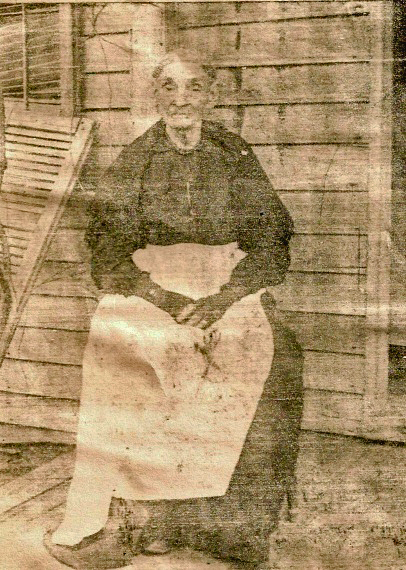
Serilda Bridges, circa 1900.

Serilda (Long) Gilliland Bridges, circa 1900.


Sources

1.  Transcription of the Rakestraw Family Bible.

2.  1840 U.S. Census, Hardin, Kentucky, p. 30, Ancestry.com.

3.  1850 U.S. Census, New Albany, Floyd, Indiana, p. 105, HeritageQuestOnline.com.

4.  Floyd County, Indiana Marriages, Volume 4, p. 485, Stuart Barth Wrege Indiana History Room.

5.  1860 U.S. Census, 6th Ward, New Albany, Floyd, Indiana, p. 106, FamilySearch.org.

6.  Floyd County, Indiana Marriages, Volume 6, p. 644, Stuart Barth Wrege Indiana History Room.

7.  1880 U.S. Census, New Albany, Floyd, Indiana, p. 2B, HeritageQuestOnline.com.

8.  1900 U.S. Census, 5th Ward, New Albany, Floyd, Indiana, p. 16B, FamilySearch.org.

9.  Floyd County, Indiana Deaths, Book CH-20, p. 32, Stuart Barth Wrege Indiana History Room.

10.  Obituary, New Albany Evening Tribune, Friday, 13 Sept 1907, p. 4, column 2, Stuart Barth Wrege Indiana History Room.

11.  Floyd County, Indiana Deaths, Book CH-33, p. 54, Stuart Barth Wrege Indiana History Room.

12.  Floyd County, Indiana Deaths, Book CH-37, p. 67, Stuart Barth Wrege Indiana History Room.

Susanna Stähli: The Woman in the Polka Dot Dress (52 Ancestors #14)

Friedrich and Susanna (Stähli) Von Allmen (ca. 1895)

Friedrich and Susanna (Stähli) Von Allmen (ca. 1895)

Alright, so it isn’t truly polka dot, but I’m not sure what to call it.  This is one of the family photographs that has always intrigued me.  I often find myself wondering about Susanna Stähli.  I love her dress.  I also get the impression that she must have been stern, based on her expression here and how tightly her hair was pulled back.

I haven’t really researched my Von Allmen line, as I have a cousin who has done extensive research on them.  I tend to research the other side of my family more.  Almost everything I know about Friedrich and Susanna (Stähli) Von Allmen is thanks to my cousin, Shirley.

Friedrich and Susanna lived in Wilderswil, Switzerland and immigrated to America in 1883 on the S.S. Canada.

Von Allmen home in Wilderswil, courtesy of Shirley Wolf, Von Allmen Family File, Stuart Barth Wrege Indiana History Room

Von Allmen home in Wilderswil, courtesy of Shirley Wolf, Von Allmen Family File, Stuart Barth Wrege Indiana History Room

S.S. Canada, courtesy of Shirley Wolf, Von Allmen Family File, Stuart Barth Wrege Indiana History Room

S.S. Canada, courtesy of Shirley Wolf, Von Allmen Family File, Stuart Barth Wrege Indiana History Room

S.S. Canada Passenger List, courtesy of Shirley Wolf, Von Allmen Family File, Stuart Barth Wrege Indiana History Room

S.S. Canada Passenger List, courtesy of Shirley Wolf, Von Allmen Family File, Stuart Barth Wrege Indiana History Room

Friedrich and Susanna had eleven children traveling with them, so I can see why Susanna would need to be stern.  They purchased land in Floyd County, Indiana to start a dairy.  It’s interesting to me that it looks as though they lived at the bottom of a knob in Switzerland and purchased similar land in Floyd County.

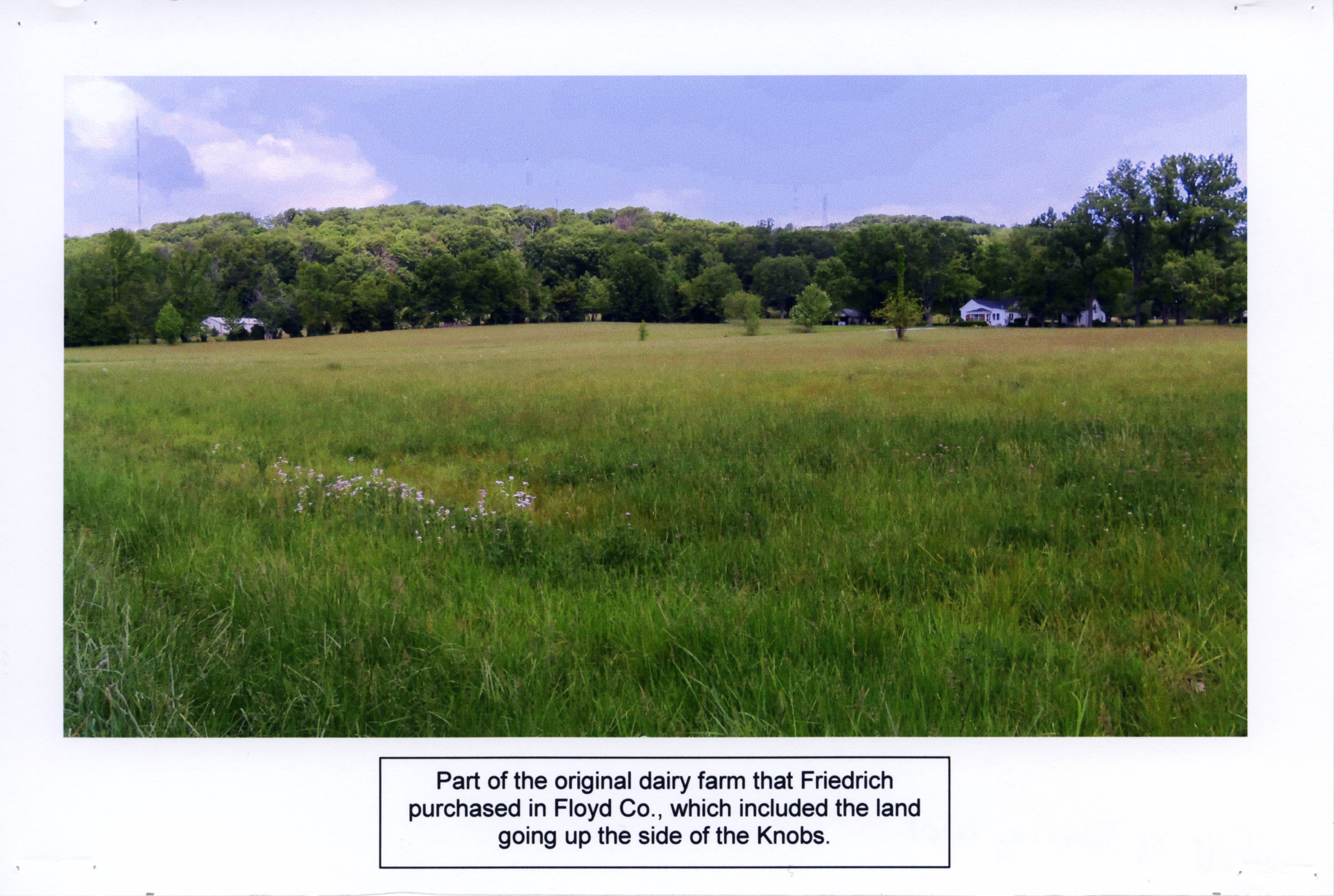
Floyd County land, courtesy of Shirley Wolf, Von Allmen Family File, Stuart Barth Wrege Indiana History Room

Floyd County land, courtesy of Shirley Wolf, Von Allmen Family File, Stuart Barth Wrege Indiana History Room

Gray-Von Allmen Sanitary Milk Company Truck, courtesy of Shirley Wolf, Von Allmen Family File, Stuart Barth Wrege Indiana History Room

Gray-Von Allmen Sanitary Milk Company Truck, courtesy of Shirley Wolf, Von Allmen Family File, Stuart Barth Wrege Indiana History Room

Ewing-Von Allmen Dairy Products Bottle, in my possession.

Ewing-Von Allmen Dairy Products Bottle, in my possession.

According to St. Mark’s Baptismal Records, Friedrich and Susanna had two more children.   As I mentioned before, Shirley has done extensive research and found that there was another child who did not live long.

St. Mark's Baptismal Records, courtesy of Shirley Wolf, Von Allmen Family File, Stuart Barth Wrege Indiana History Room

St. Mark’s Baptismal Records, courtesy of Shirley Wolf, Von Allmen Family File, Stuart Barth Wrege Indiana History Room

Susanna died on December 16, 1898 of stomach cancer.

New Albany Evening Tribune, 17 December 1898, courtesy of Shirley Wolf, Von Allmen Family File, Stuart Barth Wrege Indiana History Room

New Albany Evening Tribune, 17 December 1898, courtesy of Shirley Wolf, Von Allmen Family File, Stuart Barth Wrege Indiana History Room

Kraft Funeral Home Records, courtesy of Shirley Wolf, Von Allmen Family File, Stuart Barth Wrege Indiana History Room

Kraft Funeral Home Records, courtesy of Shirley Wolf, Von Allmen Family File, Stuart Barth Wrege Indiana History Room

Tombstone of Friedrich and Susanna Von Allmen at Atkins Cemetery, courtesy of Shirley Wolf, Von Allmen Family File, Stuart Barth Wrege Indiana History Room

Tombstone of Friedrich and Susanna Von Allmen at Atkins Cemetery, courtesy of Shirley Wolf, Von Allmen Family File, Stuart Barth Wrege Indiana History Room

This may sound strange, but this is, coincidentally, one of my favorite tombstones.  It’s a very unique stone in the Atkins Cemetery and I was always drawn to it as a child attending the church.

I do intend to do my own research on the Von Allmens at some point, as I have lots of questions.  One thing I often wonder is whether Susanna worked in the dairy or had another job.  They immigrated in 1882 and she died in 1898, so there is no record of it on any Census.  Certainly, if the dairy was as successful as it seems, she would have needed to be involved in the dairy work.

Von Allmen Family Crest, courtesy of Shirley Wolf, Von Allmen Family File, Stuart Barth Wrege Indiana History Room

Von Allmen Family Crest, courtesy of Shirley Wolf, Von Allmen Family File, Stuart Barth Wrege Indiana History Room