The State of Indiana v. John Bridges: Trial, Day 1

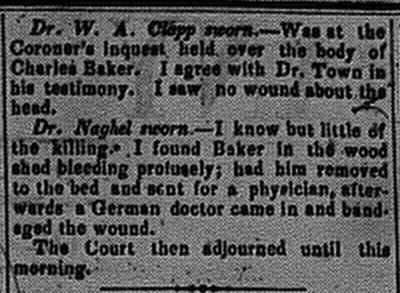
About ten months after the Coroner’s Inquest, the murder trial of John Bridges finally went to court.  It was several days of jury selection and testimony, so I’ll break it up into separate posts for ease of access.  It’s quite lengthy, but I find it all very interesting.  The following articles are the two pre-trial articles and the first day of the trial, which includes the testimony of Sarah Jane Baker (or Albaker), wife of the deceased, and Doctors Town, Clapp, and Naghel.

New Albany Daily Tribune, Monday, 31 October 1859, p.3, column 1, Stuart Barth Wrege Indiana History Room

New Albany Daily Tribune, Monday, 31 October 1859, p.3, column 1, Stuart Barth Wrege Indiana History Room

New Albany Daily Tribune, Tuesday, 1 November 1859, p.2, column 2, Stuart Barth Wrege Indiana History Room

New Albany Daily Tribune, Tuesday, 1 November 1859, p.2, column 2, Stuart Barth Wrege Indiana History Room

New Albany Daily Tribune, Wednesday, 2 November 1859, p.2, column 3, Stuart Barth Wrege Indiana History Room

New Albany Daily Tribune, Wednesday, 2 November 1859, p.2, column 3, Stuart Barth Wrege Indiana History Room

New Albany Daily Tribune, Wednesday, 2 November 1859, p.2, column 4, Stuart Barth Wrege Indiana History Room

New Albany Daily Tribune, Wednesday, 2 November 1859, p.2, column 4, Stuart Barth Wrege Indiana History Room

To be continued…

Ossian Salisbury: An Ocean of Possibilities (52 Ancestors #03)

Ossian Salisbury has been a very tough woman to track down.  Part of the reason she’s been so tough to research is because she didn’t live very long.  She was born in 1835 and died sometime between 1860 and 1866.  The other reason she’s been so difficult is because her name is different on almost every record on which she appears.  I’ve come across Ossian Salisbury, Ocean Landsbury, Ocean Stansberry, Osia Ann Sausberry, Ocean Sauelsbury, and Oceanna Browning.  My grandmother told me before that she had also seen OssiAnn as a variant given name and Saulsberry and Lounsbury as variant surnames.  I have yet to find those.

I don’t know much about Ossian’s origins.  She was born in Illinois.  Her mother was Elizabeth Burns (or maybe Barnes).  She had a stepfather named Bevis.  I don’t know if Burns/Barnes was Elizabeth’s maiden name, or Bevis’ surname.  Or, Bevis could’ve been his surname and then I don’t know his given name.  I know nothing about Ossian’s birth father.

Here are the facts:

1.  Ocean Landsbury married Daniel Browning on June 30, 1852 in Louisville, Jefferson County, Kentucky.  She was seventeen and he was twenty one.  Ocean was born in Illinois.

Kentucky Marriages, 1852-1914, p.2, Ancestry.com

Kentucky Marriages, 1852-1914, p.2, Ancestry

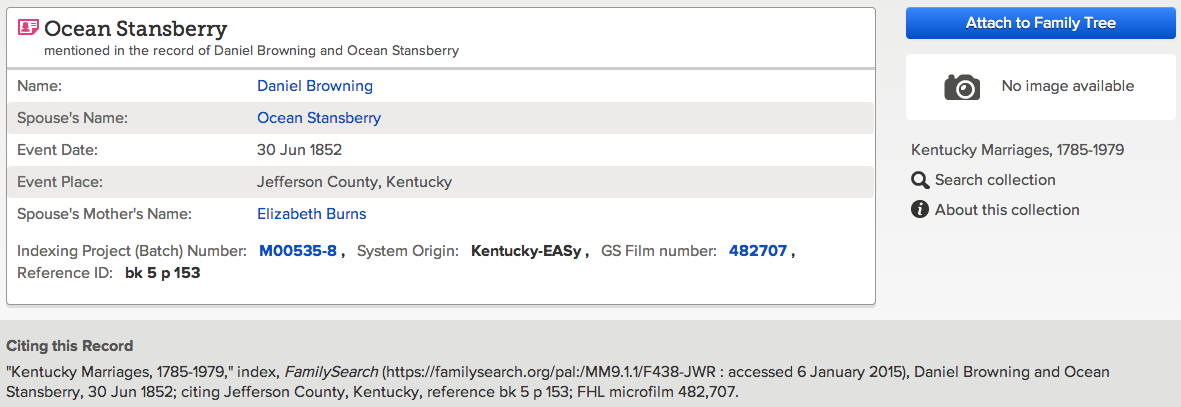
2.  Ocean Stansberry married Daniel Browning on June 30, 1852 in Jefferson County, Kentucky.  Her mother was Elizabeth Burns.

Kentucky Marriages, 1785-1979, FamilySearch.org

Kentucky Marriages, 1785-1979, FamilySearch

3.  Mary Francis Browning was born on December 29, 1856 in Jefferson County, Kentucky to parents Daniel Browning and Osia Ann Sausberry.

Kentucky Births and Christenings, 1839-1960, FamilySearch.org

Kentucky Births and Christenings, 1839-1960, FamilySearch

4.  In 1860, Daniel (28) and Oceanna (25) Browning are living in 2nd District, Jefferson County, Kentucky with their children:  Harriet A. (7), Lydia F. (6), and Joseph (3).  Oceanna was born in Illinois.

1860 U.S. Federal Census, 2nd District, Jefferson, Kentucky, p.101, Ancestry.com

1860 U.S. Federal Census, 2nd District, Jefferson, Kentucky, p.101, Ancestry

5.  In 1870, D. (39) and Nancy C. (30) Browning are living in Boston, Jefferson County, Kentucky with their children:  George B. (3) and Mary C. (1), and his children from a previous marriage, Harriet A. (17), Lydia F. (16), Joseph (13), and Clara E. (9).
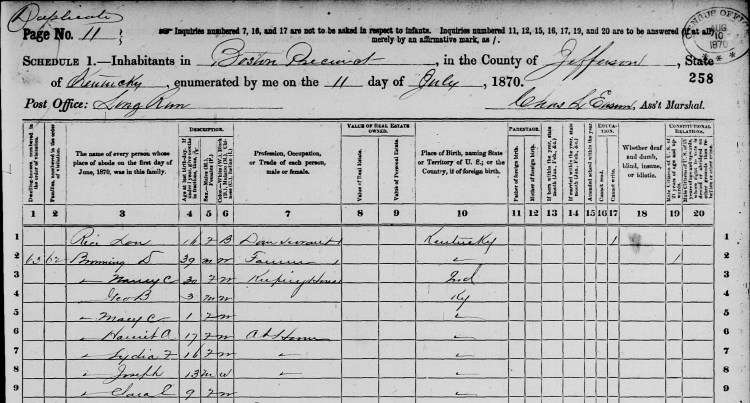
1870 U.S. Census, Boston, Jefferson, Kentucky, p.11, FamilySearch.org

1870 U.S. Census, Boston, Jefferson, Kentucky, p.11, FamilySearch

6.  Frances L. Wiseheart was born on June 14, 1853 to parents Daniel Browning and Ocean Sauelsbury.

Floyd, Indiana Deaths, CH-33, p.55, Stuart Barth Wrege Indiana History Room

Floyd, Indiana Deaths, CH-33, p.55, Stuart Barth Wrege Indiana History Room

7.  In a postcard to Sanford Wiseheart (Ossian’s grandson), Marie de la Montange says that his grandmother’s record needs to be corrected.  Her name is Ossian Salisbury.
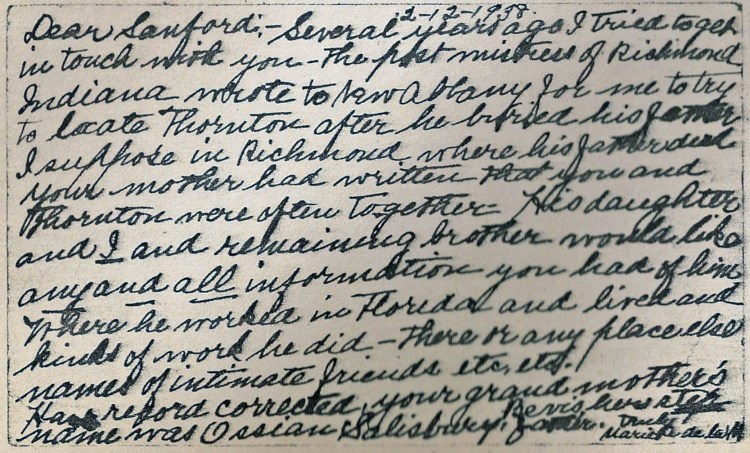
Postcard from Marie de la Montange to Sanford Wesley Wiseheart, 12 Feb 1938

Postcard from Marie de la Montange to Sanford Wesley Wiseheart, 12 Feb 1938

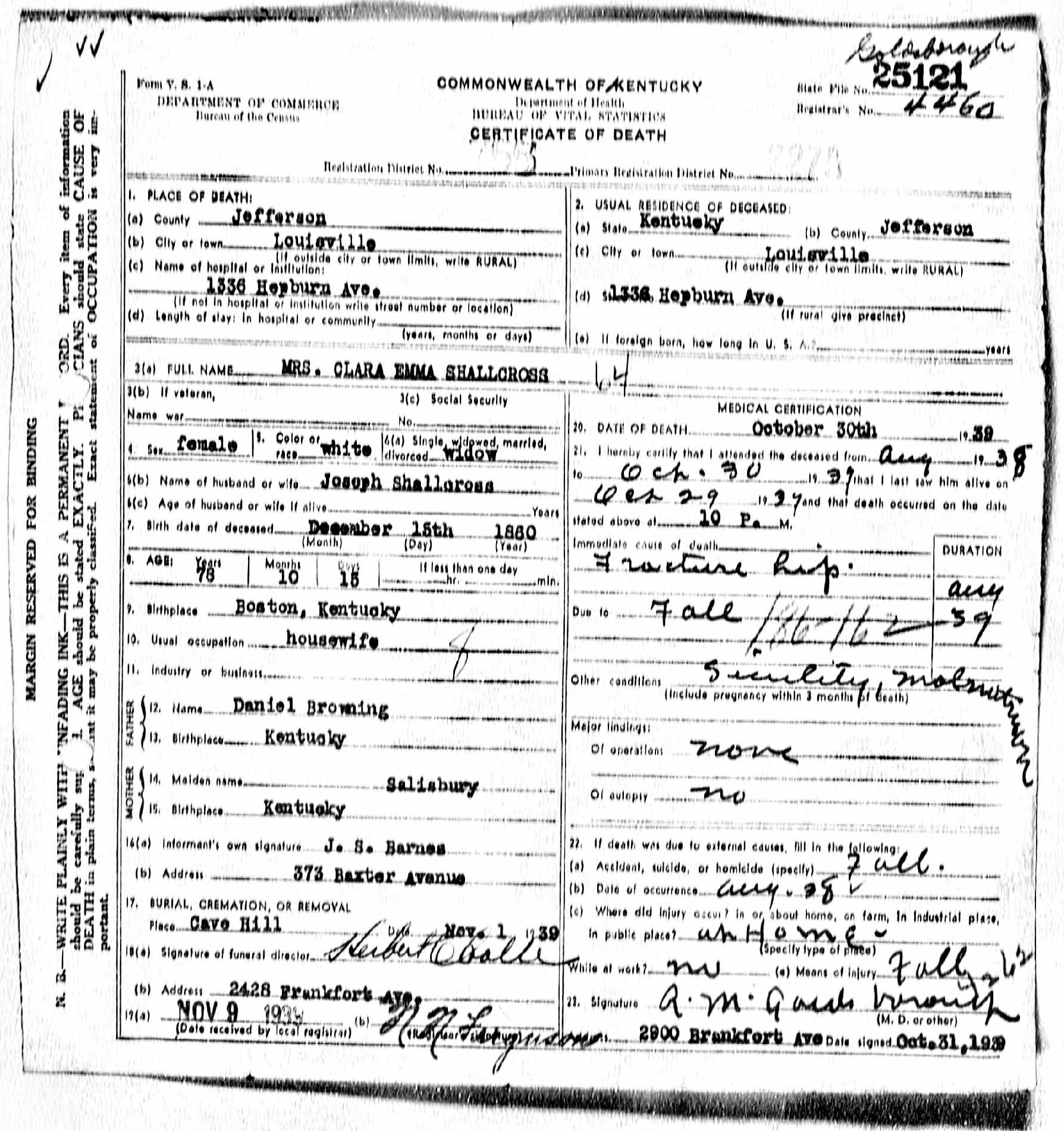
8.  Clara Emma Browning was born on December 15, 1860 to parents Daniel Browning and __________ Salisbury.
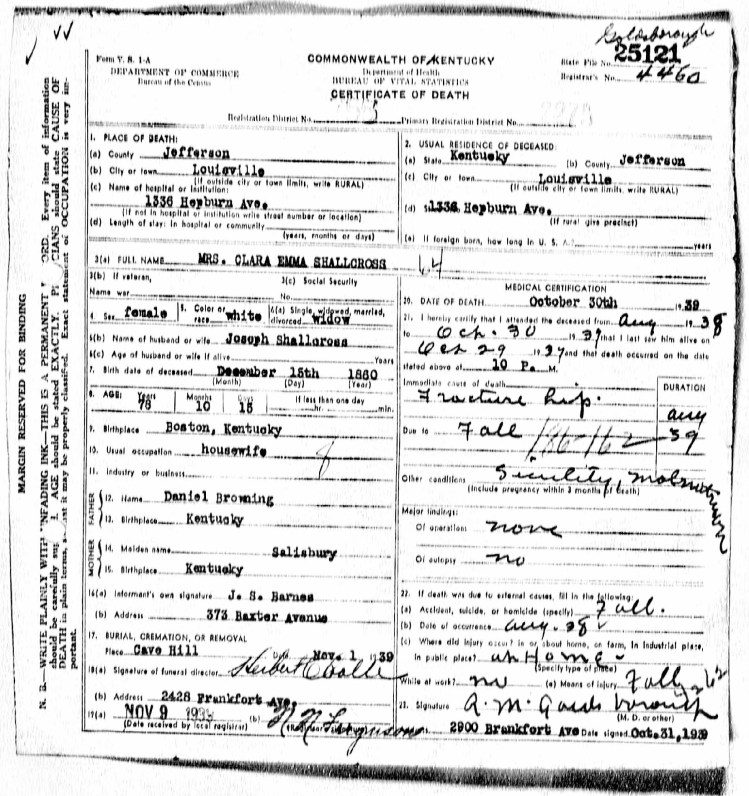
Jefferson County, Kentucky Deaths, 1911-1961, Vol. 51, certificate 25121, Ancestry.com

Jefferson County, Kentucky Deaths, 1911-1961, Vol. 51, certificate 25121, Ancestry

Why did I choose Ossian Salisbury as the correct spelling of her name?  I’ll start with Salisbury.  I believe it is Salisbury because it appears that way in two documents, whereas every other spelling only occurs once.  In addition, Sauelsbury and Sausberry would both sound similar to Salisbury when spoken.  I can’t account for Stansberry without seeing the actual record, but I’d be wiling to bet this is a transcription error and that the name actually is Salisbury, Sauelsbury, or some similar sounding variant.  Landsbury is very different, however, I’ve examined a lot of early handwriting firsthand, and I can tell you that cursive capital “S” and “L” do look very similar.  I also believe that Marie de la Montange, who was a long time friend of the family, would be more likely to know the spelling of her name than any clerk would be able to guess from someone speaking it.

As for Ossian, Salisbury/Landsbury and Burns/Barnes are English or Scottish surnames.  Ossian (or Oisin) was a popular legend in both Scotland and Ireland.  Also, Ossian was born in Illinois.  Ossian M. Ross settled in Illinois in 1821 and founded Lewistown.  He was a Major in the War of 1812.  This name would’ve been popular in Illinois around the time of her birth.  I can’t account for why a female child was given a name that is traditionally male, but it isn’t unheard of for that to happen.  And, again, I do believe Marie de la Montange would’ve known.  The pronunciation of Ossian is similar enough to Ocean that it would be easily mistaken if it were only spoken and not written.

Of course, there are far too many variables in all of this for me to set anything in stone.  I just had to have something to call her in my pedigree chart and something to work with.  I continue, on a regular basis, to search for every variant of Ossian that I can think of with every combination of surnames sounding or looking similar to Salisbury or Landsbury that I can think of.  My greatest hope is to find her in the 1850 Census with her mother and stepfather.

Two Marriages & A Murder

Three days ago, I posted about Serilda Gilliland marrying John Bridges twice and that John went to prison for murder.  I was able to unravel a little bit more today.  First, I looked up the Daniel G. Stewart who was a minister from 1835 to 1837 again, and he was actually Daniel S. Stewart and is not the same D.G. Stewart who married them.  I looked in a different city directory today (1848) and David G. Stewart was listed as a homeopathic doctor.  Having the correct first name, I looked him up in the newspaper index and found a listing for an obituary.  According to his obituary in the New Albany Daily Ledger Standard (9 Apr 1878, p.4, c.2-3), David G. Stewart was a doctor who moved to New Albany in 1832.  He joined the First Christian Church and regularly preached when the the pastor was absent.  He was not ordained.  Therefore, Serilda and John’s first marriage was not valid.  Now I know the mechanics of why they were married twice, but I’m still left wondering how he got out of prison for it.

Now, on to the murder trial…

The State of Indiana v. John Bridges:  Coroner’s Inquest

New Albany Daily Tribune, 17 Jan 1859, p.3, c.1, Stuart Barth Wrege Indiana History Room

New Albany Daily Tribune, 17 Jan 1859, p.3, c.1, Stuart Barth Wrege Indiana History Room

Genealogy Bullet Journaling

I was in the lounge at work the other day and a couple of my co-workers were talking about bullet journals.  I’d never heard about a bullet journal before.  My co-workers gave me a description, and I looked it up when I got home.  Basically, it’s a style of journaling wherein a person writes everything with bullets or checkboxes to save the time and energy it would take to go into detail about one’s day.  I could never journal like that.  However, I thought it could be slightly adapted to work for genealogy, so I gave it a try.

The first page of my bullet journal.  I left two pages open for this person, but some people only have one page.

The first page of my bullet journal. I left two pages open for this person, but some people only have one page.

I write my ancestor’s name as the page title.  If I have something I have to look up, I draw a box and write it down.  When I look for it, I mark the box with an X if I didn’t find it and a check if I did find it.  If I didn’t find it, I also write a quick note about why I couldn’t find it.  Doing so will prevent me from looking for it again in the future and wasting time.  If I find something that I didn’t think to look for while I’m doing my research, I add a bullet and write it down.  This indicates to me that it is a note and not something on which I need to take action.  Since a lot of my research is done on my breaks, this is very helpful for me.  I can look up one or two items and save the rest for later.  It also keeps me from getting distracted from my goals and researching a different person just so that I don’t forget to later.

In the genealogy class that I teach, one of the basic genealogy “do’s” is to make a list of what you want to research so that you can accomplish the goal and not get distracted, because, let’s face it, it’s easy to see multiple family names in an index or see suggestions on Ancestry.com and never get around to what we set out to research.  For me, I’ve always brought in a checklist and a blank sheet of paper or a notebook to make notes of the things I find that I need to look up later.  This journal combines both in a way that is easy for me to handle.  I don’t mean to sound like an advertisement here.  I just found this to be really useful and I thought I’d pass on what I’ve learned.

A Marriage Mystery

Last night, while doing research for a collection that I’m processing at work, I saw my great great great great grandmother’s name on a marriage record index page… twice… to the same man… fourteen years apart.  I quickly made a note to look them up later.  I knew that she had been married once to Leason Gillilland, from whom I am descended, and who died young.  I knew that she married John Bridges after Leason died.  Today, on my lunch break, I did look up the records.  The first one was John T.M. Bridges and Sirelda Gilland on October 15, 1857.  The second was John T.M. Bridges and Serrelda Gilliland on February 3, 1871.

Floyd County, Indiana Marriages, Vol. 4, p.485

Floyd County, Indiana Marriages, Vol. 4, p.485, Stuart Barth Wrege Indiana History Room

Floyd County, Indiana Marriages, Vol. 6, p.644

Floyd County, Indiana Marriages, Vol. 6, p.644, Stuart Barth Wrege Indiana History Room

This is weird.  I consulted a co-worker who has been doing genealogy far longer than I have and has taught me most of what I know about researching.  She agreed that it is weird.  At first we thought that maybe the first marriage was invalid.  The name of the minister is smudged out and we thought that possibly he wasn’t really a minister.  A cleaner copy of that marriage record is available on FamilySearch.org and the minister’s name can be read.  He is D. G. Stewart.  Daniel G. Stewart is listed in the back of the index as being a minister from 1835-1837.  In the 1857 New Albany city directory, he’s listed as a homeopathic physician.  While I was looking up the minister, my co-worker searched the newspaper index for me.  She found that John Bridges wasn’t such a great guy.

My grandfather had always told me that John was a drunk and that he was constantly in trouble.  He had heard stories about John from his great grandmother, Serilda’s daughter, who had helped raise him.  Today, I discovered that John murdered a man, was convicted, and went to the Indiana State Prison in Jeffersonville, Indiana.  I didn’t have a lot of time on my lunch, so I only read the brief descriptions of the over a dozen articles on the trial and his other run-ins with the law.  I’ll copy those as soon as I can.  The result of the trial is that he was convicted in 1859.  The 1860 Census lists him with the family, but in the last column, where it asks for a person’s condition, it says “convict.”  In the 1870 Census, he’s listed among other convicts as being in Indiana State Prison.  Yet, somehow, he married or re-married Serilda in 1871.  Maybe the marriage was annulled or they got a divorce when he went to jail?  Maybe the first marriage really wasn’t legal?  I’m not sure.  What I really want to know is did they get married in the jail, or was he released from prison after only twelve years when he was sentenced for murder?  I’m hoping the articles about the trial will shed some light on that.