More Clues for Frank Springer

As my uncle was going through things at the house yesterday, he came across a ledger belonging to Mildred Springer.  It mostly contains dates and amounts received.  I’m not sure what they are exactly, but I think they could be child support payments from her father, Frank Springer.

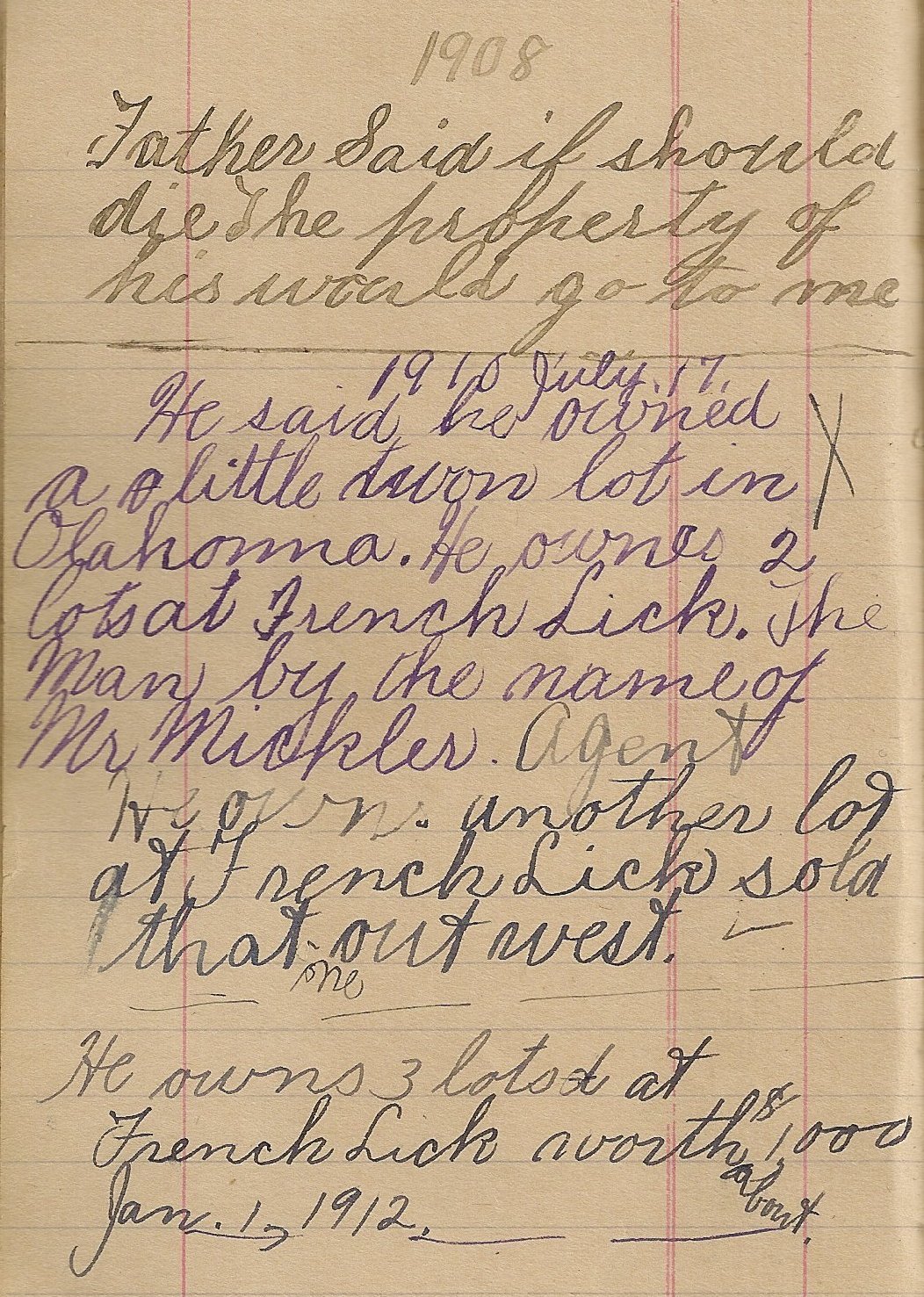
Frank left his home in Paoli, Indiana in 1893 for the World’s Fair in Chicago and I have lost track of him from then until 1920 when he appears in Paoli again.  On one page of this ledger, Mildred wrote about her father’s land holdings.

A page from Mildred Springer's ledger, 1908-1917.

A page from Mildred Springer’s ledger, 1908-1917.

In 1910, Mildred writes that Frank has a lot in Oklahoma and two lots in French Lick.  A newspaper article regarding land in Oklahoma was tucked between this page and the next.

Newspaper article from Mildred Springer's ledger, 1908-1917.

Newspaper article from Mildred Springer’s ledger, 1908-1917.

On the ledger page from the previous image, Mildred also writes that by 1912, Frank had sold his lot out west and purchased a third lot in French Lick.  There is also one page of the ledger that lists two payments coming from Madison, Illinois in 1913.

My theory is that he left Chicago after the World’s Fair and travelled West.  He settled in Oklahoma circa 1904 for a time, but was on the move again before the 1910 Census. I’ve searched for Frank Springer in the 1900 and 1910 Census for Indiana, Kentucky, Tennessee, Illinois, Iowa, Missouri, Kansas, Oklahoma, and Arkansas with no luck.  With some fairly strong evidence to suggest he was in at least two of those states, a transient lifestyle seems a logical explanation as to why I can’t find him.

Here’s my theory with a visual…

Frank Springer's journey

1.  Living in Paoli, Indiana (1892).

2.  Goes to World’s Fair, Chicago, Illinois (1893).

3.  Possible trip to Iowa.  (Part of family legend is that he spent some time in Iowa).

4.  Back to Paoli to check in with family.

5.  Purchases land in French Lick, Indiana (circa 1900).

6.  Claims land near Woodward, Oklahoma (1904).

7.  Possible trip to California.  (Part of family legend is that he spent some time in California).

8.  Sells land in Oklahoma (circa 1912).

9.  Buys another lot in French Lick (circa 1912).

10.  Goes to Madison, Illinois (1913).

11.  It is possible that the California trip fit in here instead of after Oklahoma.

12.  Back in Paoli (1920).

This is the guide I’ll be working with to try to locate Deed and City Directory records for Frank.  It’s confusing, and kind of a long shot, but it’s definitely more than what I had to go on before.  As my co-worker said just a few days ago, most genealogists don’t do it because it’s easy, they do it for the thrill of following the clues and solving the mystery.

Josephine Sellers: A Wedding, A War, and A Pandemic

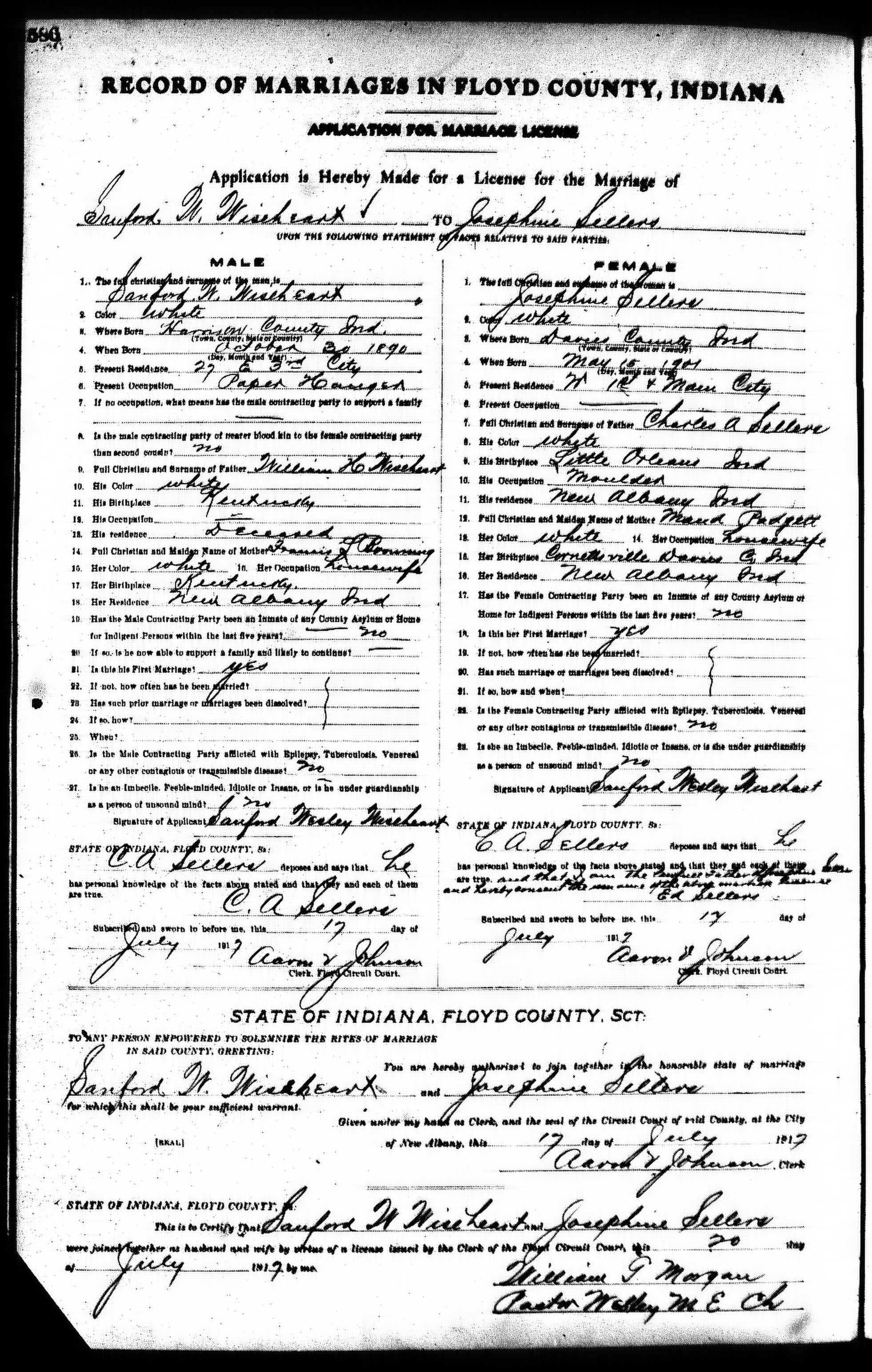
Several years ago, as I was sitting with my cousins after having eaten lunch, my grandpa brought a document into the room for me to look at.  It was a Certificate of Death for a Josephine Sellers Wiseheart.  Josephine was not a family name with which I was familiar.  Grandpa said she was Pap’s (his dad) first wife.

In 1918, there was an influenza pandemic that killed an estimated 50 million people.  Josephine Sellers Wiseheart was one of these people.  She was sixteen and a half.  She and Sanford Wesley Wiseheart (Pap) had been married for almost a year and half.  For such a short marriage, it was certainly an eventful one.

I have no idea how they met or exactly when, I just know that Josephine was living with her parents and two brothers in Vincennes, Indiana in 1910, so they couldn’t have been in New Albany for more than seven years.  In any case, Sanford and Josephine were married by the pastor of Wesley Methodist Episcopal Church on July 20, 1917.  Josephine’s birthdate was listed as May 15, 1901, which would have made her sixteen at the time of their marriage.  She was born in Daviess County, Indiana.  Her parents were Charles A. Sellers and Maud Padgett.  Charles Sellers consented to the marriage.

Just four months later, the couple separated and Josephine filed for divorce, rather her mother filed for her because she was a minor.

New Albany Daily Ledger, 10 Nov 1917, p.4, column 2, Stuart Barth Wrege Indiana History Room

New Albany Daily Ledger, Saturday, 10 Nov 1917, p.4, column 2, Stuart Barth Wrege Indiana History Room

Family legend is that Sanford, or Sandy as he was known around town, filed for divorce because he found out that Josephine had lied about her age.  I haven’t found any evidence that he ever filed for divorce.

On April 22, 1918, Sandy was inducted into the Army, having already filled out a draft registration card in June of 1917.  In August of 1918, he left for France.

In December of 1918, Josephine caught the flu.  Dr. Schoen attended her from December 2nd until her death on December 11th.  Her Death Record shows that she was married to a J. Wiseheart at the time of her death.  I’ve found no record of the divorce having gone through and I’ve found no record of Josephine ever having married again.  I believe that it was supposed to have been S. Wiseheart.

Floyd County, Indiana Deaths, Book CH-24, p.104, Stuart Barth Wrege Indiana History Room

Floyd County, Indiana Deaths, Book CH-24, p.104, Stuart Barth Wrege Indiana History Room

Her death record also states that she was born on May 24, 1902.  So, either she (and her father) lied about her age when she married or the clerk made an error.  Or, the death record is incorrect.  I’ve tried to find a birth record to verify the date to no avail.  I searched first in Daviess County, since that’s where the marriage record says she and her mother were born.  Then I searched Orange County, where her father was born, and Knox County where they lived before moving to New Albany.  I also searched the surrounding counties of Pike, Martin, Dubois, and Greene in case she had been born while they were moving from one place to another.  Lastly, I searched Floyd County, since that’s where they ended up.  No birth record.

Josephine was buried in Sandy’s plot at Fairview Cemetery on December 14, 1918 as Josephine S. Wiseheart.  Her father had her moved to the Sellers family plot in Holy Trinity Cemetery just two months later.

Fairview Cemetery, Volume VI, 1910-1919, p.127, Stuart Barth Wrege Indiana History Room

Fairview Cemetery, Volume VI, 1910-1919, p.127, Stuart Barth Wrege Indiana History Room

Her tombstone reads Josephine Sellers, 1902-1918.  I wonder if he moved her because she was posthumously granted the divorce or if he just really wanted her to be separated from Sandy even in death.  I’m keeping an eye out for any documentation that a divorce was granted, but everything I’m finding says that Sandy was a widower.

Such was the short, dramatic life of Josephine Sellers.  Even though I’m not directly related to her, I sometimes wonder about her.  What did she look like?  What was her personality?  Why did she marry at fifteen or sixteen?  What really happened to cause her to file for divorce?  When I think about her in terms of being my great grandfather’s first wife, it doesn’t seem so long ago, but looking at dates, it was nearly one hundred years ago.  These are questions to which I will probably never know the answer.

20 Rules for Genealogy

I often talk about my research with my co-workers.  I find myself saying things like, “I know ____ happened.”  When my co-worker asks how I know, my response is often “because my grandpa told me.”  Of course, I know, and frequently say, that nothing is “known” until it’s been proven.  I’m just sometimes so involved in what I’m doing that it’s hard for me to take a step back and look at it objectively, which is why I often talk to my co-workers about my research.  They act as a mirror.  They tell me the things I know but fail to recognize.  Currently, I have several different people that I’m researching and I really just need a reminder of what I need to do.  So, I set out to write down my rules.  Some of these I’ve picked up from peers and mentors and others I’ve learned the hard way.

  1. Genealogy without proof is mythology. Every fact needs supporting evidence.
  1. You have to be a detective. Pay attention to the details, think outside the box, and put yourself in your ancestor’s shoes. Be willing to beat your head against the brick wall until you make it through.
  1. Work from the known to the unknown. Start with yourself and move backward. Maybe you are descended from royalty, but it takes multiple times longer to trace it down from that royal ancestor to you.
  1. Be open. Accept that some of the things you “know” may be only partially true or may not be true at all. Family stories can be like playing telephone for decades. Also keep in mind that everyone has skeletons in their family closet. You can’t be afraid of what you might find. We are not responsible for the actions of our ancestors.
  1. Use pencil until it’s proven. Not only will you save paper (and trees), but this will also help you see what you still need to research.
  1. Use primary sources whenever possible. Secondary sources can be a helpful guide, but primary sources are generally more reliable.
  1. Cite your sources! It’s frustrating to you when you need to re-copy something and you can’t remember where you found it. It’s frustrating to others when they can’t verify something that you’ve written.
  1. Track your work. Knowing what sources were not helpful is just as important as citing the ones that were. Accidentally revisiting the same unhelpful source is a headache and a waste of your valuable time.
  1. One source is not proof. A minimum of two sources is preferable. Even vital records can be wrong. However, one source is better than no source.
  1. Check all possible spellings, sound-alikes, and look-alikes. Also look for nicknames, initials, and the use of a middle name instead of the first. “To ere is human.” Clerks, enumerators and transcribers are no exception.
  1. Always spell the month and use all four digits for the year. 3/2/12 could be March 2, 1912 or February 3, 1812. Using 2 Mar 1912 or March 2, 1912 is clearer. If you aren’t sure what the original record means, make a note of exactly how it appeared on the record.
  1. Research your collaterals. Your ancestor’s sibling may be the key to breaking through your brick wall. This is especially true if everyone in your family was named Charles, William, and Elizabeth, but there was one sister named America.
  1. Check and re-check all your sources. What doesn’t seem important now may prove to be important later. This is especially true if you’ve inherited copies from another family member and can’t quite connect some of the names to what you have researched.
  1. Back-up your work. Save it on your computer, an external hard drive, a flash drive, an online database, and the cloud. Make photocopies or printouts of everything. You can never have too many. Making a schedule for this will help. Maybe you save to your computer and print a copy immediately, back up to a flash drive and/or an online database once a week, and back up to an external hard drive once a month.
  1. Don’t be afraid to ask for help. Everyone needs help sometimes, even the experts. Sometimes you can be so focused on something, that the avenues you normally would consider have escaped your notice. Two heads are better than one.
  1. Ask questions of your elders. Having lived the longest, these family members will be the ones with the most information for you. Of course, you want to get information wherever you can, so don’t ignore the rest of the family. Often times, hearing family stories from more than one point of view can give you clues for your research. Record your family’s stories. The longer you wait, the harder it will be and it may be a useful tool for future generations.
  1. Share your discoveries. Publish a book, write a blog, or donate copies to your local genealogical society, historical society, or library. This allows access to others, ensures that future generations will be able to find it, and acts as another form of back-up, should anything happen to your files.
  1. Do not publish or post information about living people without their permission. Some people may wish to avoid being found for whatever reason. Many people simply like to keep things private and we should respect that.
  1. Some brick walls are permanent. Many records have been destroyed due to war or natural disasters, and some due to human accident. Some events were never recorded.
  1. You will probably never be finished. “New” sources are being discovered and digitized everyday. There is always something new to learn.

Dolores Schroeder: A Servant’s Heart (52 Ancestors #04)

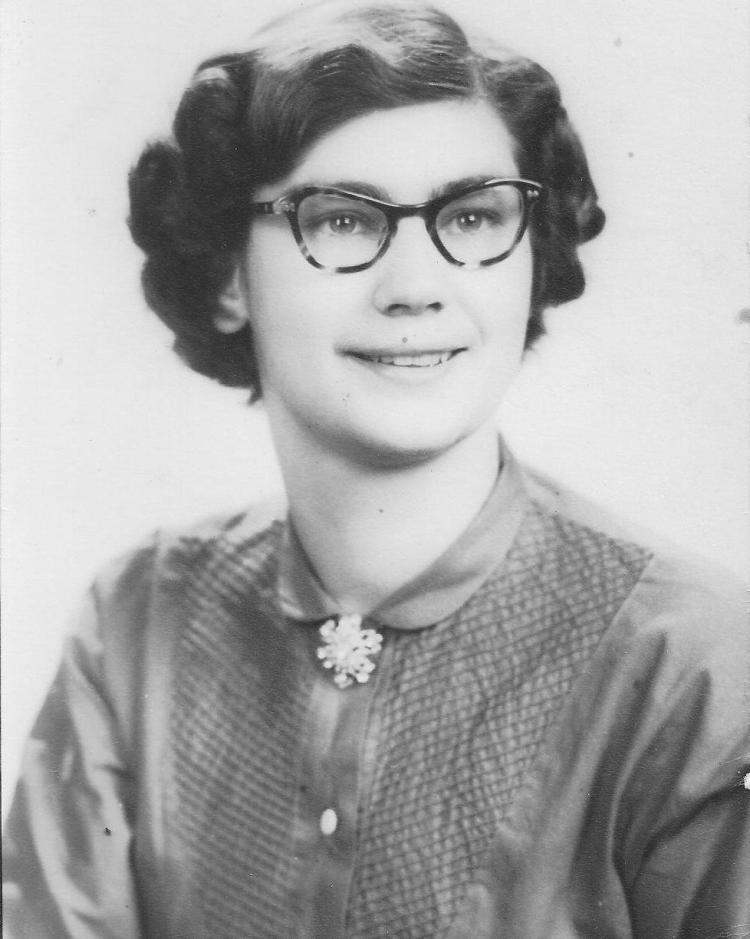
Dolores Louise Schroeder, circa 1949.

Dolores Louise Schroeder, circa 1949.

Dolores was my grandmother.  I was born the day after her 52nd birthday.  We both love daffodils and cooking, although, my love of those things is probably because of how much time I spent with her.  My cousins, siblings, and I spent every spare moment at her house.  At Christmas, I helped her bake Springerles and German Sour Cream Twists.  I still bake those every year.  I’m like her in many ways, but I aspire to be more like her.

Dolores Louise Schroeder was born on March 3, 1931 in Toledo, Ohio to parents George Herman and Louise Marie (Von Allmen) Schroeder.1,5  The Schroeders moved to Indiana when Dolores was about seven.  They lived in Lafayette in Floyd County, Indiana and joined Atkins Chapel United Methodist Church.1

Dolores graduated from Indiana Central College with a bachelor’s degree in education, and she received her master’s degree at Indiana University Southeast.  She taught at S. Ellen Jones school from 1954 to 1955.2  In 1955, she was forced to resign.  She would never tell me what happened.  The account I had from my grandpa, Sanford “Bud” Wiseheart, is as follows:

She was teachin’ over at S. Ellen Jones and Peder Espeseth was the principal over there.2,3  Well, he called her in the office one day and said, ‘Miss Schroeder, I’d like for you to resign.’  And she said, ‘Well, Mr. Espeseth, what in the world about?’  And he said, ‘You didn’t seek my counsel and that’s one of the rules in the school system.  Teachers always have to seek the principal’s counsel.’  She never could figure out what was provoking him and she went to see Willie Wilson, superintendent.  He said, ‘Miss Schroeder, unfortunately, in the school system, if you do not resign and he presses it and they fire you, then you can’t teach anywhere in the state of Indiana.  But if you do resign, you are free to go anywhere else in the state and teach.’  She said it hurt her terribly, but she went ahead and resigned to please Espeseth.  So she went back up to where she’d been goin’ to college and got on up there.

Dolores taught in Indianapolis from 1956 to 1958.4  By the summer of 1958, she had gone on some dates with Bud.  That story is also best told from his point of view:

Dolores and I had took in some things together.  We went to James Whitcomb Riley home and things like that.  Finally it came to July one night, I was goin’ home from her house.  We walked out to the car together and she said that it’s gettin’ to that time of the year when she has to let them know at Indianapolis whether she was goin’ to teach that year or not and she’d have to sign a contract.  And I said, ‘Well, I don’t know what to tell you, but,’ I said, ‘if you want to stay down here,’ I said, ‘I’ll sign a contract with you.’  And she said, ‘It sounds good to me.’  I guess that’s a crazy way of proposin’ to somebody.

Dolores Louise Schroeder and Sanford William Wiseheart were married on August 2, 1958 at Atkins Chapel United Methodist Church in Floyd Knobs, Indiana by Reverend Earl W. Reed.  5,6,7Dolores and Bud had four sons and ten grandchildren.9  She devoted her life to her family, her church, and helping others.

Dolores was the treasurer of Atkins Chapel for twenty years.  She was a Sunday school teacher and she was in charge of Vacation Bible School, a program to provide meals for those in need, and the church’s Harvest Homecoming booth.  She was also involved in the church’s quilting group, which made quilts for Home of the Innocents and St. Elizabeth’s Maternity Center; Helping Hands ministry, which paid rent and utility bills for people who couldn’t afford it; women’s missions; fundraising for charities; and other outreach, such as visiting the sick.  In 2006, Dolores received the Gold Leaf Award from Community Foundation for outstanding volunteer service.8,9

Dolores Louise Wiseheart died of leukemia on Sunday, September 10, 2006 at her home in New Albany, Indiana.9
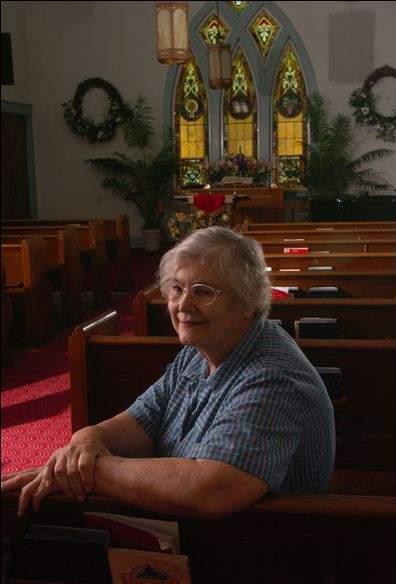
Dolores Louise (Schroeder) Wiseheart, June 2006.  Photo taken by Keith Williams for The Courier-Journal (Louisville, KY).

Dolores Louise (Schroeder) Wiseheart, June 2006 at Atkins Chapel United Methodist Church. Photo taken by Keith Williams for The Courier-Journal (Louisville, KY).

I wonder if she really didn’t know why Mr. Espeseth wanted her to resign, or if she just didn’t want to say.  I never heard her say a bad word about anyone in her entire life.  Just a few weeks ago, I was down at my grandparents’ house with my dad and my uncles.  We were going through paperwork and came across some of her school records.  This prompted my uncle to tell us what he knew about what had happened with Grandma and Mr. Espeseth.  Dolores had been in charge of a school play and had allowed African American children to be in it (this was during integration).  Mr. Espeseth was upset that she hadn’t consulted him about it and asked her to resign.  I’ve always been proud of my grandma, but hearing this story makes me tremendously proud of her for doing the right thing.


Sources

1.  1940 U.S. Federal Census, Lafayette, Floyd County, Indiana, p.1B, FamilySearch

2.  Caron’s New Albany-Jeffersonville (Floyd-Clark Counties, Ind.) City Directory, Vol. 40, 1955, Stuart Barth Wrege Indiana History Room

3.  New Albany Tribune, 9 Oct 1963, p.1, c.6, Stuart Barth Wrege Indiana History Room

4.  Polk’s Indianapolis (Marion County, Ind.) City Directory, Vol. 47, 1957, InternetArchive

5.  Floyd County, Indiana Marriages, Vol. 55, p.244, Floyd County Clerk’s Office

6.  New Albany Tribune, Sun 24 Aug 1958, p.6, c.1, Stuart Barth Wrege Indiana History Room

7.  New Albany Ledger & Tribune, Sun 2 Aug 1998, p.B2, c.3, Stuart Barth Wrege Indiana History Room

8.  The Courier-Journal (Louisville), Sat 24 Jun 2006, p.B3, c.2

9.  New Albany Tribune, Tues 12 Sep 2006, p. A3, c.3
Stories

As I read Amy Johnson Crow’s Are Your Ancestors the Average of 5 Records?, I thought about my own recent discoveries on John Bridges, and a book about Rebecca Gilbert’s family, which is a topic for a future post.  The first time I read the book, I wished I had a book for each of my ancestors, something to give me an idea of who they were and how they lived.  With John Bridges, finding out there was more to the man than the family legend suggested was an eye-opener.  To borrow from David Walton, learning about our ancestors is more than names and dates.  (Ok, so this is a bit of a plug too, since I’m one of the reenactors, but it’s relevant nonetheless).

My grandpa loved to tell stories and he had a million of them.  I wish, now, that I had recorded or written down more of them.  As we were going through some of the things in his bedroom, my uncle found a few stories that my grandpa had written down.  I never knew that he had and it was a treasure to see them.  I’m a journaler by nature.  I keep a journal of everyday events.  I may write every day for a week and then I may not write again for a month.  It doesn’t really matter how often it’s done, just that it is done.  While my journal might not mean anything to anyone now, one hundred years from now, it may be a treasure to a descendant.  It may provide clues to family relationships that couldn’t have been found otherwise.  Part of the reason I started this blog was to put family history in a place where it can be easily accessed and not lost.  I encourage the patrons, where I work, to write down their stories too and I encourage anyone reading this to do the same.

Stories are important.  They give our ancestors character, a voice.  They make them relatable and significant.  They make them real to us in a way that just the dry facts cannot do.  I’ve made it one of my goals to research and write a story for each of my direct line ancestors (at least).  It will only be a snapshot of their lives, but it will be more than I had before and it will give me a sense of who they were.  If finding out who our ancestors were as people isn’t one of the primary goals of every genealogist, it should be.