An Example of Best Practice Genealogy from My Great Great Grandfather

Some time around one hundred years ago, Daniel Wiseheart asked his father, William Henry (my great great grandfather), if he could borrow the family Bible.  William lent it to him.  A letter from Daniel states that the family Bible was destroyed in the 1917 tornado (or cyclone) that struck New Albany, Indiana.  As I read this letter, I was dismayed.  Until that point, I held out hope that one of Uncle Dan’s descendants might still have the Bible.

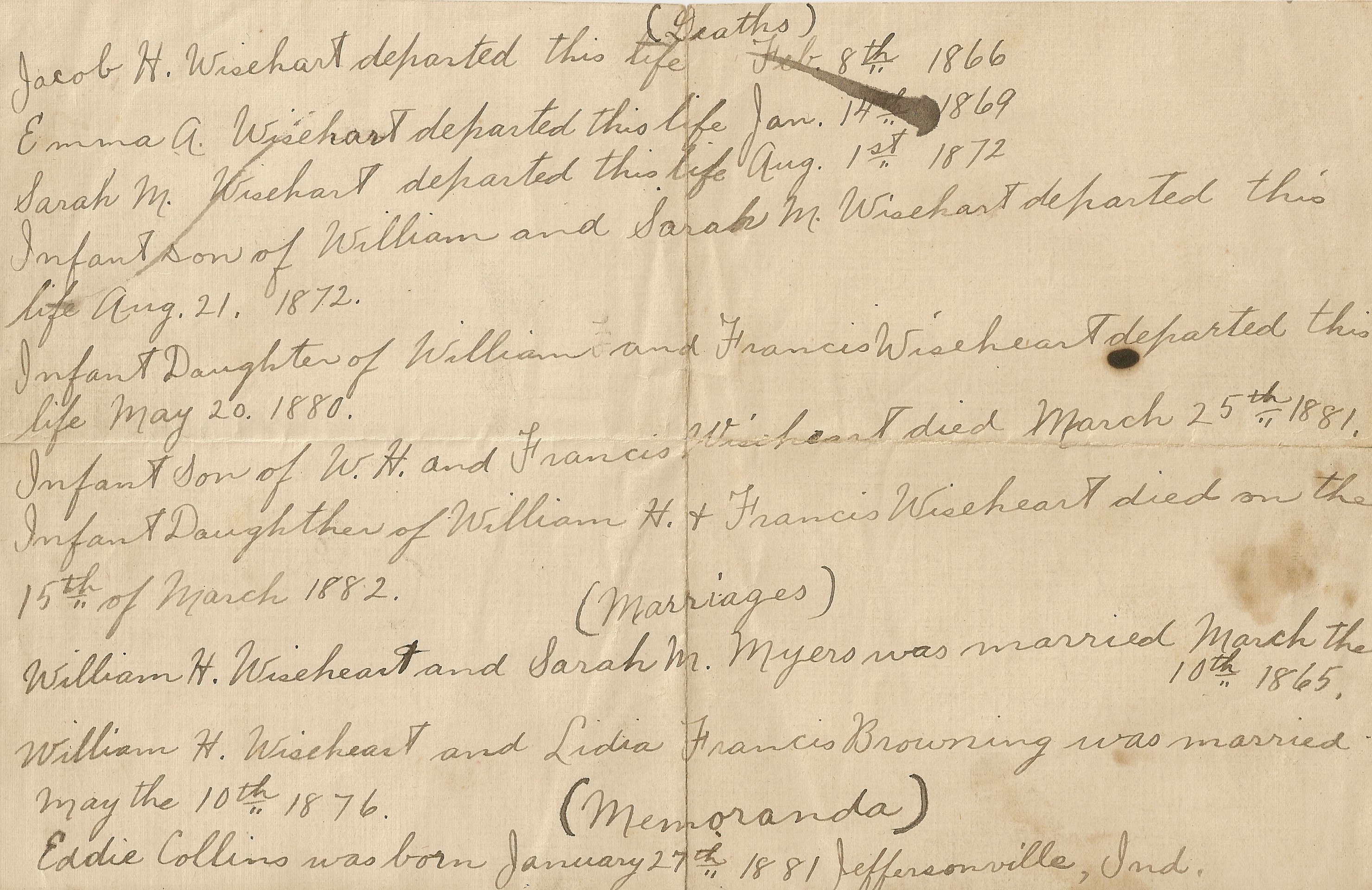
A couple of days ago, as my uncle and I went through the Rakestraw trunk looking for letters relating to Frank Springer, we found that William H. Wiseheart had copied down all of the information from the family Bible onto a piece of paper.  Words cannot express the joy I felt with that discovery!

I’m also grateful that my great great grandpa had the foresight to copy the information.  I can take a lesson from him.  Make sure to copy everything before you loan it, or make copies for the person who wants to do the borrowing.

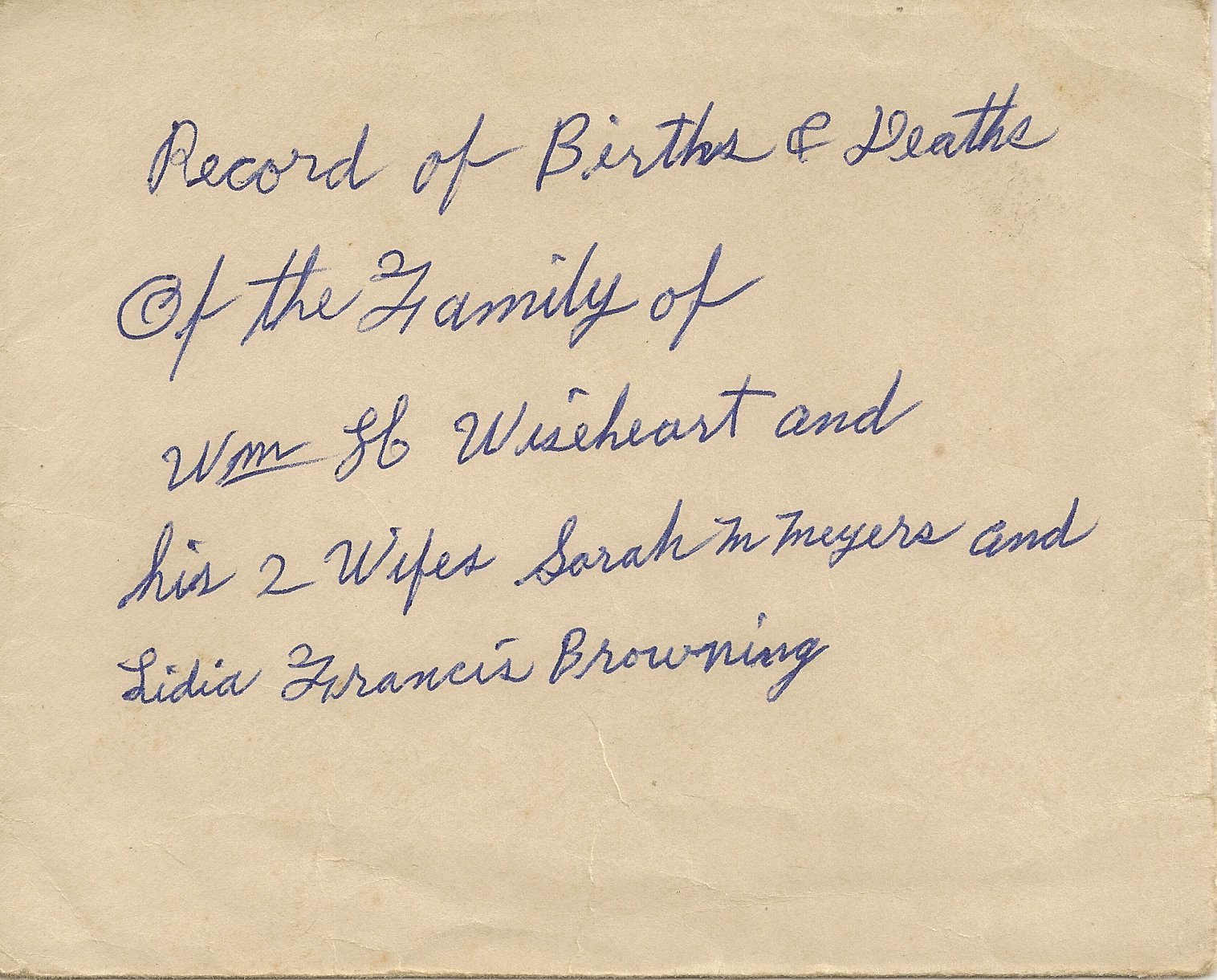
The following images are the envelope the paper was in, and the front and back of the page.  I don’t know whose writing is the blue ink, but the information is accurate based on my research thus far.

Envelope containing transcription of William H. Wiseheart Family Bible.

Envelope containing transcription of William H. Wiseheart Family Bible.

Transcription of the William H. Wiseheart Family Bible by William H. Wiseheart.  Births.

Transcription of the William H. Wiseheart Family Bible by William H. Wiseheart. Births.

Transcription of the William H. Wiseheart Family Bible by William H. Wiseheart.  Deaths, Marriages, and Memoranda.

Transcription of the William H. Wiseheart Family Bible by William H. Wiseheart. Deaths, Marriages, and Memoranda.

More Clues for Frank Springer

As my uncle was going through things at the house yesterday, he came across a ledger belonging to Mildred Springer.  It mostly contains dates and amounts received.  I’m not sure what they are exactly, but I think they could be child support payments from her father, Frank Springer.

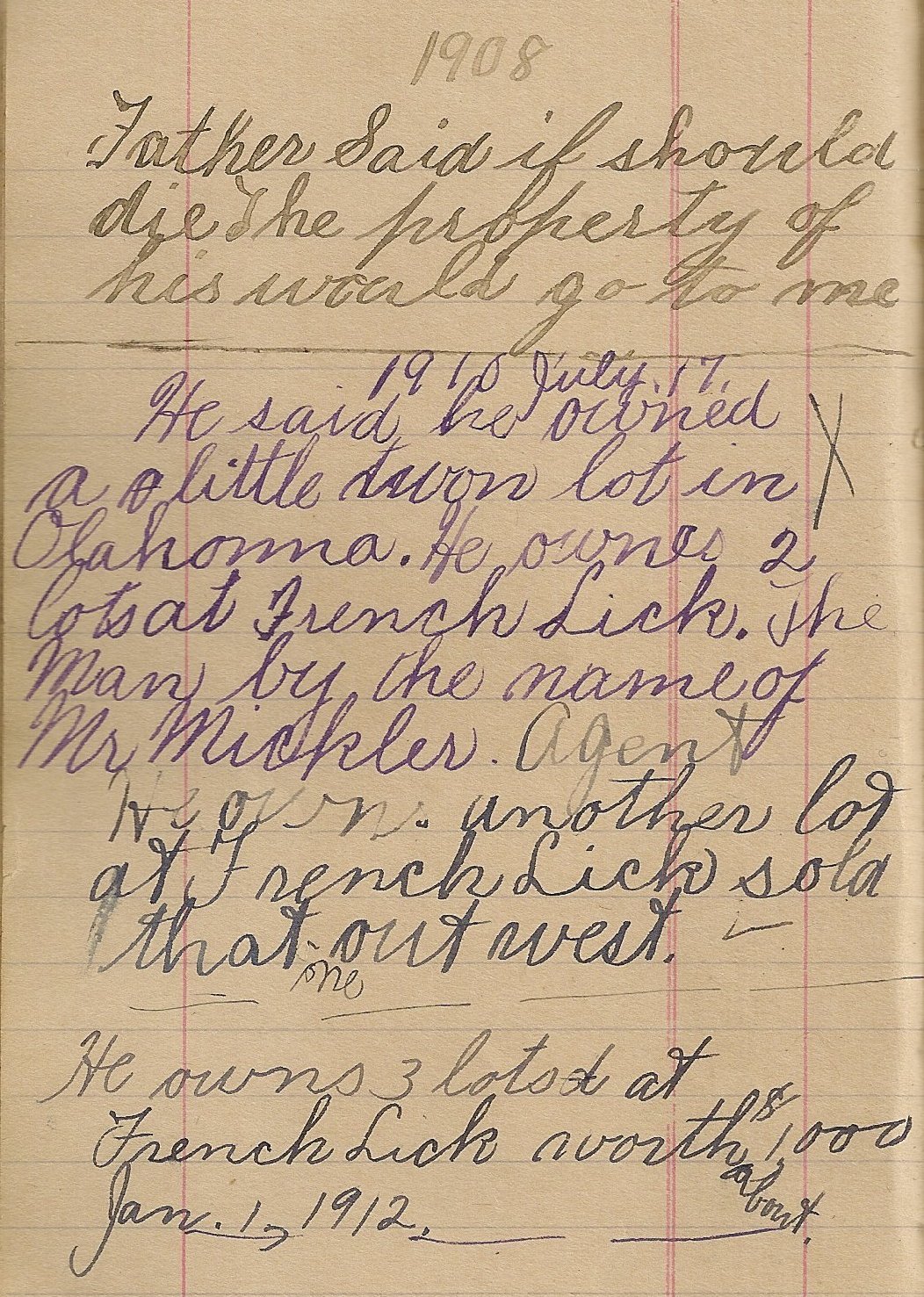
Frank left his home in Paoli, Indiana in 1893 for the World’s Fair in Chicago and I have lost track of him from then until 1920 when he appears in Paoli again.  On one page of this ledger, Mildred wrote about her father’s land holdings.

A page from Mildred Springer's ledger, 1908-1917.

A page from Mildred Springer’s ledger, 1908-1917.

In 1910, Mildred writes that Frank has a lot in Oklahoma and two lots in French Lick.  A newspaper article regarding land in Oklahoma was tucked between this page and the next.

Newspaper article from Mildred Springer's ledger, 1908-1917.

Newspaper article from Mildred Springer’s ledger, 1908-1917.

On the ledger page from the previous image, Mildred also writes that by 1912, Frank had sold his lot out west and purchased a third lot in French Lick.  There is also one page of the ledger that lists two payments coming from Madison, Illinois in 1913.

My theory is that he left Chicago after the World’s Fair and travelled West.  He settled in Oklahoma circa 1904 for a time, but was on the move again before the 1910 Census. I’ve searched for Frank Springer in the 1900 and 1910 Census for Indiana, Kentucky, Tennessee, Illinois, Iowa, Missouri, Kansas, Oklahoma, and Arkansas with no luck.  With some fairly strong evidence to suggest he was in at least two of those states, a transient lifestyle seems a logical explanation as to why I can’t find him.

Here’s my theory with a visual…

Frank Springer's journey

1.  Living in Paoli, Indiana (1892).

2.  Goes to World’s Fair, Chicago, Illinois (1893).

3.  Possible trip to Iowa.  (Part of family legend is that he spent some time in Iowa).

4.  Back to Paoli to check in with family.

5.  Purchases land in French Lick, Indiana (circa 1900).

6.  Claims land near Woodward, Oklahoma (1904).

7.  Possible trip to California.  (Part of family legend is that he spent some time in California).

8.  Sells land in Oklahoma (circa 1912).

9.  Buys another lot in French Lick (circa 1912).

10.  Goes to Madison, Illinois (1913).

11.  It is possible that the California trip fit in here instead of after Oklahoma.

12.  Back in Paoli (1920).

This is the guide I’ll be working with to try to locate Deed and City Directory records for Frank.  It’s confusing, and kind of a long shot, but it’s definitely more than what I had to go on before.  As my co-worker said just a few days ago, most genealogists don’t do it because it’s easy, they do it for the thrill of following the clues and solving the mystery.

John Bridges: Maniacal, Mischievous, or Misunderstood?

On a rare few occasions, my grandpa told me about John Bridges, my fourth great grandmother’s second husband.  He never spoke in specifics.  He said that his great grandmother, John’s step-daughter, did not like him.  According to family legend, John was a drunk and a layabout who never worked.  He went to prison and was eventually put in the asylum because he was insane.  I never cared to look into it until I happened upon his two marriages to Serilda Gilliland.

I know nothing of John’s life before he married Serilda.  John Bridges is a fairly common name.  In fact, there was another John Bridges living in the same town at the same time.  In addition, multiple birth places are given for him and I have next to no information about his parents.

In previous posts, I revealed that John Bridges married Serilda Gilliland in 1857, and then again in 1871 because the first marriage wasn’t valid.  I also posted at length about the trial for the murder of Charles Baker and the subsequent sentence of life in the state prison in Jeffersonville.  I still had no answers as to how John could go to prison, in Clark County, for life in 1859 and then somehow be in Floyd County in 1871 to marry Serilda again.  So I kept looking.

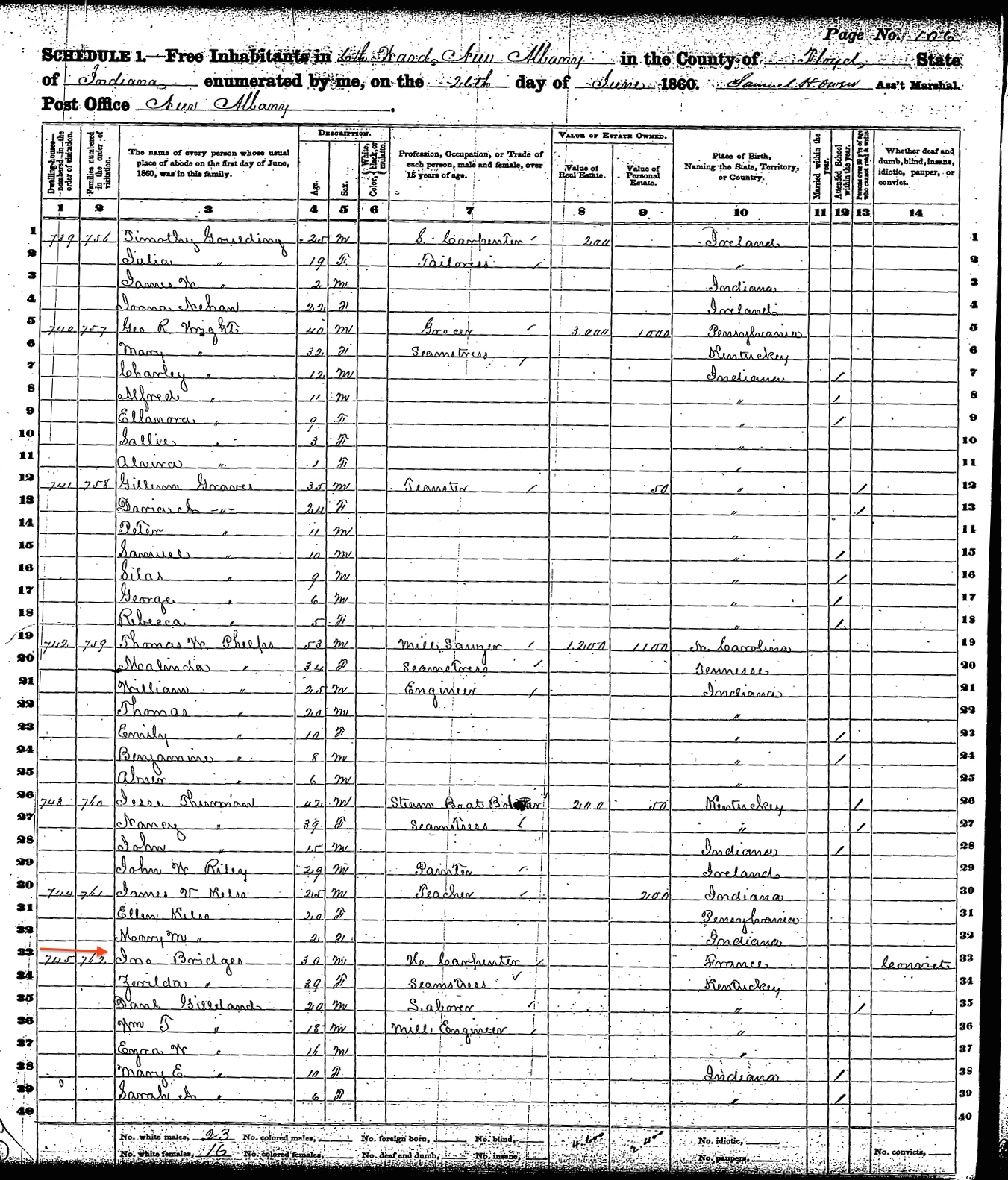
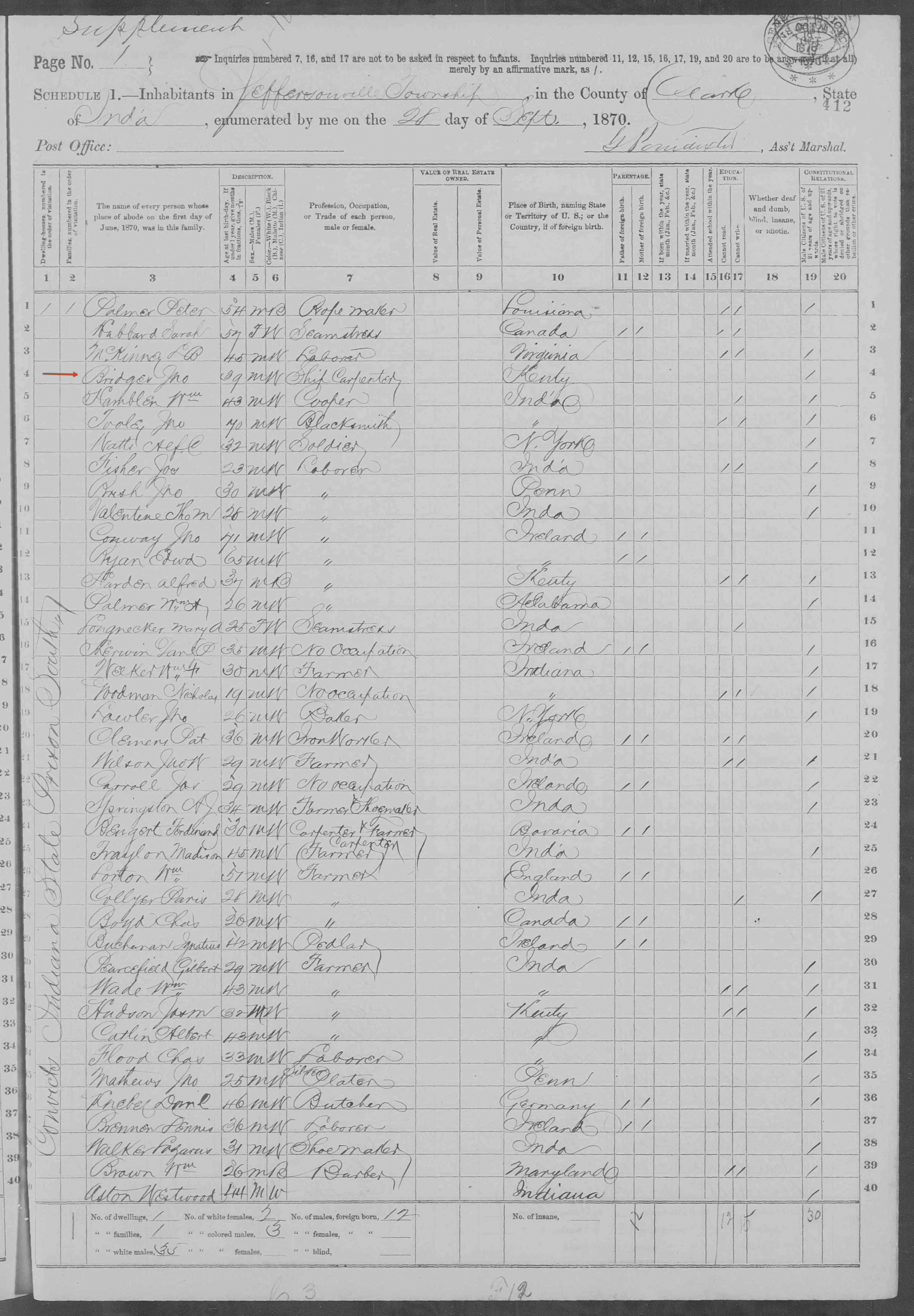
I found him on the 1860 Census listed with the family, but in the 14th column, he is marked “convict.”  It also gives his birthplace as France.  It is important to note that he is listed as a ship carpenter, which means he did, at one point at least, have a job.  In the 1870 Census, John is listed among other convicts in the Indiana State Prison South supplement.  Here, his birthplace is Kentucky and he is still listed as a ship’s carpenter.  Then, in 1871, John is released from prison.

New Albany Daily Ledger, Friday, 3 February 1871, p.2, column 1, Stuart Barth Wrege Indiana History Room

New Albany Daily Ledger, Friday, 3 February 1871, p.2, column 1, Stuart Barth Wrege Indiana History Room

The case of the prosecution seemed shaky.  It relied heavily on the testimonies of people who were known to lie and people who simply overheard something, what is known in court as “hearsay.”  The paper had stated that there would be a move for a new trial.  I suppose that a pardon isn’t hard to believe.  This explains how John was able to get married in Floyd County on the very day that this article was published.  The fact that John was pardoned made me wonder what else in the family legend may have been skewed.  And the search continued.

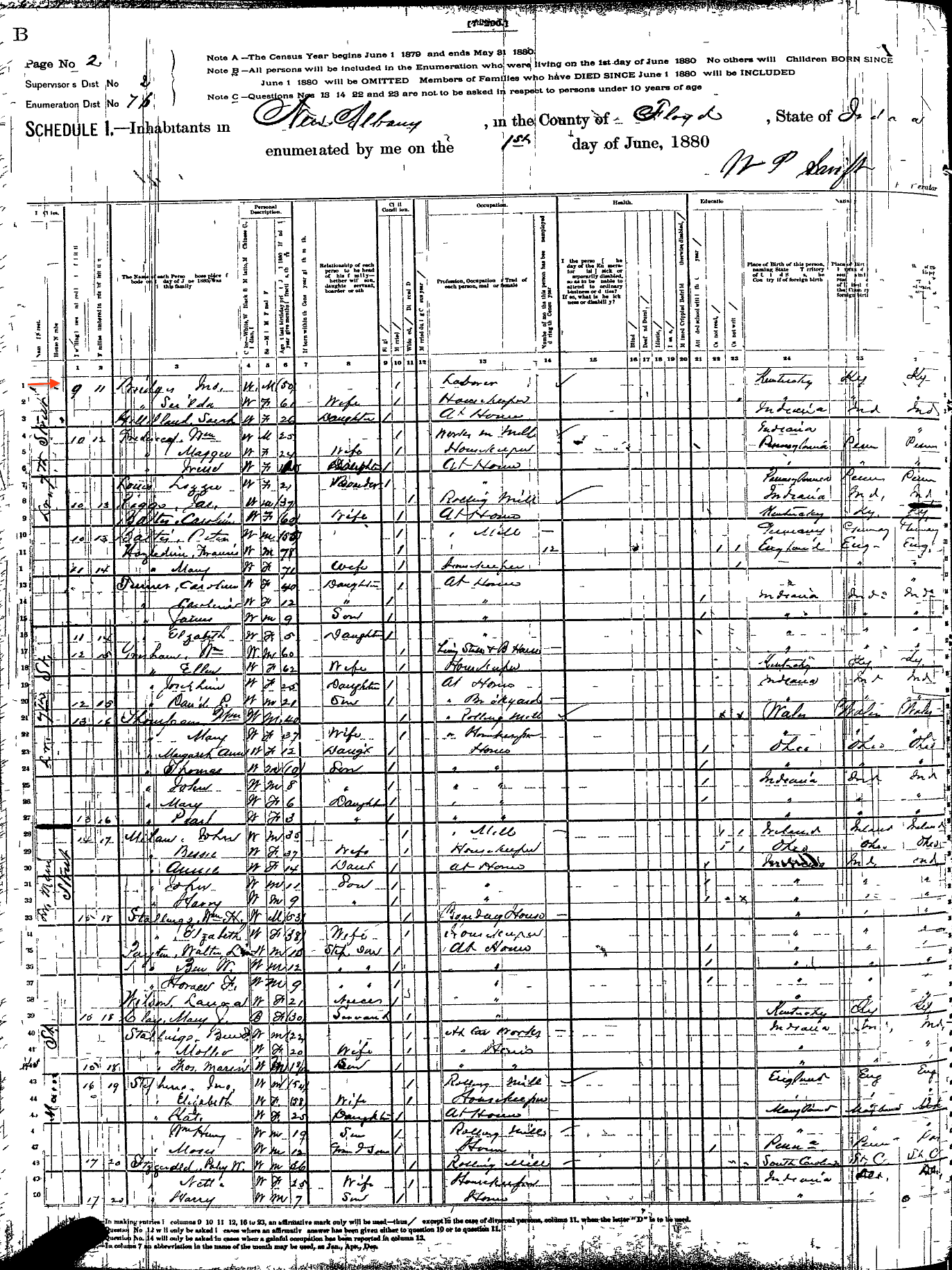
In the 1880 Census, he was living with his wife and youngest step-daughter.  He is a laborer.  His birthplace is Kentucky, as is the birthplace of both his parents.  He managed to stay out of trouble for about ten years after his release, or at least anything that the newspaper would have found out about.  Until…

New Albany Ledger, Thursday, 20 July 1882, p.4, column 2, Stuart Barth Wrege Indiana History Room

New Albany Ledger, Thursday, 20 July 1882, p.4, column 2, Stuart Barth Wrege Indiana History Room

Somehow, he got out of it with only a fine.  The next item in the timeline for John Bridges is his entry into the Floyd County Asylum (aka. Floyd County Poor Farm) and subsequent death.  He entered the asylum on March 13, 1899 and his condition was “sickly,” not insane or feeble-minded.  He died on May 2, 1899.  His obituary confirms his condition.

New Albany Daily Ledger,  2 May 1899, p.4, column 2, Stuart Barth Wrege Indiana History Room

New Albany Daily Ledger, 2 May 1899, p.4, column 2, Stuart Barth Wrege Indiana History Room

I always have to take newspaper articles with a grain of salt.  In fact, never believe what you read in the paper unless you have another document to confirm it.  This one says that John was in the asylum for two years, when asylum records state it was two months.  It does confirm that he was in poor health.  It also suggests that he was able to work until recently.  His death record provides no new information, other than another possible birthplace.

Floyd County, Indiana Deaths, CH-18, p. 7 (transcription)

Floyd County, Indiana Deaths, CH-18, p. 7 (transcription)

Addressing the issues…

Was John Bridges a drunk?  It’s hard to say.  The only mention of alcohol was in the murder trial.  He was at a bar at about four o’clock in the afternoon and “seemed to be in liquor.”  Was this a regular occurrence or was it to do with the upcoming confrontation with Baker?  We’ll probably never know.

Was he a layabout who never worked?  Not from what I can tell.  He is listed on two census as a ship’s carpenter and as a laborer on a third.  His step-son said that he was a watchman on the river.  His obituary said that he had been “unable to work in recent years.”

Did he go to prison?  Yes.  He was sentenced to life in prison for the murder of Charles Baker.  He was pardoned after he had served twelve years.

Was he sent to the asylum for insanity?  No.  The asylum records indicate that he was “sickly.”  His obituary confirms that he had come out of prison in “broken health.”  There is no indication that he was insane.  That’s not to say he wasn’t, but there are no official records indicating insanity and that is not the reason he ended up in the asylum.  It is strange that he has three different birthplaces.  This could indicate insanity, or maybe he enjoyed tall tales.

I still have very few hard facts about John Bridges, but I feel as though I have a fairly complete story for him (minus his early life).  I also find that I don’t dislike him as much as I did before.  When I stop to think about it, it’s amazing the strong feelings I have for and about people I’ve never met simply because I am related to them.  I know it has to be the same for others, to some degree.  I see it when people talk about how proud they are of their Revolutionary War or Civil War ancestors, or how scared they are that they might find skeletons in the family closet.  To the latter, I say, keep researching, because what you think you know may not be what really happened.  John Bridges is a case in point.
The State of Indiana v. John Bridges: The Verdict

The first article is about the instructions to the jury, and then we finally have a verdict.

New Albany Daily Tribune, Monday, 7 November 1859, p.3, column 1, Stuart Barth Wrege Indiana History Room

New Albany Daily Tribune, Monday, 7 November 1859, p.3, column 1, Stuart Barth Wrege Indiana History Room

New Albany Daily Tribune, Tuesday, 8 November 1859, p.3, column 1, Stuart Barth Wrege Indiana History Room

New Albany Daily Tribune, Tuesday, 8 November 1859, p.3, column 1, Stuart Barth Wrege Indiana History Room

I checked the paper for the next few days and never saw anything about a new trial. From that, I’m guessing that a new trial wasn’t granted.

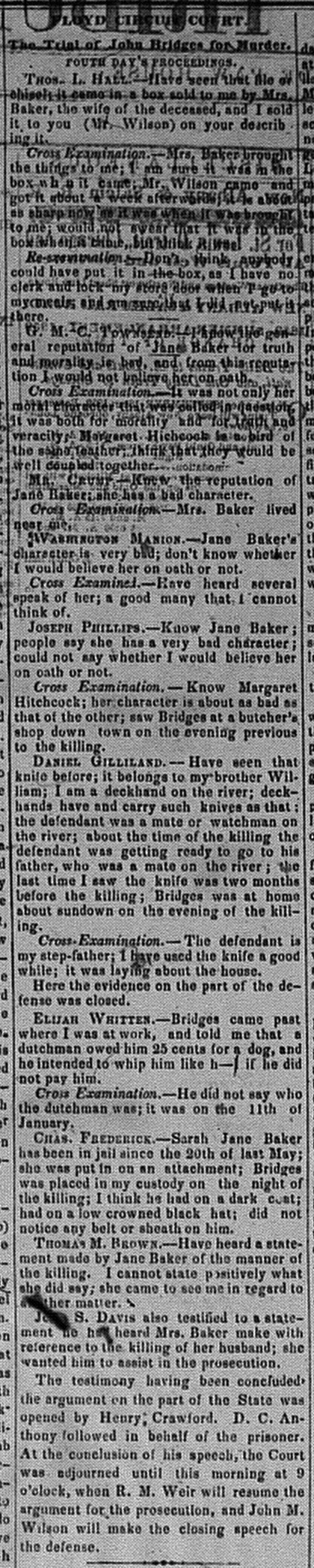
The State of Indiana v. John Bridges: Trial, Day 4

Today, we read the testimonies of Thomas L. Hall, G. M. C. Townsend, Mr. Crump, Washington Manion, Joseph Phillips, Daniel Gilliland (step-son of John Bridges), Elijah Whitten, Charles Frederick, Thomas M. Brown, and John S. Davis.

New Albany Daily Tribune, Saturday, 5 November 1859, p.2, column 2, Stuart Barth Wrege Indiana History Room

New Albany Daily Tribune, Saturday, 5 November 1859, p.2, column 2, Stuart Barth Wrege Indiana History Room

To be continued…